How Will Russia’s Intervention Affect the Middle East?
March 16, 2022
US – Bangladesh Partnership Dialogue: New Realities and Expectations
March 29, 2022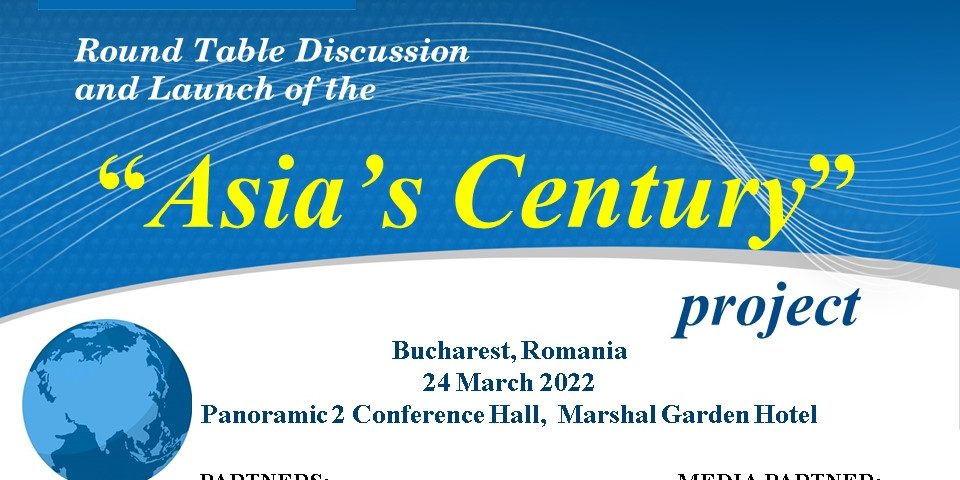
If the 20th century was considered mainly America’s century, there are more and more arguments for profiling the 21st century as Asia’s century. “The West has been at the forefront of the world history for almost 200 years. Now it has to learn to share, even abandon, that position and adapt to a world it can no longer dominate.” (see Kishore MAHBUBANI)
“The superiority complex is hard to cure. Nobody in Europe is longing for a return to empire (well, nobody in continental Europe at least). Most Americans still pretend they never even had an empire. But Europeans and Americans that we are entitled to dominate international politics and that it is perfectly natural that the EU and the US are the wealthiest places on Earth. Deep down, we feel that we have merited this through our hard work – the implication being that if other people are less well off, they have merited that also. The reality is, of course, that we created the international order to our economic benefit.” (Sven BISCOP, Egmont Foundation)
Under the current circumstances of increasing global interdependences, there is a need for the EU to overcome its “superiority complex” (see Egmont Foundation) and to work towards an in-depth understanding of Asia. At the same time, Asia needs to develop a better understanding of the EU and its complexity, the diversity of the Member States, and the potential of cooperation.
“Neither Europe nor Asia has any alternative. The difference is that Europe well knows there is no alternative – and therefore is multilateral. Asia thinks it has an alternative – and therefore is strikingly bilateral, while stubbornly residing enveloped in economic egoisms. No wonder that Europe is/will be able to manage its decline, while Asia is (still) unable to capitalize its successes”. (Anis BAJREKTAREVIC, IFIMES)
Project objectives
This project aims to contribute to reducing tensions among various EU countries and countries from Asia and to facilitate communication and cooperation among them. It is also aimed at overcoming barriers generated by the current pandemic and the Russia-Ukraine crisis, as well as to contribute to resuming direct interinstitutional and human contacts.
Agenda
Moderator: Dr. Liviu MUREȘAN, President, EuroDefense Romania
11:00 – 11:10 Opening Remarks: Flavius CABA – MARIA, President, MEPEI Romania
11:10 – 12:15 Keynote Speeches
Guest Speaker: Prof. Anis BAJREKTAREVIC, Department Head for Strategic Studies on Asia, International Institute for the Middle East and Balkan Studies (IFIMES), IFIMES Permanent Representation to Austria and Vienna-based IOs
Dr. Werner FASSLABEND, President, the Austrian Institute for European and Security Policy (AIES), President EuroDefense Austria, and former Minister of Defense of Austria (1990-2000), Austria – On-line intervention
Prof. Teodor MELEȘCANU, Former Minister of Foreign Affairs
Prof. Adrian SEVERIN, Former Minister of Foreign Affairs
Amb. Viorel ISTICIOAIA-BUDURA, career diplomat, former Ambassador of Romania to People’s Republic of China, Mongolia, Republic of Korea. As an European official was Head of the Asia-Pacific Department with European External Action Service and Ambassador of the EU to Japan – On-line intervention
Dr. Alexandru GEORGESCU, Strategic Analyst, EuroDefense Romania
12:15 – 12:50 Q&A Session
12:50 – 13:00 Closing Remarks
Media partners and supporting organizations
Organizers:
MEPEI – Middle East Political and Economic Institute
EuroDefense Romania
Partners:
IFIMES – International Institute for the Middle East and Balkan Studies
ICI – National Institute for Research & Development in Informatics
AIES – Austrian Institute for European and Security Policy
Media Partner:
Financial Intelligence
Venue
Marshal Garden Hotel, Panoramic 2 Conference Hall