Epic Fury-2
October 29, 2026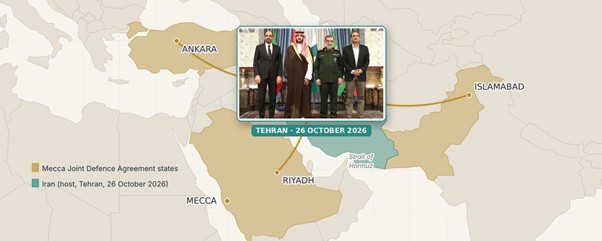
The last week of October has been a significant one for Middle Eastern diplomacy. On October 26, a quadrilateral meeting between Türkiye, Saudi Arabia, Pakistan and Iran took place in Tehran, with President Masoud Pezeshkian and Foreign Minister Abbas Araghchi attending. The agenda included regional security, Israel’s activities in the region and developments in Palestine and Lebanon.[i] One day later, the Emir of Qatar met Pezeshkian in Moscow. At the same time, Washington is signalling that the war against Iran could resume after the US midterms. Taken together, these moves point to a regional realignment that goes beyond crisis management.
Three questions arise:
- Is the Tehran meeting the beginning of a new regional security complex, or a last attempt at de-escalation before the war resumes?
- What does a Saudi-Iranian channel mean for the narrative of competing Sunni and Shia axes?
- Who can mediate and guarantee what comes next?
Historical context and the Cold War
The rivalry between Saudi Arabia and Iran dates back to 1979, when the Islamic Revolution brought to power a leadership that wanted to establish Iran as a regional power through Shia Islam, directly challenging Saudi Arabia’s view of itself as the leader of the Muslim world and guardian of Islam’s holiest sites, Mecca and Medina. The competition became a cold war of its own, partly descending from the global one, with Western support for Riyadh and Russian support for Tehran, albeit both conditioned by their own interests. It also became a sort of Berlin Wall between Islamic denominations, with Sunni and Shia camps competing over regional supremacy, as an Iran under sanctions and without Saudi-level oil revenues started to rely on proxies and sympathetic governments.[ii] However, beneath the religious framings, the rivalry has always had motivations related not only to survival, but also to gaining influence.
2023 showed that the rivalry can be managed, or at least contended, when, following a few years of talks hosted by Iraq and Oman, and through Chinese involvement, the two announced an agreement in Beijing, reopening diplomatic engagements. The main drivers were, for Saudi Arabia, stability to support its economic and military sectors, and for Iran the perception of a stronger and more autonomous Riyadh, which it wants to condition to non-interference in its own domestic affairs[iii], but the mediation and dialogue support provided by all the states involved contributed to laying the bases for a framework for interactions.
The quad meeting: when, where
The meeting took place in Tehran, which is not a neutral space such as Doha, muscat or Baghdad, making it a form of recognition that Iran, as an actor, has to be part of any regional arrangement. Hosted by Mohsen Rezaei, secretary of Iran’s Supreme National Security Council, the meeting brought together Saudi Defence Minister Khalid bin Salman, Pakistan’s army chief Asim Munir and Turkish intelligence chief Ibrahim Kalın, which means that the Mecca Alliance sent its military and intelligence representatives, not its diplomats. It was reported that the talks focused on building a regional nonaggression network and covered the US – Iran negotiations, the Houthi attacks on Saudi Arabia, the Strait of Hormuz and the US blockade of Iranian ports, while Rezaei spoke of a “new and positive atmosphere” in the region. It was also the first high-level contact between Iran and the three alliance members since the Houthis escalated their attacks on Saudi Arabia[iv], so Riyadh and Tehran having a dialogue while the Yemeni front is still open represents a signal in itself. Both the participants and the agenda point toward an attempt to lay the foundations of a new security complex in the region, although no participant has officially disclosed details of the talks or provided an official declaration yet.
Moreover, the meeting came right before the Israeli elections, as Washington and Tel Aviv were reported to be considering an operation against Iran, with more than ten military US transport aircraft landing at Israeli bases in a single week, together with other military cargo flights arriving in the Middle East, including in Jordan, Kuwait and Saudi Arabia. The electoral dimension was present on both sides, as Iran reportedly sought to interfere in the Israeli vote and to disrupt the US midterms, while the Shin Bet was asked to examine suspected foreign interference.[v] The diplomatic and military communications suggest that the US and Israel are preparing a new round of heavy combat operations, aimed at degrading Tehran’s position and pushing it into accepting their negotiation terms.[vi] In this context, the meeting in Tehran can also be seen as a deterrent. The presence of the defence and intelligence chiefs of three of Washington’s partners, one of them a NATO member and another a nuclear power, means that a strike would not only hit Iran, but also the other actors involved in the diplomatic process. At the same time, it reflects a hope in diplomacy, and an effort to address tensions before they escalate further.
Sunni axis, Shia axis
The religious dimension cannot be ignored, starting with the name of the alliance itself, which places Mecca at the centre of the new defence framework. After the US and Israel attacked what they call the “axis of evil” and what Tehran calls the “axis of resistance”, Israeli decision-makers started warning of a new Sunni axis led by Türkiye, filling the vacuum left by the weakened Shia one.[vii] The Tehran meeting adds another layer to this narrative, as the states described as the core of the Sunni axis sat at the same table with the leadership of the Shia one and agreed to continue the dialogue. This new dynamic raises a question that is yet to be answered: what would it mean for the region if Saudi Arabia and Iran, together with Türkiye and Pakistan, manage to find common ground in favour of energy, commercial corridors and security? For Israel, an Iran integrated into a regional framework instead of isolated would weaken past moves and alignments, such as the UAE’s integration into the Abraham Accords, and would suggest the need for a recalculation in regards to joining regional dialogue, relying less on outside support from the US to strengthen its security.
The mediators
The mediation landscape has also changed since 2023. Qatar remains a central channel, with its prime minister discussing during summer, in Tehran, a temporary shipping corridor through Hormuz and a possible joint project to clear the strait of mines, in a period of intense diplomacy that also involved Oman’s foreign minister and Pakistani officials, but it all rests on conditions that Iran wants to impose the US.[viii] Doha finds itself in a delicate position, since Qatar has been struck by Iran during the war, yet in pushes for diplomacy and pledges with Iran to stop threatening Gulf states.[ix] Iran’s seven-day plan was also communicated to the US through Qatar: Washington would end the aggression, lift the naval blockade, ease restrictions on oil exports and release frozen assets, and Iran would reopen the strait on the sixth day, with talks resuming on the seventh. The proposal seems to be aimed at trust-building measures, but it does ask for more concessions on the American side. Meanwhile, US officials told several countries in the region to be prepared for strikes after the midterms.[x] Türkiye, Pakistan, and China (as it is credited with part of the Saudi-Iran partial reconciliation) are asked, indirectly, to assume the role of guarantors of the new security architecture.
China, Russia and the United States
At the Gas Exporting Countries Forum summit, whose members include Iran, Qatar and the UAE, the Moscow Declaration expressed concern over the impact of Middle Eastern developments on gas supply security and objected to unilateral coercive measures not authorized by the United Nations[xi], a formula close to Tehran’s position on sanctions. Putin had already said in early October that Russia was prepared to take part in mediation, while Iran’s conditions remain strong, and Washington insists on a reduction of nuclear enrichment.[xii] China benefits from a framework that includes Iran, but it maintains a distance and avoids direct involvement. There is also another aspect to be taken into consideration, respectively the limits of middle powers themselves: Gulf states have diversified their relationships and are slowly ending the default reaction to gravitate towards the US, but Washington continues to maintain the security architecture of the region.[xiii]
Conclusions
For Saudi Arabia, keeping an open channel with Tehran is a form of insurance, which could limit the Houthi front and reduce the risk of becoming a target again. For Türkiye and Pakistan, it is a test of their credibility as both Saudi allies and Iran interlocutors. For Iran, it brings regional legitimacy, but its conditions for negotiating with Washington limit what it can deliver. For the United States, regional mediation can serve either as an exit or as a cover for escalation. For Israel, it challenges the status-quo of its security approach, as it risks to be excluded from current calculations. The Saudi-Iran rivalry has not ended, and a joint statement does not automatically translate to a stable security architecture. It all depends on whether the discussions in Tehran become the foundation of a regional security order, or the last conversation before the next round of strikes. Only one thing is certain: the stakes are high. A great number of belligerents and mediators continue to be involved, thus unpredictability remains the defining characteristic of the war.
[i] https://www.aa.com.tr/en/politics/turkiye-saudi-arabia-pakistan-iran-hold-quadrilateral-meeting-in-tehran/4101395
[ii] https://www.aljazeera.com/features/2020/6/4/analysis-how-saudi-arabia-and-iran-became-rivals
[iii] https://www.tandfonline.com/doi/full/10.1080/03068374.2024.2329615
[iv] https://www.aljazeera.com/news/2026/10/26/officials-from-mecca-pact-states-to-hold-talks-in-iran-amid-regional-tensions
[v] https://www.timesofisrael.com/top-us-commander-briefs-trump-on-iran-military-options-as-regional-buildup-grows/
[vi] https://www.wsj.com/world/middle-east/u-s-warns-gulf-of-possible-short-intense-renewal-of-iran-war-after-midterms-cd1a55e1
[vii] https://www.ynetnews.com/opinions-analysis/article/s1zt5sppgg
[viii] https://www.aljazeera.com/news/2026/8/27/iran-qatar-hold-hormuz-talks-amid-intl-hopes-dialogue-with-us-will-resume
[ix] https://www.aljazeera.com/news/2026/10/27/qatars-emir-meets-irans-pezeshkian-in-moscow
[x] https://www.chinadaily.com.cn/a/202610/30/WS6ae3facfe4b06d4aa0566085.html
[xi] https://www.gecf.org/Events-Conferences/Events-HH/ArticleID/1790/Moscow-Declaration-8th-GECF-Summit
[xii] https://www.timesofisrael.com/qatar-iran-discuss-war-and-hormuz-in-moscow-meeting-as-another-ship-struck-in-strait/
[xiii] https://www.rusi.org/explore-our-research/publications/commentary/middle-powers-and-illusion-post-america-middle-east-0

Larisa-Nicoleta PĂTRAȘCU
Junior Researcher at the Middle East Political and Economic Institute (MEPEI). Her research and professional interests center on peacebuilding, diplomacy and conflict resolution, international cooperation, and MENA geopolitics.