
The 2025 U.S. National Security Strategy: An Economic Analysis of the End of Globalization and the Rise of a New World Order
December 7, 2025
Tracing King Salman Energy Park: Saudi Arabia’s Drive for Localisation of Energy Supply Chain
December 14, 2025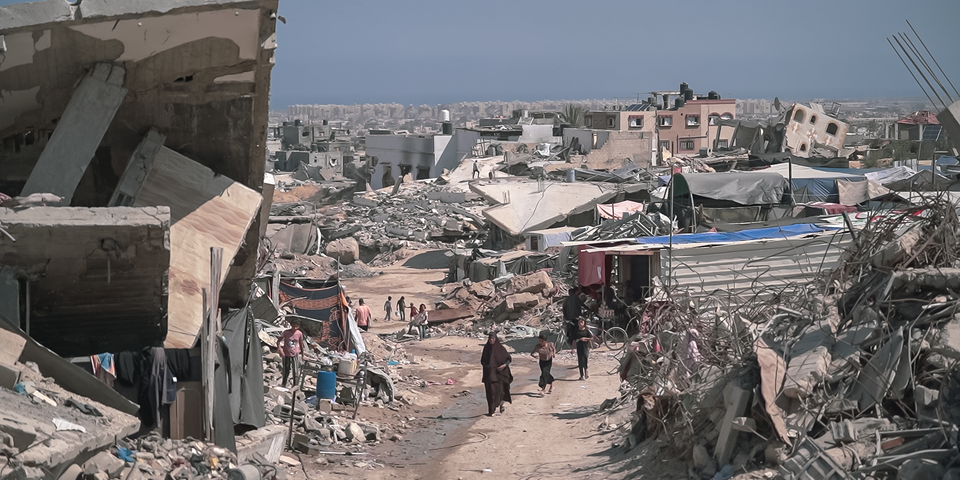
The ongoing sufferings of the Gazans are not ending due to Israel’s aggressive designs against innocent, unarmed Palestinians and its regional agenda.
The continuity of Israeli forces’ killing of Palestinians alarms about the failure of President Donald Trump’s efforts to end the two-year devastating asymmetrical warfare between Israel and Hamas in Gaza. Besides, Netanyahu’s sustained militaristic approach towards the neighbours exposes the limits of President Trump’s initiative to usher in a new era of peace in the Middle East. Though he backed and assisted Israel’s successful operations against Hamas, Hezbollah, the Houthis Iran, he seems unsuccessful in promulgating a stable ceasefire in the region. Are the dynamics of deepening instability, not peace, unleashing a second phase of genocide of the Palestinians?
Since the beginning, the fragile ceasefire has been repeatedly violated. Israel has continued bombardment, mass starvation blocked humanitarian aid across Gaza. On December 06, 2025, Qatar’s Prime Minister Sheikh Mohammed bin Abdulrahman al-Thani warned that negotiations to reach the US-backed truce in Gaza were at a “critical moment.” He opined that “We cannot consider it yet a ceasefire. A ceasefire cannot be completed unless there is a full withdrawal of the Israeli forces – (until) there is stability back in Gaza, people can go in and out – which is not the case today.” He correctly concluded that there is a pause rather than a ceasefire.
The United Nations Security Council (UNSC) approval of Trump’s peace and development plan on November 17, 2025, was an optimistic development, provided the plan is implemented in letter and spirit without further delays. The resolution stated, “conditions may finally be in place for a credible pathway to Palestinian self-determination and statehood.” The challenging questions—who will govern Gaza, whether and how Hamas will be disarmed and involved in politics thereafter what to do about Israel’s ongoing occupation—have remained unanswered. Hamas rejected the resolution because of the establishment of an international force whose mission includes disarmament.
Notably, even after the announcement of the ceasefire, Hamas enjoys the majority of Palestinian support. According to the Palestinian Center for Policy and Survey Research (PCPSR) fall 2025 poll, the support for Hamas remained higher than it had been before the start of the war. Moreover, the PCPSR opinion poll Nos. 87-96 reveals that the Palestinian public wants Palestinian leadership at the center many are willing to accept Arab and international support, too, as long as foreign forces are not explicitly tasked with disarmament and their role is limited in scope and duration. Thus, the Palestinian public does not support the disarmament of Hamas.
The UNSC approved the creation of a foreign-controlled Board of Peace and International Stabilisation Force. Qatar and Egypt called for the swift deployment of the International Stabilisation Force after warning that the truce is at a “critical moment.” The Muslim countries, including Pakistan, committed their troops to the Gaza peace force, but distanced themselves from disarming the Palestinian resistance group Hamas. On November 29, 2025, Deputy Prime Minister and Foreign Minister Ishaq Dar said, “We are not ready for that (disarmament). This is not our job, but of the Palestinian law enforcement agencies. Our job is peacekeeping, not peace enforcement. We are definitely ready to contribute to the force.” A similar stance was reiterated by Manal Radwan, a senior official from the Saudi Arabian Foreign Ministry, at the Doha Forum 2025. She said, “So we cannot go back and redefine what we mean by ceasefire, what we mean even by disarmament, what we mean by a Palestinian-led process in governing Gaza.”
Another positive news is that the Trump administration characterised the Middle East in the last week, releasing the 2025 National Security Strategy (NSS), as a source and destination of international investment. The 2025 NSS of the U.S. focuses on a partnership in investment and technology rather than a site of military engagement or democratic engineering. Washington’s approach to the Middle East through a geoeconomic instead of a geostrategic lens may compel Tel Aviv to honour its ceasefire commitments. However, the 2025 NSS underlines that “the region not be an incubator or exporter of terror against American interests or the American homeland that Israel remain secure.” Indeed, for the permanent deredicalization and ending of incubation of religious terror against American interests and Israeli security, the just resolution of the Palestinian issue is a prerequisite. Without the settlement of the Palestinian issue, the peace in the region seems like wishful thinking.
Realistically, the ceasefire in Gaza is a reduced fire. The UN coordinated aid corridors have opened and closed, no international stabilization force has been established uninterrupted Israeli strikes are killing Palestinians. It was reported that at least 367 Palestinians have been killed in Israeli attacks on Gaza since the first full day of the truce on October 11, 2025. Not a single hospital in Gaza has returned to full operational status. Amnesty International’s secretary general, Agnès Callamard, warned that “the world must not be fooled. Israel’s genocide is not over.” Thus, life in Gaza has not returned to normal.
Admittedly, the axis of resistance is radically reduced in effectiveness, Tehran’s warfighting potential is temporarily compromised without complete denuclearization, eight Muslim countries endorse Trump’s peace plan Riyadh pledged trillion-dollar investments in the U.S. have created a favorable strategic environment for Israel. Conversely, Israeli ruling elites’ inflexible approach towards the Palestinians’ right of self-determination, a sine qua non for peace unpreparedness to admit the realistic two-state solution to end the Israeli-Palestinian conflict keep the entire region on a powder keg.
Disclaimer. The views and opinions expressed in this analysis are those of the author and do not necessarily reflect the official policy or position of MEPEI. Any content provided by our author is of his opinion and is not intended to malign any religion, ethnic group, club, organization, company, individual, or anyone or anything.