
Vision 2030: A New Era of Minerals and Industrialisation in Saudi Arabia
December 1, 2025
Gaza war: Fragile ceasefire
December 11, 2025The 2025 U.S. National Security Strategy: An Economic Analysis of the End of Globalization and the Rise of a New World Order
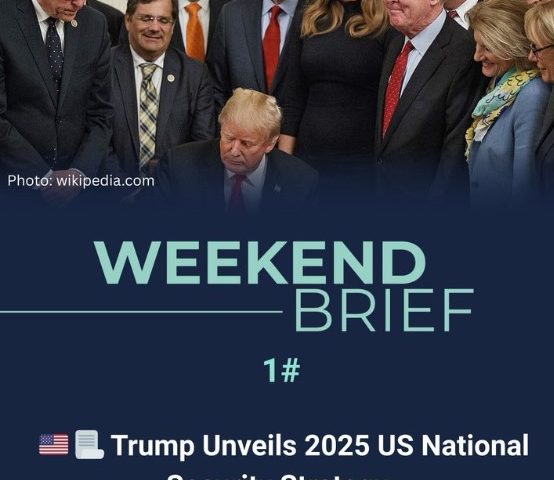
The United States released its 2025 National Security Strategy yesterday, and in my assessment, it represents far more than a traditional security document. It is an economic declaration marking the end of an era shaped by American-led globalization and the beginning of a new phase defined by national economic interests, strategic competition, and a recalibration of global partnerships. From its first page to its final lines, the document reflects a clear conviction that the old model of globalization no longer serves U.S. economic power and that maintaining wide-ranging military commitments is no longer sustainable in a rapidly transforming world.
The document is the most explicit and economically grounded national security strategy Washington has produced in decades. It redefines America’s place in the global economy and openly acknowledges that the international order, as constructed after the Cold War, now imposes more costs than benefits on the United States.
The strategy places the domestic economy at the center of American power. This is not political rhetoric but an economic doctrine based on measurable realities. U.S. GDP has returned to a growth rate of 2.3 % despite the global slowdown. Industrial reshoring initiatives attracted 78 billion dollars in new domestic investment in 2024. High-tech sectors received more than 130 billion dollars in capital inflows, while the non-oil trade deficit shrank by 11 %. These figures form the backbone of the new security outlook: a protected economy, revitalized local production, and a structural reduction in dependence on global supply chains.
This approach revives a modern version of the Monroe Doctrine, adapted for the twenty-first century. It aims to prevent rival powers from gaining influence or control over strategic assets in the Western Hemisphere and seeks to tighten U.S. control over critical minerals, advanced manufacturing inputs, and logistics networks. This shift comes at a time when more than 30 % of U.S. rare-earth imports and over 20 % of lithium and cobalt supplies come from countries increasingly integrated into China’s economic orbit.
The strategy’s treatment of the Middle East represents one of its most significant transformations. For roughly half a century, the region has been the central axis of American foreign policy due to oil and great-power competition. The new document states unambiguously that these dynamics no longer apply. The United States now produces 12.9 million barrels of oil per day and is nearing full energy independence. Meanwhile, global oil demand is shifting decisively toward Asia, which absorbs 70 % of Gulf crude exports. These economic shifts have eroded the structural reasons that once made the Middle East indispensable to Washington.
Accordingly, the strategy describes the region as “a zone of partnership, not of long-term military commitment.” This single sentence reshapes American engagement in the Middle East. Washington will neither focus on forms of governance nor promote democratic transitions nor interfere in political structures. Instead, it will evaluate regional states based on one criterion: whether they can provide tangible economic or strategic value to the United States. Even long-standing principles, such as support for Israel’s security and the protection of maritime corridors, are redefined as red lines rather than open-ended commitments.
Europe emerges as the principal economic loser in this new vision. For decades, the United States subsidized European security through NATO and sustained European economic growth by keeping its market open to nearly 500 billion dollars of annual exports. The 2025 strategy ends this arrangement. It demands that European countries raise defence spending to 2.5 % of GDP, overhaul migration policies that have cost European economies more than 340 billion dollars since 2015, and rebuild industrial capacity after cutting off access to cheap Russian energy. Europe is now expected to shoulder the costs of its own security and competitiveness, marking a profound shift in transatlantic relations.
Asia, meanwhile, stands at the center of the emerging global economic order. The strategy highlights Asia as the engine of global growth, contributing more than 55 % of world GDP expansion and attracting the majority of investment in advanced technologies. In this new architecture, Japan and South Korea are positioned as the primary winners because they can absorb American investments, deepen technological partnerships, and counterbalance Chinese industrial dominance. India, in contrast, is defined as a relative loser despite its growing economic weight because its development model still depends heavily on the old globalized system the United States is now moving away from.
The document also reframes the U.S. competition with China and Russia in economic rather than military terms. With China controlling 31 % of global industrial output and 42 % of advanced supply chains, and investing more than 70 billion dollars annually in artificial intelligence, Washington now acknowledges that the real contest is technological, industrial, and commercial, not territorial. Russia, meanwhile, is portrayed as an indirect beneficiary of America’s reduced military commitments in Europe, gaining more room to manoeuvre economically and geopolitically.
In essence, the 2025 U.S. National Security Strategy announces the arrival of a post-globalization world. It prioritizes national economic strength over international commitments, reduces reliance on global supply networks, and recalibrates alliances based on measurable economic value rather than political ideals. In the Middle East, this means a new era in which the United States will not return to the deep interventionism of the past, and where only states capable of generating real economic relevance will secure meaningful partnerships with Washington.
This strategy marks a historic inflection point that will reshape global power balances, redirect investment flows, and redefine economic alliances over the next decade. For the Middle East and for countries like Iraq in particular, the message is unmistakable: national economic capacity, not political alignment, will determine who thrives in the new international order.
Disclaimer. The views and opinions expressed in this analysis are those of the author and do not necessarily reflect the official policy or position of MEPEI. Any content provided by our author is of his opinion and is not intended to malign any religion, ethnic group, club, organization, company, individual, or anyone or anything.

Dr. Nawar AL-SAADI
Dr. Nawar AL-SAADI, Researcher in International Economics, is currently serving as a faculty member at Al-Nahrain University in Baghdad/Iraq and as the Director of the Research Center at Cihan University – Duhok.