
The Eightieth Session of the United Nations General Assembly: The High-Level Meeting on the 30th Anniversary of the Fourth World Conference on Women
October 6, 2025
Round Table “Kazakhstan in the Era of Artificial Intelligence”
October 6, 2025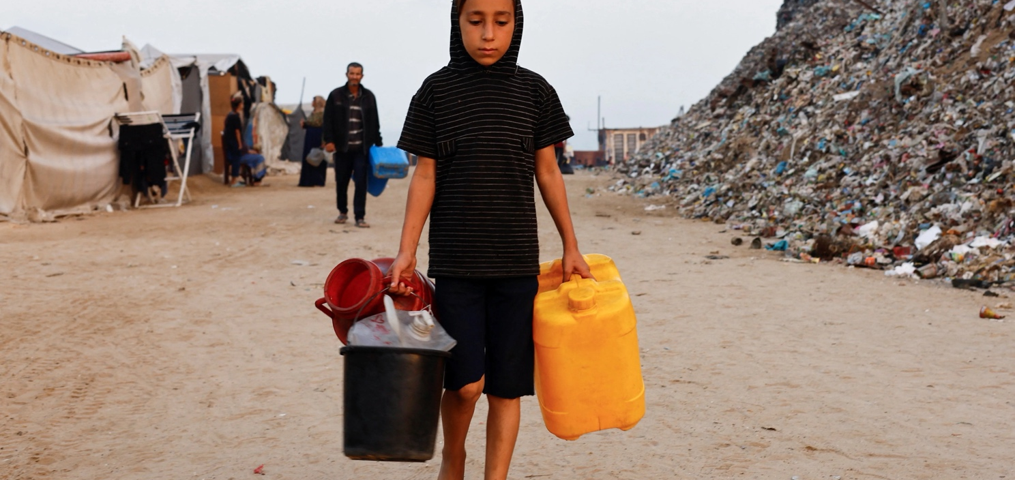
Photo: Mahmoud Issa /Reuters via Al Jazeera (https://www.aljazeera.com/gallery/2025/10/4/israeli-air-strikes-hit-gaza-despite-trumps-stop-bombing-demand)
On October 6th, 2025, delegations from Hamas and Israel are meeting in Cairo for a new round of negotiations mediated by Egypt and Qatar, two years after the Gaza war began. The United States has re-entered the mediation process with envoy Steve Witkoff and Jared Kushner, seeking to finalise the proposed “20-points plan”.[1]
- The development of the war and the pursuit of objectives
Two-years after the beginning of the Gaza war, the conflict is manifesting profoundly asymmetric. What began as an assault by Hamas has turned into a humanitarian catastrophe for Palestinians, and Israel, other than its military dominance, has achieved little beyond destruction and moral condemnation. The war has devastated Gaza to the point that it can no longer be referred to as part of a functioning state. The strip that was before October 2023, with a Gaza City that had decent infrastructure now lies in ruins, a situation that is serving Israel’s long-standing objective of territorial expansion. The current state of Gaza’s infrastructure renders sovereignty a distant achievement, for the moment only reinforcing Israel’s control even as international recognition of Palestine grows.
Hamas’s initial strategy backfired. In an effort to respond to Israeli expansion and force the Palestinian issue back on the international agenda, it managed to condemn its own population to suffering. The loss of over 60,000 Palestinians and the systematic attacks against civilian life have discredited Hamas as a governing or representative body of the Palestinian people, a function it was still trying to hold even though they were elected almost 20 years ago.
Meanwhile, Israel’s goals of eliminating Hamas and securing permanent control over Gaza, remain incomplete. Netanyahu has publicly rejected the establishment of a Palestinian state and affirmed Israel’s intention to remain miltarily present across most of Gaza.[2] After two years of war, very few objectives have been reached on both sides, while the conflict has been deepening the region’s instability.
- The consequences on both sides and on the world
Both Israeli and Palestinian societies are currently in a state of exhaustion. The fatigue is mostly moral, not military, as leaders on both sides are ready to continue fighting should they not reach an agreement that satisfies their incompatible requests. In Israel, protests continue, with people in Tel Aviv calling for a ceasefire and the return of the hostages.[3] Still, 62% of Israelis still agree that “there are no innocent bystanders in Gaza”[4], evidence of how polarised the national sentiment has become.
The international scene has shifted drastically. During the first year of war, the world leaders remained relatively silent. That silence has transformed into today’s open disapproval. Repeated condemnations from the UN, ICJ rulings, and international recognition of Palestine have proven largely symbolic, revealing how limited the instruments for international accountability remain. The war has exposed the fragility of international law when both parties act as aggressors and civilians are the victims.[5]
Across the region, the war has put to test both alliances and public opinion. Arab states and other regional actors, after leading a balanced policy between silent cooperation with Israel and rhetorical solidarity with Palestine, are now facing the need to take firm stances. Their growing frustration was visible in when Egypt, Jordan, Saudi Arabia and Türkiye have criticised Israel’s intervention over Trump’s proposed peace framework, resulting in a modified document reflecting its own security priorities rather than a fair agreement.[6] The global fatigue surrounding this war has become both a humanitarian and diplomatic demand for change.
- Trump’s plan put to the test – will Israel and Hamas find common ground?
Trump’s “Principles for Peace” is the most rigorous attempt to end the war, but it has a major vulnerability: it relies on reciprocal trust from a dynamic of mistrust. Its first step, a hostage-prisoner exchange within 72 hours and a halt to hostilities[7], requires a level of trust that neither side has. Earlier exchanges pretended only temporary ceasefires, while this one is to set in motion an Israeli initial withdrawal and an eventual Hamas disarmament, concessions seen as red lines by the respective sides so far. The pressure is on Hamas to accept the plan, accept the defeat, and imagine Gaza’s future without itself.
Netanyahu has affirmed that the second phase regarding withdrawal and disarmament “is still to be negotiated”, as a mechanism to preserve Israel’s leverage for as long as possible.[8] Hamas has already lost both the military war and the diplomatic one and now has only one remaining bargaining chip: the possibility to delay the process by demanding “the necessary field conditions for implementing the exchange”, invoking the need for security guarantees and for an end to Israeli attacks.[9] Netanyahu insists Israel will act “in accordance with the principles set forth by Israel that are consistent with President Trump’s vision”[10], which shows that it is not fully aligned with Washington’s proposal.
The plan constructs Gaza’s administration under a technocratic transitional authority chaired by Trump and joined by Tony Blair[11], going further than past Cairo frameworks that collapsed after Israel’s rejection of a ceasefire in early 2025.[12] Trump’s America, unlike Biden’s, is more aggressive and transactional, eager to gain the fruits of a resolution. Arab states, while backing mediation, show signs of tension in the face of Israel’s influence over the plan.[13] Egypt’s Foreign Minister Badr Abdelatty also warned that in order to not give Israel “an excuse to carry on with its offensive”, Hamas must disarm.[14]
- The future perspectives of the war
The following weeks will determine whether the peace process will have achieved its goal. Two outcomes are most plausible, and both end in reconstruction: either Hamas accepts Trump’s proposal and negotiations create a fragile environment for discussions, or it rejects the plan, generating a response from what will be a fully American supported Israel. The important variable in this equation is how the beginning of the reconstruction process will be reached, either by communication and cooperation, or by force.
Trump’s delegation has repeated that it is “looking toward reconstruction”, highlighting that this war has ceased to represent a path to potential gains.[15] Gaza’s future is starting to be approached less in military terms and more as a logistical and economic challenge. The question is no longer whether Gaza will be rebuilt, but who will control that reconstruction and on what terms.
The Arab state’s role is critical. As Abdelatty declared, displacement will not happen, because “it means the end of the Palestinian cause”.[16] Regional actors understand that reconstruction without sovereignty risks reproducing the same dependency that generated the conflict, while at the same time hurting their interests. The real struggle that lies ahead is not necessarily about weapons or prisoners, but about governance and identity, and it is going to be a long process.
[1] Al Arabiya English, Negotiators due in Egypt for Gaza talks, 6 Oct 2025 — https://english.alarabiya.net/amp/News/middle-east/2025/10/06/negotiators-due-in-egypt-for-gaza-talks-
[2] Middle East Monitor, Trump’s Gaza initiative: chance for peace or empty words?, 4 Oct 2025 — https://www.middleeastmonitor.com/20251004-trumps-gaza-initiative-chance-for-peace-or-empty-words/?amp
[3] CNN, Zeena Saifi, How do Israelis see the war in Gaza?, 5 Oct 2025 — https://edition.cnn.com/2025/10/05/middleeast/global-outrage-israel-gaza-intl
[4] aChord Center, Public Opinion Survey: “No Innocent Bystanders in Gaza”, Hebrew University of Jerusalem, Aug 2025 — https://drive.google.com/file/d/1dOWb6SQcp0jyy3xI5vPznT6SkJ0j2EzX/view
[5] France 24, Despite talks over an end to the war, the bombing doesn’t stop, 6 Oct 2025 — https://www.france24.com/en/middle-east/20251006-war-gaza-live-israel-hamas-egypt-trump-gaza-plan
[6] Middle East Monitor, Saudi Arabia, Türkiye, Jordan, Qatar angered by Netanyahu’s changes to Trump’s Gaza plan, 1 Oct 2025 — https://www.middleeastmonitor.com/20251001-saudi-arabia-turkey-jordan-qatar-angered-by-netanyahus-changes-to-trumps-gaza-plan/
[7] Al Arabiya English, Negotiators due in Egypt for Gaza talks, 6 Oct 2025 — https://english.alarabiya.net/amp/News/middle-east/2025/10/06/negotiators-due-in-egypt-for-gaza-talks-
[8] Euronews, Netanyahu interview, 6 Oct 2025.
[9] Middle East Monitor, Trump’s Gaza initiative: chance for peace or empty words?, 4 Oct 2025 — https://www.middleeastmonitor.com/20251004-trumps-gaza-initiative-chance-for-peace-or-empty-words/?amp
[10] Middle East Monitor, Trump’s Gaza initiative: chance for peace or empty words?, 4 Oct 2025 — https://www.middleeastmonitor.com/20251004-trumps-gaza-initiative-chance-for-peace-or-empty-words/?amp
[11] Al Arabiya English, Negotiators due in Egypt for Gaza talks, 6 Oct 2025 — https://english.alarabiya.net/amp/News/middle-east/2025/10/06/negotiators-due-in-egypt-for-gaza-talks
[12] Al Jazeera, Timeline: the path to the Israel–Hamas ceasefire deal in Gaza, 19 Jan 2025 — https://www.aljazeera.com/amp/features/2025/1/19/timeline-the-path-to-the-israel-hamas-ceasefire-deal-in-gaza
[13] Middle East Monitor, Saudi Arabia, Türkiye, Jordan, Qatar angered by Netanyahu’s changes to Trump’s Gaza plan, 1 Oct 2025 — https://www.middleeastmonitor.com/20251001-saudi-arabia-turkey-jordan-qatar-angered-by-netanyahus-changes-to-trumps-gaza-plan/
[14] Al Arabiya English, Egypt trying to convince Hamas to accept Trump plan, says foreign minister, 2 Oct 2025 — https://english.alarabiya.net/amp/News/middle-east/2025/10/02/egypt-trying-to-convince-hamas-to-accept-trump-plan-says-foreign-minister
[15] Al Arabiya English, Negotiators due in Egypt for Gaza talks, 6 Oct 2025 — https://english.alarabiya.net/amp/News/middle-east/2025/10/06/negotiators-due-in-egypt-for-gaza-talks-
[16] Al Arabiya English, “Egypt trying to convince Hamas to accept Trump plan, says foreign minister,” 2 October 2025, https://english.alarabiya.net/amp/News/middle-east/2025/10/02/egypt-trying-to-convince-hamas-to-accept-trump-plan-says-foreign-minister