
Tianjin SCO Summit 2025
September 2, 2025
Doha in the Crosshairs: What Israel’s Strikes Mean for Regional Stability
October 3, 2025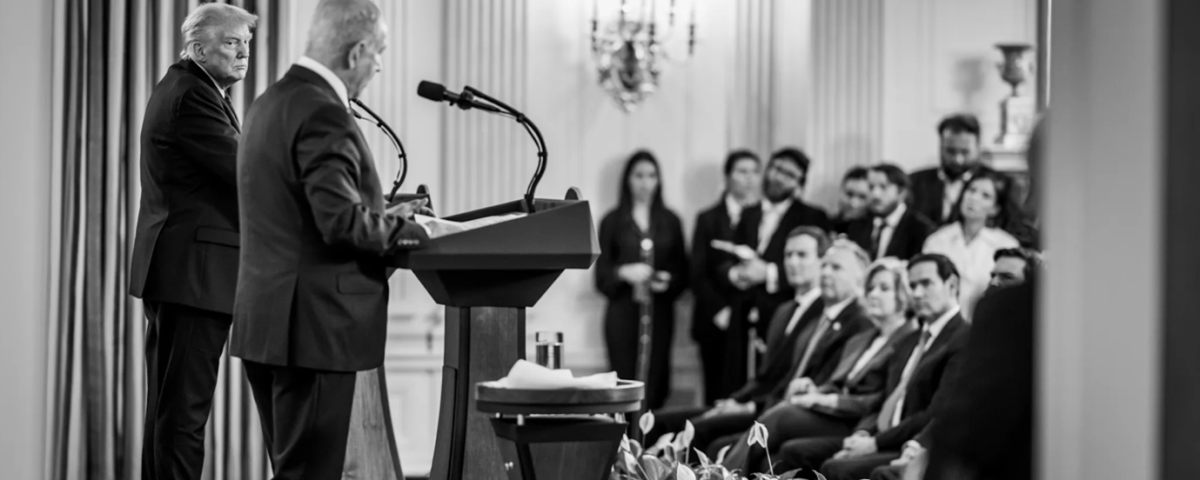
Photo source: https://www.whitehouse.gov
On September 29th, USA President Donald Trump held a joint statement with his Israeli counterpart, Benjamin Netanyahu, at the White House, presenting his “Principles for Peace”, a 20-point plan that is to end the war between Israel and Palestine.
During the conference, the world watched as both leaders presented their proposal, which tackled some of the most pressing issues. In light of failed negotiations in the past, this initiative’s chances of success rely on Hamas’s reaction, as the international community has displayed overall support for the plan.
What does the plan entice and what does it mean for the regional stability and security? There are different spheres that will be impacted by it, as follows:
Palestine, to be or not to be?
The current wave of recognition for a Palestine state is mostly symbolic, grounded in public pressure and solidarity, but it did however contribute to increasing momentum for ending the conflict. According to the plan, the governance of Gaza would not be given to the Palestinian Authority, but rather to a transnational authority, the Board for Peace, under Donald Trump’s leadership, joined by former UK Prime Minister Tony Blair. Under foreign leadership, the model is structured technocratic principles. International experts are to take charge in the initial phase, with the eventual transfer of responsibility to the Palestinians.
Hamas, cornered in a zero-sum game
The plan calls for the removal of Hamas from power and full demilitarization of Gaza. Hamas is not given a choice: it either accepts the plan or face an intensification of aggression, as both Trump and Netanyahu reiterated their readiness to respond with force. Compliance and security are to be guaranteed by regional partners of the plan. The first step is an immediate release of all Israeli captives, alive and deceased, followed by a proportional hostage release from Israel’s part. Additionally, the plan stipulates safe passage for former Hamas leadership.
Reinforcement of the Abraham Accords
Although the plan itself does not directly reference the Abraham Accords, they represented an important subject featured prominently in the joint statement. The accords remain one of the most influential political developments of Trump’s first mandate, and indeed a complex multilateral negotiation that also required concessions from the United States s mediator. These accords formalized economic, diplomatic and security cooperation, and resulted in the recognition of Israel by several regional powers. However, the war has put at risk the normalization of ties with Israel. At the same time, the current international context creates the possibility of expanding the accords, for instance with Syria’s new leadership, but not exclusively. Cooperation for the present Plan for Peace is closely tied to the objectives of the Abraham Accords, as it can be perceived as a practical test of their operational viability. In this regard, Netanyahu’s public address on the September attack in Qatar, taking responsibility and offering guarantees that it would not be repeated, showcases the importance of securing regional support for the plan.
The occupation
The current Plan for Peace represents a relative pivot from Trump’s initial 2020 peace proposal. Palestinians are allowed to remain, with no displacement speculated. Instead, Israel is to undertake a gradual withdrawal, structured in three phases. The first step would follow the safe release of the hostages. A second withdrawal would be linked to the mobilization of an International Stabilization Force tasked with securing Gaza and training a police force. Finally, a third withdrawal will consist of establishing a buffer zone.
The humanitarian interventions
Trump’s plan, although accelerated by the 2025 UNGA which provided the context for rapid negotiations, represents a limitation of UN powers in peacekeeping. Many responsibilities that in similar situations traditionally fell under UN missions are now redistributed to future institutions that would predominantly fall under Trump’s direct control. Within this framework, institutions such as the UN and the Red Crescent are permitted to provide humanitarian aid and rebuild infrastructure. The plan also includes initiatives aimed at fostering interfaith dialogue and promoting peaceful co-existence.
The reconstruction
The first step outlined in the Plan for Peace is the destruction of all terror infrastructure, including tunnels, weapons, and production facilities. Following this, the plan suggests the creation of a special economic zone with favorable terms, supporting a broader strategy to rebuild Gaza through global investment and job creation. Investments from the Unites States and other allies could generate significant economic growth, although the concrete implications for Palestinians still require closer analysis. This aspect of the plan is still a delicate aspect, following prior declarations from Trump regarding real estate developments in Gaza.
International response
Hamas: It initially stated that it had not officially received the plan, hearing only reports in the media. Later, Qatari and Egyptian mediators briefed them. The head of the Gaza government media office, Ismail Al-Thawabta (which does not have a political say in the conversation) rejected the proposal on Facebook, calling it “a new guardianship” that legitimizes Israeli occupation and does not respect the national, political, and human rights of Palestinians. [1]
Palestinian Authority: It welcomed Trump’s efforts to end the war, reiterating the commitment to a peace deal that supports the two-state solution.[2]
Palestinian public opinion: Palestinians are predominately reticent to the presence of Tony Blair[3], as his figure is associated with the 2003 Iraq war in the Middle East.
Israel: It is facing mixed reactions. Opposition leader Benny Gantz is a supporter of Trump’s plan, focusing on objectives such as bringing the hostages home, maintaining Israel’s operational freedom, replacing the Hamas regime and expanding normalization with moderate Arab states.[4] On the other hand, far-right Finance Minister Bezalel Smotrich is a critic of the plan, considering it a diplomatic failure and a betrayal of the events of October 7.[5] Tensions between Smotrich and Netanyahu could lead to a possible coalition conflict.[6]
Jordan, United Arab Emirates, Indonesia, Pakistan, Türkiye, Saudi Arabia, Qatar, Egypt (Joint Statement): They welcomed the efforts to end the war in Gaza, expressing confidence in his ability to mediate a peace deal, while highlighting the importance of partnerships with the United States in securing regional stability. They supported the proposal’s elements to rebuild Gaza, prevent displacement, and halt annexation of the West Bank, reaffirming their commitment to humanitarian aid, release of hostages, full Israeli withdrawal, Gaza’s integration with the West Bank, towards reaching the two-state solution.[7]
United Kingdom: It had relatively aligned reactions. Prime Minister Starmer encouraged cooperation between the different parts in order to finalize the agreement, calling on Hamas to lay down arms and release hostages. Former Prime Minister Tony Blair endorsed the plan as “bold and intelligent”, especially for its potential to end the war, secure Israel and create a better future for Gaza.[8]
European Union: The President of the European Commission, Ursula von der Leyen, expressed support for the proposal, with German chancellor, Friedrich Merz, who is partial to Israel, saying that the plan was the “best chance” to end the war. Spain, after becoming one of the most vocal European states regarding Israel’s actions in Gaza has welcomed the plan too.[9]
[1] https://www.reuters.com/world/live-updates-trump-meet-netanyahu-white-house-with-focus-new-gaza-peace-plan-2025-09-29/
[2] https://english.wafa.ps/Pages/Details/161877
[3] https://www.linkedin.com/feed/update/urn:li:activity:7378719344303767552/
[4] https://www.timesofisrael.com/liveblog_entry/gantz-praises-trumps-gaza-proposal-says-it-must-be-implemented/
[5] https://www.aljazeera.com/news/2025/9/29/trumps-gaza-peace-plan-welcomed-by-arab-and-islamic-countries-the-west
[6] https://animanews-info.blogspot.com/2025/09/smotrich-pune-conditii-dure-lui.html
[7] https://www.mofa.gov.ae/en/MediaHub/News/2025/9/30/30-9-2025-uae-qatar
[8] https://www.aljazeera.com/news/2025/9/29/trumps-gaza-peace-plan-welcomed-by-arab-and-islamic-countries-the-west
[9] https://www.theguardian.com/world/2025/sep/30/trump-gaza-proposal-peace-reactions-welcomed-world-leaders-palestinian-residents-remain-sceptical

Larisa-Nicoleta PĂTRAȘCU
Larisa-Nicoleta PĂTRAȘCU is a Junior Researcher at the Middle East Political and Economic Institute (MEPEI). Her research and professional interests center on peacebuilding, diplomacy and conflict resolution, international cooperation, and MENA geopolitics.