
US-Armenia-Azerbaijan agreement: a geopolitical reshuffle or just a next step?
August 11, 2025
Trump’s 20-points plan for Eternal Peace
September 30, 2025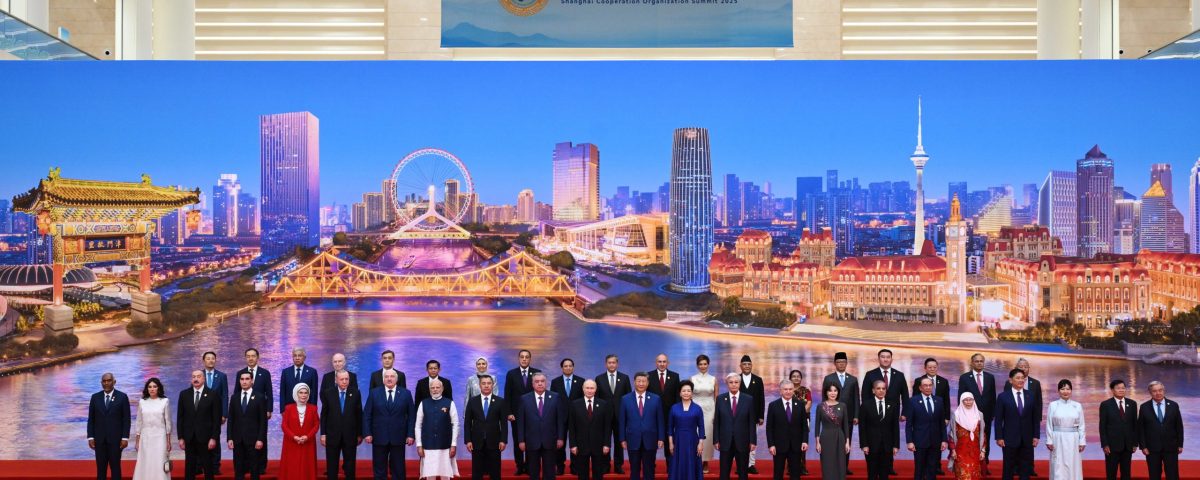
Photo: On 31 August 2025, a reception and concert program were held at the Tianjin Meijiang International Convention and Exhibition Center in honor of heads of state and government and their spouses, hosted by the General Secretary of the Chinese Communist Party, Xi Jinping, and First Lady Peng Liyuan. General Secretary of the Chinese Communist Party Xi Jinping and First Lady Peng Liyuan welcomed President of the Republic of Azerbaijan Ilham Aliyev and First Lady Mehriban Aliyeva. Afterward, the heads of state and government and their spouses posed for a group photo.
The Shanghai Cooperation Organization (SCO) Summit in Tianjin, China, from August 31 to September 1, 2025, is the Organization’s largest gathering of heads of state to date.
It occurred amid changing regional geopolitics and realignments in international politics. The gathering of over 20 countries from Eurasia and the Middle East is being seen as a powerful demonstration of solidarity among the Global South during the rapid transformation of global geopolitics.
The steady shift from unipolarity to multipolarity, which is now the catchphrase of both President Xi Jinping and President Putin, was validated at the Summit. President Xi demonstrated his country’s leadership of a large coalition of like-minded nations that oppose the hitherto US-led international order. On August 31, 2025, while speaking at the SCO welcome banquet, he opined that the Organization has “become an important force in building a new type of international relations and a community with a shared future for humanity.”
Founded in Shanghai in 2001 with just six members – Russia, China, Kazakhstan, Kyrgyzstan, Tajikistan and Uzbekistan – the SCO has grown rapidly over the past decade. India and Pakistan joined it in 2017, Iran in 2023 and Belarus in 2024. In addition to ten full member states, the SCO also has two observers – Afghanistan and Mongolia – and 14 dialogue partners, including Türkiye, Egypt, Armenia, Azerbaijan, several Gulf States and several other Asian states. The significant number of non-members’ participation underscores the SCO’s pivotal role in the evolving international multipolarity, a key aspect of the changing global dynamics. The motto of the Tianjin Summit is “Promoting the Shanghai Spirit: SCO in Action.” The participants also deliberated on the long-term SCO development strategy, the implementation of the SCO Sustainable Development Year’s action plan.
Pakistan assigned great significance to the multilateral forums, including the SCO. Since becoming a permanent member, Pakistan has actively participated in the SCO’s meetings and activities. On August 30, 2025, Prime Minister Shehbaz Sharif visited China to attend the Tianjin SCO Summit. While addressing the SCO’s Council of Heads of State (CHS), the highest decision-making body of the Organization, he shared Pakistan’s perspectives on pressing regional and global issues and highlighted strategies to strengthen the SCO’s role in fostering regional cooperation and stability. The SCO’s efforts in this direction should inspire optimism about its impact on the region.
Chinese Foreign Minister Wang Yi’s trip to India, Pakistan and Afghanistan marked Beijing’s efforts towards regional cooperation and connectivity. During his visit, he emphasized the importance of enhancing the security dialogue mechanism, deepening law enforcement and security cooperation, strengthening the fight against transnational terrorism and eliminating conditions that foster extremism. All these issues, which are the cardinal objectives of the SCO, reflect the organization’s mission to promote regional security and stability.
Wang Yi’s visit to India last month signified an improvement in relations between Beijing and New Delhi. On August 18, 2025, while meeting his Indian counterpart, Subrahmanyam Jaishankar, Wang said the two countries should “view each other as partners and opportunities, rather than adversaries or threats.” He added that the resumption of “dialogue at all levels” and “maintenance of peace and tranquility in border areas” as evidence that bilateral ties were on a “positive trend of returning to the main path of cooperation.” To allure Indians, he announced the lifting of export restrictions on fertilizers, rare earth magnets, critical minerals and tunnel boring machines.
Taking advantage of Wang’s presence, Prime Minister Narendra Modi set aside protocol and met him and also accepted the invitation to attend the SCO Tianjin Summit. It is Modi’s first visit to China in seven years. His meeting with President Xi on the sidelines of the SCO Summit generated optimism about improving relations between Beijing and New Delhi with a positive impact on regional security.
The SCO provides China with an opportunity to showcase its increasing acceptance in the emerging multipolar world and its defiance of American-led unipolarity and efforts to contain China. Additionally, it provides a platform for war-torn Iran and Russia to present their regional and international perspectives. Interestingly, India had attempted to downgrade the Organization to appease the US-led Western nations, but is now using the SCO to signal its acceptance in the global South. To conclude, the SCO members are using the platform to mitigate their differences, except India and Pakistan. The continuous frictions between these two core members obstruct the Organization’s ability to accomplish its primary objectives—combating terrorism, separatism and extremism.
This op-ed was published firstly in Pakistan Observer on Sep 02, 2025.
Disclaimer. The views and opinions expressed in this analysis are those of the author and do not necessarily reflect the official policy or position of MEPEI. Any content provided by our author is of his opinion and is not intended to malign any religion, ethnic group, club, organization, company, individual, or anyone or anything.
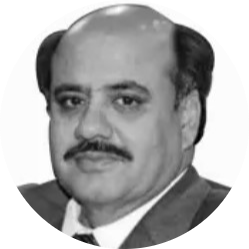
Prof. Zafar Nawaz JASPAL
Nonresident Fellow at MEPEI, Prof. Zafar Nawaz JASPAL is an Islamabad-based analyst and meritorious professor of International Relations at SPIR, Quaid-i-Azam University and an advisory Board Member of the Institute for East-West Strategic Studies (RIESS), affiliated with Oxford University, U.K. E-mail: jaspal_99@hotmail.com, X: @zafar_jaspal