
Overview of the Outcomes of the 2025 SCO Member States Foreign Ministers’ Tianjin Meeting
August 3, 2025
Tianjin SCO Summit 2025
September 2, 2025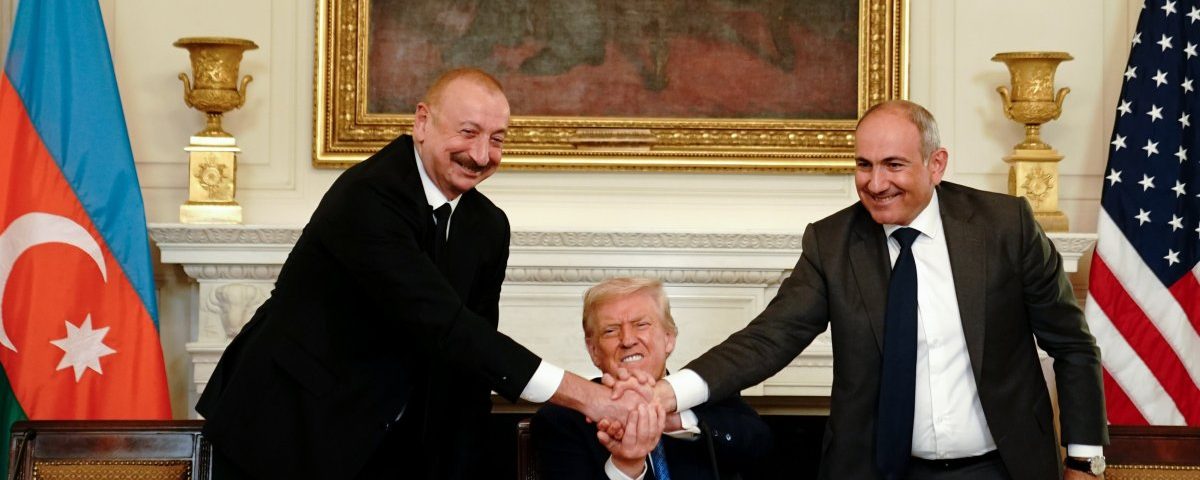
(EPA Photo)
1. Introduction
In early August 2025, a trilateral agreement brokered by US President Trump was presented to the public as a “peace pledge” (Ahmadi, Venkatraman, & Atanesian, 2025) or “peace deal” (Guardian & Agencies, 2025), while the implications of this accord appear to be more significant in the wider geopolitical landscape.
The endeavor of peace between Azerbaijan and Armenia has long sought-for by the two countries and other regional countries, hence the agreement appears as a major breakthrough, should the pledges be held by parties, unlike in the past. But this was not the only provision of the trilateral pact. Among others, the US reportedly signed bilateral agreements for the development of economic ties with the two countries (Schwartz & Bazail-Eimil, 2025), certain restrictions of military cooperation between the US and Azerbaijan were lifted (Daily News, 2025), and Armenia granted Washington “exclusive rights” to a railway corridor connecting Azerbaijan’s mainland with its Nakhchivan exclave (Azatutyun, 2025).
The conflict between Azerbaijan and Armenia emerged after the dissolution of the Soviet Union and was known since the beginning as the Nagorno-Karabakh war. In recent iterations of this conflict, Azerbaijan demonstrated superior firepower and resolve, supplied with military equipment by Türkiye and Israel, and managed to conquer Armenian-controlled territory.
As always, the roots of this conflict had been complex, and are not discussed in detail in this study, but it must be emphasized that at present, there is a significantly large Armenian diaspora across the world, and at the beginning of the 19th century, many Armenians died under Ottoman rule, in what certain observers allege to a genocide, while Turkish authorities cite wartime conditions as a cause.
2. Armenia and Azerbaijan: background and evolution
Azerbaijan and Armenia became independent from the Soviet Union in 1991. The two new states inherited pre-1991 conflict and tension, while still under Kremlin. As of 2024, Azerbaijan has a population of approximately 10.2 million, and Armenia 3.03 million according to World Bank. From 1991, Azerbaijan’s population continued to increase from 7.21 million, while Armenia’s population decreased from approximately 3.61 million (World Bank Pop., 2025).
As of 2024, Azerbaijan’s economy was relying on oil and gas, and its GDP (current $) amounted $ 74.32 billion, whereas Armenia’s economy, reliant on remittances from abroad and tourism, registered a GDP in amount of $ 25.79 billion. The per capita incomes in PPP terms were comparable and in the range $ 20’000 – 25’000 per year. While Armenia’s democracy index was 4.7 in 2025, Azerbaijan, under the Aliyev family since 1993, registered a democracy index of 2.8 (weaker result), significantly lower than Türkiye’s 4.26 or Norway’s 9.81 (Our World in Data / Economist Intelligence Unit, 2025).
Neither Azerbaijan nor Armenia are countries large enough to significantly influence regional geopolitics, when considering the population and economies of the Russian Federation, Türkiye, and Iran. Likewise, their economies are neither very large, nor highly financialized in order to influence significantly the region or global economy. These are important factors to consider when assessing American and other exogenous interest in the region: there are no direct economic incentives to prioritize the investment in Zangezur Corridor, i.e. Trump Route for International Peace and Prosperity (TRIPP), when considering other geopolitical challenges, the West and particularly the US is facing as of 2025. Furthermore, there is no strategic economic gain for third parties when investing in a secondary or even tertiary trade route, given its location and regional development potential, when compared to China’s Belt and Road Initiative (BRI) or competing projects. Hence, the considerations are solely geopolitical, strategic, and related to background dynamics, like for example the long-term process of replacing Soviet Union influence around its nowadays borders with American and allied influence, encircling Iran and increasing American control in a region which might be key in China – Europe trade on land routes.
At the beginning of 20th century, Nakhchivan region had been part of Armenia for centuries, but in the aftermath of Moscow and Kars agreements, it was transferred to Azerbaijan’s control and became an exclave separated from the rest of the country. One century later, Azerbaijan keeps expanding its territory, and Türkiye reaffirms its support for a renewed Turkic world, in which Azerbaijan is both a Turkic and a (predominantly Shi’a) Islamic country. Türkiye’s support actions for Azerbaijan’s wellbeing are multiple. Besides being an ethnically related nation, Azerbaijan empowered Türkiye to become a competing player in the trade corridors competition, and establish its position as a hub for hydrocarbon transit.
3. Türkiye and South Caucasus relations
The Turkish city of Kars became a symbol of Türkiye’s role in Europe – Asia trade, as the Baku-Kars-Mersin route of Middle Corridor allows Türkiye to compete with the Baku-Batumi route, that from Batumi can reach Ukraine, Romania, or Türkiye by boat (Eldem, 2022). The Trans-Anatolian Natural Gas Pipeline (TANAP) and the oil pipeline Baku-Tbilisi-Ceyhan (BTC) both connect Azerbaijan to either various markets, like Europe or Israel (MEE Staff, 2025) through Türkiye, or Türkiye itself. Furthermore, the brotherly relations and reciprocity between the two Turkic states goes beyond hydrocarbon sales and trade routes. The relative isolation of Nakhchivan exclave would have probably been very challenging unless the latter would not have shared a border with Türkiye. However, Türkiye’s regional connectivity projects went beyond competing the Middle Corridor or a potential Europe – India route through the Middle East and bypassing Türkiye, with the New Iraq Development Road, that connects the Persian Gulf to Turkish ports and trade nodes, and with the Kars-Igdir-Nakhchivan railway, which reportedly helps reducing the travel time from Kars to Nakhchivan down to 85 minutes (Report News Agency, 2025). Besides the logistics advantage, and Türkiye’s trade opportunities with the Nakhchivan, this route also provides Azerbaijan with a relatively simple access route to its exclave, with developmental, security and military implications. Therefore, Azerbaijan’s influence around its territory appears to expand.
Türkiye certainly envisions expanding influence abroad, and Azerbaijan certainly represents an important front. Whether Armenia maintains or not the so-called “sovereignty” over the transport corridor over which the US reportedly received “exclusive rights”, is a de jure matter rather than a set of de facto implications. From this perspective, Türkiye will not be able to control an eventual longer trade route from Asia through Southern Caucasus, and the regional countries gave away own influence and resolve to enable this cooperation to the US. Armenia and Azerbaijan might not become as rich as the former cities on the Old Silk Route centuries ago due to this new railway near Armenia’s south border with Iran, despite the fact that the BRI Northern Route through Russia became unusable as the Nord Stream Pipeline to Europe did, because there are at least two major routes already competing the Zangezour Corridor, i.e. the Baku – Kars route and the Baku – Batumi route.
The Turkish opposition politician Doğu Princek reportedly stated that the (American) Zangezour Corridor may pose threats to Turkish and Iranian interests, due to foreign interference in the region (Mehr News, 2025). While this vision does not appear to be shared by more establishment-related Turkish voices, there are two potential perspectives on this matter. As the Turkish – American partnership, especially in military and security matters, is very close, there would be no issue to share South Caucasus influence. Another theoretical perspective might relate to a purely hypothetical scenario in which Türkiye may seek sovereign influence within the region and beyond, like for example in the Middle East or Africa. There is less to no evidence to support decisive Turkish action in this direction, since Turkish and American interests generally match at the level of principle, and in terms of cooperation frameworks.
4. Iran as a neighboring country for Armenia and Azerbaijan
Iran’s perspective on American implication in a “trade route” is fundamentally different. As previously established, there are economic incentives for the US to pursue such projects in general, but not necessarily with highest priority. From a geopolitical and security perspective however, it is not difficult to identify that the US is building a new base right near Iran’s border, be it sovereign or not, for logistics only or not. The US holds military bases or significant deployments in Türkiye, Iraq, and in the Persian Gulf: Kuwait, Bahrain, Qatar, UAE, and Oman. This situation is not a simple development, since Iran has been the target of continuous Western pressure before and after 1979, and more recently, Israel and the US attacked Iran in the so-called “12 days war”. Iranian reports on the recently-announced deal and upcoming American arrival on its border with Armenia, presented the situation as a next step in great power confrontation (Khosroshahi, 2025), and as a development that Iran will block “with or without Russia” (Tasnim, 2025).
Iran’s regional influence appeared to return since the JCPOA agreement, and its allies in the region apparently increased influence. However, during President Trump’s first and second terms, Iran and its regional partners were confronted, in Lebanon, Syria, Iraq and Yemen. Iran was even attacked on the territory of its consulate in Syria, and on sovereign territory at home. The developments from recent years suggest Iranian influence in West Asia is contracting, as the country turned to BRICS for cooperation and development. However, confusing declarations related to the Israeli and American goals when attacking Iran in June 2025, which revolved around containing its nuclear program and “regime change”, clearly hint at a systematic American and allied attempt to either carry out a coup in Iran, as in the 1950s and onward, or encircle the oil and gas-rich nation.
European reports hint indeed that Iran and the Russian Federation are set to lose from the US deal with Armenia, and Azerbaijan (Wintour, 2025), which is an obvious outcome of the deal should it be carried out as presented. The Iranians also portray the step in the context of the competition between the US, Russian Federation and China, which is also relatively accurate, but does not include the European Union.
Iran is confronted with an open war from the US, Israel and allies from the West, a long rivalry and scarce cooperation with the Arab Persian Gulf states, a long-term refugee crisis from Afghanistan, security challenges at the border with Pakistan and decades-long sanctions and boycotts from Western peers. With or without these preconditions, Iran is definitely being more encircled by the US with the new Zangezur under American control, and not less.
As a major neighbor for both Armenia and Azerbaijan, Iran attempted to maintain a balanced approach, but Azerbaijan appears to have lost its confidence in Iranian trade prospects due to recent security breaches on Iranian territory, and while Armenia did not blame Iran for the outcomes of 2023 war with Azerbaijan, it apparently opted for American security guarantees. However, while the American presence might have the potential to stop land transfer from Armenia to Azerbaijan, this is not necessarily guaranteed, especially when considering the financial resources of Azerbaijan, now a potential candidate for US exports of expensive weapons. This does not necessarily imply Patriot and F-35 sales this year or in 2026, but the path is now open, and an increasing number of American military or civilian personnel will begin to visit the South Caucasus, be it in Armenia or Azerbaijan. Furthermore, any regional deal, be it for trade, security, and anything else, might require Azerbaijan and Armenia to at least carry out more discussions with the Americans, and even ask approval if the security dependency threshold will become high enough.
5. Wider geopolitical implications of US involvement in South Caucasus Affairs
The Russian Federation and China are certainly impacted by this development. As the EU is, when considering American influence on major land trade routes from Asia: both remaining trade routes, pass through Azerbaijan, and they will become increasingly subjected to American interests. Likewise, Iranian connectivity with the Russian Federation might be impacted, and Chinese relations with Azerbaijan and Armenia. therefore, American permanent presence in South Caucasus would be significant, very likely consequential at regional level, especially for Iran.
In the post-2001 era, marked among others by an increasing number of unilateral decisions to invade countries based on false justifications and lose alliances that certainly do not replace systematic consensus systems like the United Nations Security Council (UNSC), Iran’s concerns are even more obvious in contexts like the US-Armenia-Azerbaijan agreement. The development itself is relatively surprising, but when considering an increasingly confrontational landscape, not necessarily a reshuffle. Due to various reasons, among which the rise of BRICS as a competitor in global affairs, the US apparently developed the need to harden its already dominant position in global affairs, a dynamic visible in the relation with Iran, Europe, South-East Asia, South America and even its large neighbors Canada and Mexico. Irrespective of the causes for this approach, the perspective of weakening Iran is certainly consequential for the relations between the US on one hand, and the Russian Federation or China on the other hand.
An American presence in South Caucasus complements American influence in Türkiye, Western Asia through Israel, and as long as Europe is at war with Russia, this is sufficient to control major trade routes from East to West. In establishing presence throughout Armenia and Azerbaijan, the US becomes a closer neighbor with Iran, Türkiye, and the Russian Federation, whereas these countries do not become closer neighbors to the US. At the same time, the US sets the stage with this next step for a confrontation scenario in which it will have the capacity to separate and control any potential alliance that will oppose its interest and domination project, unless this trend will be disrupted by the US itself or other dynamics.
6. Conclusions
The conflictual landscape from Central Asia becomes more relevant especially in the context of the war from Ukraine. While the West appears to carry out an expansion of influence eastwards, the Russian Federation appears to begin opposing this expansion due to long-stated security concerns.
However, since both sides have been determined in this confrontation, and generally operate with universalistic claims, the intensity of the conflict appears to increase. Whether the US will still involve Europe, or consider that, for example, a hypothetical Turkic alliance would better serve its interests, remains an open question, along the outcome of this increasingly belligerent attitude to international relations in general.
Bibliography
Ahmadi, A., Venkatraman, S., & Atanesian, G. (2025, August 10). Azerbaijan and Armenia sign peace pledge at White House summit with Trump. Retrieved from BBC: https://www.bbc.com/news/articles/c39dzl1lzrgo
Azatutyun. (2025, August 10). U.S. Set To Gain ‘Exclusive Rights’ To Corridor Through Armenia. Retrieved from Azatutyun: https://www.azatutyun.am/a/33497070.html
Daily News. (2025, August 08). Trump says Armenia, Azerbaijan committed to end fighting ‘forever’. Retrieved from Daily News: https://www.hurriyetdailynews.com/trump-says-armenia-azerbaijan-committed-to-end-fighting-forever-212331
Eldem, T. (2022, October 28). Russia’s War on Ukraine and the Rise of the Middle Corridor as a Third Vector of Eurasian Connectivity. Retrieved from SWP Berlin: https://www.swp-berlin.org/10.18449/2022C64/
Guardian & Agencies. (2025, August 10). Azerbaijan and Armenia sign peace deal at White House that creates a ‘Trump Route’ in region. Retrieved from The Guardian: https://www.theguardian.com/world/2025/aug/09/azerbaijan-and-armenia-sign-peace-deal-at-white-house-that-creates-a-trump-route-in-region
Khosroshahi, H. (2025, August 10). Zangezur: A corridor to ‘peace’ or gateway to new confrontation of big powers? Retrieved from Press TV: https://www.presstv.ir/Detail/2025/08/10/752832/zangezur-corridor-peace-gateway-new-confrontation-between-big-powers
MEE Staff. (2025, June 09). Azerbaijan maintains oil sales to Israel despite Turkish backlash, says report. Retrieved from Middle East Eye: https://www.middleeasteye.net/news/azerbaijan-maintains-oil-sales-israel-despite-turkish-backlash-says-report
Mehr News. (2025, August 09). Zangezur Corridor project to threaten Turkish security. Retrieved from Mehr News Agency: https://en.mehrnews.com/news/235213/Zangezur-Corridor-project-to-threaten-Turkish-security
Our World in Data / Economist Intelligence Unit. (2025, August 10). Democracy Index (Economist Intelligence Unit). Retrieved from Our World in Data: https://ourworldindata.org/grapher/democracy-index-eiu?globe=1&globeRotation=56.81%2C56.45&globeZoom=1.85
Report News Agency. (2025, March 22). Kars-Igdir-Nakhchivan railway: New era in international trade development. Retrieved from Report News Agency: https://report.az/en/infrastructure/kars-igdir-nakhchivan-railway-new-era-in-international-trade-development/
Schwartz, F., & Bazail-Eimil, E. (2025, August 10). US brokers a deal between long-hostile Armenia and Azerbaijan. Retrieved from Politico: https://www.politico.com/news/2025/08/07/us-deal-armenia-azerbaijan-00499285
Tasnim. (2025, August 09). With or Without Russia, Iran Will Block US Corridor in Caucasus: Velayati. Retrieved from Tasnim News Agency: https://www.tasnimnews.com/en/news/2025/08/09/3372566/with-or-without-russia-iran-will-block-us-corridor-in-caucasus-velayati
Wintour, P. (2025, August 09). Iran and Russia stand to lose from US deal with Azerbaijan and Armenia. Retrieved from The Guardian: https://www.theguardian.com/world/2025/aug/09/iran-and-russia-stand-to-lose-from-us-deal-with-azerbaijan-and-armenia
World Bank Pop. (2025, August 10). World Bank Data Population Azerbaijan and Armenia. Retrieved from World Bank: https://data.worldbank.org/indicator/SP.POP.TOTL?locations=AZ-AM

Prof. Ecaterina MATOI
Prof. Ecaterina MAȚOI is a Program Director at MEPEI.