The Mecca Joint Defense Agreement and the Limits of Gulf Strategic Autonomy
August 8, 2026
Was Ceuta a Warning to Spain? Migration Pressure, Morocco, and Spain’s Wider Clash With Israel and the United States
August 10, 2026The Mecca Agreement and the Reshaping of Regional Security: Is a New Security Order Emerging in the Middle East?
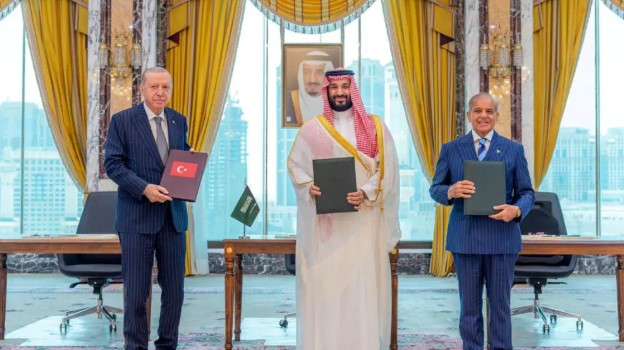
Photo: Turkish President Tayyip Erdogan, Saudi Crown Prince Mohammed bin Salman and Pakistan’s Prime Minister Shehbaz Sharif pose after signing a joint defence agreement in Mecca, Saudi Arabia, on August 7, 2026. © Saudi Press Agency
The Middle East is entering a period of profound strategic transformation. For decades, its security architecture rested largely on external guarantees, particularly the central role of the United States, Israel’s military superiority, and a regional balance shaped by competition with Iran. That model is now under growing pressure as regional powers seek greater strategic autonomy and become less willing to rely exclusively on external security guarantees.
Against this backdrop, the Mecca Agreement between Saudi Arabia, Türkiye, and Pakistan represents more than another defence arrangement. Its significance lies in the possibility that it could contribute to the emergence of a more diversified regional security architecture—one in which influential regional powers increasingly participate in producing, rather than merely consuming, security.
The agreement’s core principle—that aggression against one of its members would be regarded as aggression against all—creates a potentially significant deterrence commitment. Yet its strategic meaning remains more complicated than that of a conventional military alliance.
The central question is therefore not simply whether the agreement constitutes a new alliance. It is whether it represents the beginning of a broader shift from dependence on external security guarantees toward regional strategic autonomy.
A Security Partnership Without a Common Enemy
Traditional alliances are often built around a clearly defined adversary. NATO, for example, emerged within the context of the Soviet threat and was sustained for decades by a shared perception of a common strategic challenge.
The Mecca framework is different.
Saudi Arabia, Türkiye, and Pakistan do not share identical threat perceptions. Riyadh is primarily concerned with Gulf security, critical infrastructure, energy security, maritime routes, and missile and drone threats. Ankara operates across a much broader geopolitical environment extending from the Black Sea and Eastern Mediterranean to Syria and the Gulf, while remaining a NATO member. Islamabad’s strategic priorities remain strongly connected to South Asian security, particularly India and its surrounding strategic environment.
This absence of a common enemy represents both the agreement’s greatest weakness and one of its most revealing characteristics.
The framework is therefore better understood through the concept of “strategic hedging”. Rather than preparing for a single predetermined conflict, the three states are expanding their strategic options in an increasingly uncertain environment.
The message is not necessarily that they are preparing for war against a specific actor. It is that they do not want to face the next regional crisis in isolation.
That distinction is critical. Traditional alliances ask: “Who is the enemy?” Strategic hedging asks: “How can states reduce their vulnerability if the strategic environment deteriorates?”
The Mecca Agreement belongs much more clearly to the second category.
From National Defence to Collective Deterrence
For Saudi Arabia, the agreement reflects a broader transformation in its understanding of security. The Kingdom has invested heavily in advanced military capabilities, but recent regional conflicts have demonstrated that sophisticated weapons alone cannot eliminate strategic vulnerability.
The nature of warfare has changed. Energy infrastructure, airports, ports, communication networks, and economic centres can now be threatened by relatively inexpensive asymmetric capabilities, including drones and precision missiles.
Consequently, deterrence increasingly requires a combination of national capabilities and strategic partnerships.
Türkiye brings substantial conventional military capacity, operational experience, and a rapidly developing defence industry. Pakistan contributes military depth, extensive operational experience, and the strategic significance of being a nuclear-armed state.
Yet the value of the partnership cannot be measured simply by adding military capabilities together.
Deterrence is ultimately about credibility. Its purpose is to persuade a potential adversary that the costs of aggression will outweigh its expected benefits.
The crucial test, therefore, will be whether the three states can translate political commitments into credible mechanisms of consultation, intelligence cooperation, military coordination, and crisis response.
Iran: The Present but Unnamed Variable
Iran is not identified as an enemy in the agreement, and reducing the Mecca framework to an anti-Iranian alliance would therefore be analytically misleading.
Nevertheless, Iran remains an unavoidable variable in the regional security equation.
For Saudi Arabia, Iran is closely connected to Gulf security and the protection of critical infrastructure and maritime routes. Türkiye approaches Tehran through a more complex combination of competition and cooperation shaped by geography, trade, Syria, and broader regional interests. Pakistan, because of its geographic proximity to Iran, must also preserve a careful balance between its relationship with Tehran and its strategic partnership with Riyadh.
This diversity explains why the agreement does not explicitly define Iran as a common adversary.
Its objective may instead be to create a broader balance of power in which the costs of aggression become higher, regardless of its source.
Iran’s interpretation of the agreement will nevertheless matter greatly. If Tehran sees it primarily as a deterrence mechanism, the emerging balance could contribute to greater strategic stability. If it interprets the agreement as the foundation of a coalition designed to contain Iranian influence, it could respond by strengthening countervailing partnerships, accelerating regional polarisation.
The issue, therefore, is not only the distribution of power but also the **interpretation of intentions**.
Israel and the Future of Regional Security
Israel represents another important variable, although describing the Mecca Agreement as an anti-Israeli alliance would similarly oversimplify the picture.
The three signatories maintain different relationships with Israel and do not share a unified threat perception regarding it. Nevertheless, Israel has long occupied a central position in the Middle Eastern security architecture because of its military superiority and its close strategic relationship with Washington.
The emergence of a Saudi-Turkish-Pakistani security framework could gradually contribute to a more pluralistic regional order in which security is produced through several centres of power rather than concentrated around a limited number of external or regional actors.
For Israel, this may be strategically significant.
The issue is not whether the agreement immediately threatens Israeli military superiority. It does not. The more consequential question is whether Israel will remain indispensable to the way regional security is organised.
An increasingly autonomous regional security network could reduce the centrality of any single actor in shaping the region’s strategic architecture.
For this reason, Israel may ultimately prefer to contain rather than directly confront the emerging framework. An openly confrontational response could encourage the three states to deepen their cooperation, while dismissing the agreement as symbolic could allow it to develop gradually into a more institutionalised mechanism.
Washington and the Question of Strategic Autonomy
The United States faces an equally complex equation.
Washington may welcome greater regional burden-sharing if Saudi Arabia and other partners assume greater responsibility for their own security. At the same time, the emergence of autonomous regional security institutions could eventually reduce American influence over the architecture it has helped shape for decades.
The distinction between “burden-sharing and strategic autonomy” is therefore crucial.
If the Mecca framework remains compatible with existing American security arrangements, Washington may regard it as complementary to its interests. If it develops into an independent structure involving joint planning, intelligence-sharing, military coordination, and potentially additional members, its implications would be much greater.
The question would then no longer be whether the United States remains present in the Middle East, but whether it remains the principal architect of the region’s security order.
From Hedging to Deterrence
The Mecca Agreement should therefore neither be dismissed as a symbolic declaration nor described prematurely as a conventional military alliance.
It is better understood as a “strategic hedging framework seeking to generate regional deterrence”.
Its strength lies in bringing together three influential states with different but complementary capabilities and geopolitical positions. Its vulnerability lies in the absence of a clearly defined common enemy and in the possibility that national interests could diverge when collective action is actually required.
The ultimate test will not be the language of the agreement but its institutional development.
Will the three states establish effective mechanisms for intelligence sharing, military coordination, joint exercises, crisis consultation, and collective decision-making? More importantly, will they demonstrate political willingness to bear the costs of supporting one another when confronted with a genuine security crisis?
If they succeed, the Mecca Agreement could become more than a defence partnership. It could represent an early building block of a new regional security architecture based on greater strategic autonomy and a more distributed balance of power.
If they fail, it may remain a politically significant but operationally limited arrangement.
The broader significance of the Mecca Agreement therefore lies in the transformation it reflects rather than in the agreement alone. The Middle East is not necessarily moving away from American power, nor is it abandoning existing alliances. Instead, regional powers are increasingly seeking flexibility, diversification, and greater control over their own strategic destinies.
In this sense, the Mecca Agreement may be best understood not as an alliance against a particular enemy, but as an attempt to prepare for an uncertain future.
Its ultimate test will be whether “strategic hedging can be transformed into credible deterrence, and whether credible deterrence can, in turn, contribute to regional stability”.
The deeper question emerging from Mecca is therefore not simply who will protect the Middle East, but something more consequential:
“Who will have the capacity and political will to produce security within it?”
Disclaimer. The views and opinions expressed in this op-ed are those of the author and do not necessarily reflect the official policy or position of MEPEI. Any content provided by our author is of her opinion and is not intended to malign any religion, ethnic group, club, organization, company, individual, or anyone or anything.

Prof. Shaher Al Shaher
Dr. Shaher Al SHAHER is an Associate Professor at the School of International Studies, Sun Yat-Sen University, China. Shaher@mail.sysu.edu.cn