Trump’s Gulf Countries Visit: A Strategic and Economic Overview
May 25, 2025
Geopolitical Flashpoint: Israel Blocks Saudi-led Delegation to the West Bank
May 31, 2025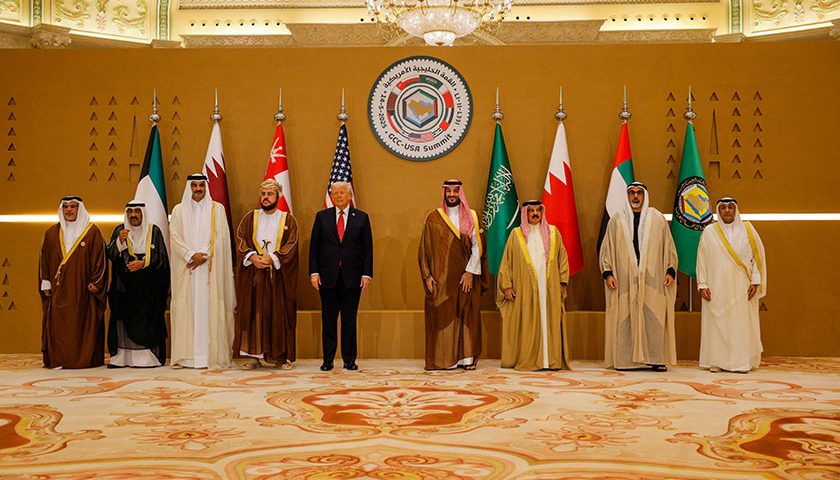
Photo: The 2025 GCC–U.S. Summit, Riyadh, 14 May 2025
Summary:
Donald Trump’s latest Middle East tour may appear anti-interventionist, but his real message is something more consequential: the U.S. is dropping the moral façade. His rejection of “lecturing” the region about democracy marks the beginning of a post-ideological empire—one that trades values for deals and replaces liberal rhetoric with raw transnationalism. But as Washington doubles down on alliances with authoritarians, it risks accelerating the multipolar backlash already reshaping global politics.
When Donald Trump returned to the Middle East stage, it was not as a diplomat or statesman. He arrived as a dealmaker—unapologetic, calculating, and brutally clear-eyed. His three-day tour of Riyadh, Doha, and Abu Dhabi was laden with more than a trillion dollars in investment pledges and a staggering $142 billion in arms deals, marking a turning point in America’s relationship with the region.
In Saudi Arabia, Trump secured a $600 billion economic partnership with Crown Prince Mohammed bin Salman, focusing on energy, defense, and infrastructure [1]. Qatar committed $10 billion to upgrade the Al Udeid Air Base and signed $42 billion in defense contracts, including a major deal for up to 210 Boeing widebody jets for Qatar Airways [2]. In the UAE, Trump announced a 10-year, $1.4 trillion investment framework aimed at bolstering U.S. sectors such as artificial intelligence, semiconductors, energy, and manufacturing [3]. This agreement followed high-level meetings between Trump and UAE officials, including Sheikh Tahnoon bin Zayed Al Nahyan.
Trump’s message was direct: The United States is no longer interested in lecturing anyone about democracy or human rights. “No more giving you lectures on how to live,” he said from the opulent halls of a Saudi investment forum — a line met with rapturous applause. For the monarchs, tycoons, and security elites in attendance, it was a rare moment of candor from the world’s most powerful empire. This was not the isolationism many feared. Nor was it the liberal internationalism that U.S. foreign policy once feigned. It was, instead, a blunt reconfiguration of empire. Less pretense, more overt coercion.
For decades, Washington cloaked its interventions in the rhetoric of democratization. From Iraq to Libya, the “freedom agenda” was deployed alongside drone strikes, sanctions, and regime change efforts. But what Trump offers is simpler and more dangerous: transactional hegemony. If previous administrations used ideals to justify power, Trump discards the façade entirely. What matters now is who can serve American interests best — and who can be armed, backed, and elevated to regional sheriff in exchange.
The logic is evident. Saudi Arabia’s role in the war on Yemen, its suppression of dissent, and the murder of journalist Jamal Khashoggi no longer raise objections in Washington. Instead, the kingdom is rewarded with advanced weapons systems, strategic backing, and lavish praise. “An incredible man,” Trump said of Crown Prince Mohammed bin Salman — words that stood in stark contrast to President Biden’s earlier attempts to marginalize him.
But it’s not just about Saudi Arabia. The same blueprint is being drawn across the region.
In February, India was granted quasi-regional policing status in South Asia — a clear signal to counterbalance China [4]. In Israel, the U.S. has already long supported Tel Aviv’s regional dominance. And in Syria, Trump lifted sanctions on a new leadership installed after Bashar al-Assad’s fall — a group once described by the U.S. itself as extremist militants [5]. One of them, now President Ahmed al-Shara, was formerly aligned with al-Qaeda. Trump’s public engagement with al-Shara and bin Salman was striking—not only for the symbolism, but for what it implied: U.S. strategic interests now appear to supersede traditional distinctions between moderates and hardliners.
This strategy mirrors Cold War logic, but with a modern twist. Where once alliances were framed around resisting socialism, today’s alignments are built to suppress resistance — of any kind. Whether it’s the Houthis in Yemen, Hezbollah in Lebanon, or popular movements in Iraq, any group opposing U.S. or Israeli influence is treated as a security threat to be neutralized, not a political force to be negotiated with. In this framework, regional sovereignty becomes a smokescreen. Trump’s praise for “letting nations chart their own destinies” rings hollow when his administration handpicks allies, floods the region with weapons, and legitimizes governments regardless of how they seize or maintain power [6]. His support for al-Shara’s Syria illustrates this perfectly: what matters is not legitimacy, but leverage.
The implications are stark. Across the Arab world, civil society has already been gutted. Protest movements in Sudan, Lebanon, and Iraq have been met with bullets and prison cells. In Palestine, the brutal war on Gaza continues with full U.S. backing, while in Yemen, American arms help fuel a forgotten humanitarian catastrophe. Trump’s pivot doesn’t reverse these dynamics — it entrenches them further.
But what truly sets this moment apart is not the brutality or even the hypocrisy — both have long been hallmarks of American foreign policy in the region. What is different now is the absence of pretense. Trump has stripped U.S. strategy of its moral vocabulary. No more talk of democracy, no appeals to human rights, no illusions of a “rules-based order.” Just power, deals, and dominance.
This ideological vacuum represents a stark break from the postwar consensus that once framed U.S. global leadership. In 1945, the United States built a world order on a blend of power and principle, however selectively applied. Institutions like NATO, CENTO, and SEATO were designed not just for military coordination but to project a vision of global security and stability — however unevenly it was practiced. Today, with those structures weakened and discredited, Trump offers nothing but raw strategic calculus. He is not pretending to promote democracy. He is not speaking about human rights. In fact, he is explicitly denying their relevance to U.S. foreign policy.
Ironically, this shift has been welcomed by some in the region, not because they admire Trump, but because his honesty exposes what many here have long suspected: America’s talk of freedom was always conditional, often hypocritical, and frequently deadly. As Saudi scholar Sultan Alamer noted, Trump’s speech echoed anti-imperialist critiques more commonly associated with thinkers like Frantz Fanon — stripped of substance but loaded with rhetorical effect.
Yet the broader geopolitical shift may be more profound.
While Trump was being celebrated in Riyadh, the rest of the world was not standing still. In Moscow, a recently concluded summit brought together leaders from China, Russia, Iran, Venezuela, Cuba, South Africa, and others — not only to commemorate the end of World War II but to present a coordinated vision for a multipolar global order [7]. Defense pacts, energy cooperation, and open criticism of U.S. regional proxies were all on the agenda. These are not isolated voices. Across Latin America, Africa, and Southeast Asia, the appetite for alternatives to Western primacy is growing.
This is not just ideology — it’s infrastructure. From Belt and Road to BRICS+, new trade routes, financial systems, and military partnerships are being forged in real time. These are not perfect or altruistic alternatives, but they are real — and for the first time since 1991, they present a plausible challenge to U.S. unipolarity.
The Middle East sits at the heart of this global shift. And yet, under Trump’s model, it is being re-colonized — not with bases and mandates, but with arms deals and strategic favoritism. Local strongmen are being weaponized to serve an American order that no longer even pretends to be global, just dominant.
At its core, Trump’s Middle East doctrine is not oriented toward peace, partnership, or even regional stability. Instead, it promotes a strategy of managed volatility—outsourced to local enforcers and justified solely by geopolitical and economic self-interest. This is a form of empire stripped of its normative veneers. And for a region long burdened by external interventions and authoritarian entrenchment, it marks not a new beginning, but a continuation of imperial logic under a more candid guise.
Notes:
- The White House. (2025, May 13). Fact sheet: President Donald J. Trump secures historic $600 billion investment commitment in Saudi Arabia. https://www.whitehouse.gov/fact-sheets/2025/05/fact-sheet-president-donald-j-trump-secures-historic-600-billion-investment-commitment-in-saudi-arabia/
- (2025, May 15). Qatar will invest $10 billion in Al Udeid Air Base, Trump says. https://www.reuters.com/world/qatar-will-invest-10-billion-al-udeid-air-base-trump-says-2025-05-15/
- Gulf Today. (2025, May 15). UAE plans to invest $1.4 trillion in US over 10 years, says Sheikh Mohamed Bin Zayed. https://www.gulftoday.ae/news/2025/05/15/uae-plans-to-invest-14-trillion-in-us-over-10-years-says-sheikh-mohamed-bin-zayed
- The White House. (2025, February 13). United States-India Joint Leaders’ Statement. https://www.whitehouse.gov/briefings-statements/2025/02/united-states-india-joint-leaders-statement/
- Ullah, A., & Li, X. (2025). Great power divergence: Military primacy versus economic engagement in the Israeli-Palestinian conflict: A theoretical reexamination of realist paradigms. Chinese Political Science Review. https://doi.org/10.1007/s41111-025-00287-1
- Nereim, V. (2025, May 14). Trump’s pledge to the Middle East: No more ‘lectures on how to live’. The New York Times. https://www.nytimes.com/2025/05/14/world/middleeast/trump-middle-east-nation-building.html
- Associated Press. (2025, May 7). Putin’s Victory Day guests at Red Square parade will include China’s Xi. AP News. https://apnews.com/article/russia-victory-red-square-parade-putin-xi-07a2654be42009c0d03efefc93e75a5f
Disclaimer. The views and opinions expressed in this analysis are those of the author and do not necessarily reflect the official policy or position of MEPEI. Any content provided by our author is of his opinion and is not intended to malign any religion, ethnic group, club, organization, company, individual, or anyone or anything.