Lebanon: Reforms and the Looming Elephant in the Room
May 17, 2025
Trump’s Middle East Doctrine and the End of U.S. Moral Authority
May 28, 2025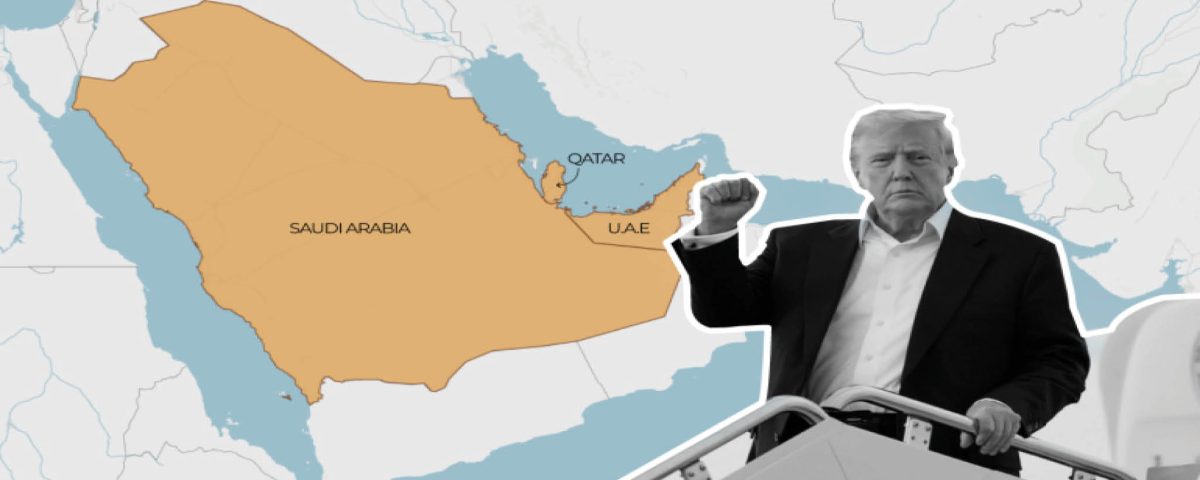
On May 16, President Trump returned to Washington, D.C., after completing his second international trip of his new term—a four-day tour across the Gulf countries. His itinerary included visits to Saudi Arabia, Qatar, and the United Arab Emirates, with a focus on deepening economic partnerships, expanding defense cooperation, and addressing regional security challenges.
Visit to Saudi Arabia
Trump began his trip in Riyadh, where he was received with an elaborate welcome by King Salman and Crown Prince Mohammed bin Salman. The official reception included traditional Saudi hospitality rituals, reflecting the longstanding diplomatic and cultural ties between the two nations. His visit underscored the shared goal of advancing economic collaboration and regional stability.
During his stay, Trump attended the Saudi-U.S. Investment Forum, held at the King Abdulaziz International Conference Center. This high-profile gathering brought together senior leaders from government, business, finance, and innovation sectors. Participants included prominent American CEOs—Elon Musk of Tesla, Sam Altman of OpenAI, and Andy Jassy of Amazon—underscoring the forum’s emphasis on the private sector’s role in driving growth and innovation.
A major outcome of the Forum was the announcement of a $600 billion investment commitment from Saudi Arabia to the United States. This significant pledge aims to strengthen economic ties and foster cooperation in various industries, including technology, energy, and advanced manufacturing. Discussions at the Forum also explored new avenues for collaboration in artificial intelligence and digital transformation, areas of growing importance for both economies.
Beyond the economic discussions, Trump held bilateral meetings with King Salman and Crown Prince Mohammed bin Salman to address issues of defense and regional security. The meetings reaffirmed the U.S.-Saudi partnership in countering terrorism and managing regional challenges, particularly concerning Iran. Trump and the Saudi leadership reiterated their shared commitment to containing Iranian-backed proxy groups operating in Yemen, Iraq, Lebanon, and Syria.
A notable milestone of Trump’s visit was his meeting with Syrian President Ahmed al-Sharaa—the first meeting between a sitting U.S. president and a Syrian head of state since 2000. This unprecedented encounter signaled potential new channels of dialogue for addressing the ongoing crisis in Syria and broader Middle Eastern stability.
Regional security discussions in Saudi Arabia also centered on the ongoing conflict in Yemen. Trump pledged U.S. support for Saudi-led coalition efforts to stabilize Yemen and reduce the insurgency by the Houthi movement. The U.S. and Saudi Arabia agreed on the need to improve humanitarian access and reduce civilian casualties, marking a shift in tone that contrasted with previous controversies surrounding American policy in Yemen.
In addition to diplomatic and defense talks, Trump and King Salman expanded intelligence-sharing agreements between their two countries, strengthening efforts to combat terrorism and extremist networks such as ISIS and al-Qaeda in the Arabian Peninsula (AQAP).
Trump also emphasized the importance of broader regional peace initiatives, expressing his intention to continue engaging with Israel and Palestinian leadership to support lasting stability.
The day in Riyadh concluded with a state dinner at Al-Turaif, a UNESCO World Heritage site that stands as a symbol of Saudi Arabia’s rich cultural heritage. This ceremonial event underscored the deep-rooted historical ties and evolving partnership between the two countries.
Visit to Qatar
Following his engagements in Saudi Arabia, Trump traveled to Qatar, where he was welcomed by Emir Tamim bin Hamad Al Thani. Their discussions focused on economic cooperation, defense initiatives, and strategic regional concerns.
A major highlight of Trump’s visit to Qatar was the announcement of an expansive $1.2 trillion economic exchange agreement between the two nations. Central to this agreement was a landmark order by Qatar Airways for 210 Boeing aircraft, valued at $96 billion, marking one of the largest purchases in the airline industry’s history. This deal is expected to support significant job growth in the U.S. aerospace sector and strengthen American manufacturing capabilities.
In addition to the aircraft deal, Trump and Emir Tamim finalized $243.5 billion in commercial and defense agreements. These agreements covered key areas such as counter-drone technology and unmanned aerial vehicle capabilities, reflecting the shared commitment to addressing emerging security threats and advancing technological cooperation.
One of the most notable—and controversial—gestures during the trip was the gift of a luxury Boeing 747-8 jet from the Qatari government to the United States. Intended for future use as Air Force One, this gift raised concerns in Washington about potential conflicts of interest and adherence to the U.S. Constitution’s emoluments clause. Critics argued that accepting such a high-value gift could blur the lines between diplomatic protocol and personal or political benefit.
Beyond the economic and defense-focused meetings, Trump and Emir Tamim also participated in a ceremonial event marking the transition of FIFA World Cup hosting duties from Qatar (2022) to the United States (2026). This symbolic moment underscored the growing cultural and sporting ties between the two nations, and highlighted the Gulf’s central role in global events and diplomacy.
Visit to the United Arab Emirates
Trump’s final stop on his Gulf tour was in the United Arab Emirates, where he was welcomed with a grand official ceremony hosted by UAE President Sheikh Mohamed bin Zayed Al Nahyan. The ceremonial reception featured a 21-gun salute and the Al-Ayyala dance, a traditional performance that symbolizes unity and strength in Emirati culture.
During his visit, the U.S. and UAE announced $200 billion in new commercial agreements. These covered strategic sectors such as artificial intelligence, energy, and defense, and reflected the UAE’s ambition to position itself as a regional technology hub. One of the key outcomes was the agreement to establish a pathway for the UAE to acquire advanced AI semiconductors from American companies, supporting the UAE’s efforts to build cutting-edge digital and technological infrastructure.
Trump also announced plans for a new Disney theme park in Abu Dhabi, to be developed in collaboration with Disney CEO Bob Iger and local partners. The project aims to blend Disney’s global entertainment appeal with Emirati cultural themes, illustrating the soft power dimension of U.S.-UAE relations.
Cultural diplomacy was an important theme throughout Trump’s stay in the UAE. He visited the Sheikh Zayed Grand Mosque, one of the world’s largest and most iconic mosques, accompanied by Crown Prince Sheikh Khaled bin Mohamed bin Zayed Al Nahyan. This visit underscored the importance of cultural exchange and interfaith dialogue in promoting mutual respect and understanding between the U.S. and the Gulf region.
Conclusion: Broader Implications and Future Outlook
President Trump’s Gulf tour underscored a strategic effort to bolster economic partnerships, expand defense cooperation, and engage in cultural diplomacy with key Gulf countries. From landmark investment commitments to renewed dialogue on regional security, the trip’s outcomes highlight the growing interdependence between the United States and the Persian Gulf region. While the agreements and promises made during this visit mark significant milestones, their true influence on the region’s future will only become clear in the months and years to come.
Disclaimer. The views and opinions expressed in this analysis are those of the author and do not necessarily reflect the official policy or position of MEPEI. Any content provided by our author is of her opinion and is not intended to malign any religion, ethnic group, club, organization, company, individual, or anyone or anything.
Ms. Naz ATABAS
Ms. Naz ATABAS is a student at the George Washington University in International Affairs and Finance. Currently, she is an intern at MEPEI.