
Syria and China: Seven Decades of Political Accumulation and the Transformation of Geography into a Strategic Opportunity
August 5, 2026
The Mecca Agreement and the Reshaping of Regional Security: Is a New Security Order Emerging in the Middle East?
August 9, 2026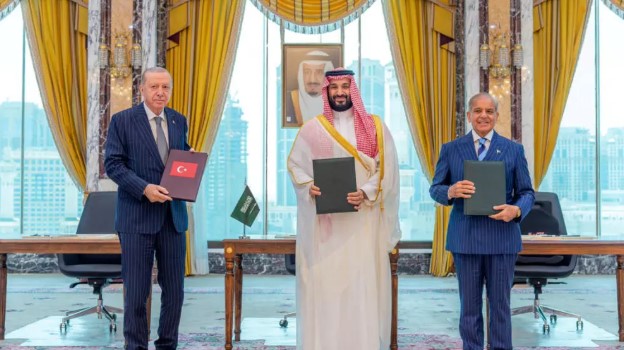
Photo: Turkish President Tayyip Erdogan, Saudi Crown Prince Mohammed bin Salman and Pakistan’s Prime Minister Shehbaz Sharif pose after signing a joint defence agreement in Mecca, Saudi Arabia, on August 7, 2026. © Saudi Press Agency
Introduction
War has a way of accelerating decisions that diplomats spend years deferring. That is the most useful lens for understanding why Saudi Arabia, Türkiye, and Pakistan chose August 7, 2026, to sign the Mecca Joint Defense Agreement (MJDA), a pact declaring that an attack on any one signatory will be treated as an attack on all three (Al Jazeera 2026; CBS News 2026). Crown Prince Mohammed bin Salman, President Recep Tayyip Erdogan, and Prime Minister Shehbaz Sharif signed the agreement in Mecca at what the three governments called the Makkah Al-Mukarramah Summit for Joint Defence (Breaking Defense 2026). The timing was not incidental. Eighteen months into a war pitting the United States and Israel against Iran, Saudi Arabia has absorbed repeated missile and drone strikes, and confidence in Washington’s willingness to backstop Gulf security in real time has visibly eroded (Al Jazeera 2026; Times of Israel 2026). What follows examines where this pact came from, what it actually commits its signatories to, why now, and what it changes.
From Bilateral Ties to a Trilateral Framework
The MJDA did not emerge from nothing. Riyadh and Islamabad had already built a bilateral floor for it through the Strategic Mutual Defence Agreement, signed at Al-Yamamah Palace in September 2025, which committed both states to collective defense and formalized a military relationship, Pakistani training of Saudi forces, chiefly, that predates the treaty by decades (Wikipedia 2026). Türkiye’s addition draws on a separate track: Ankara and Islamabad had spent years exchanging warships and training pilots, and in 2023 Saudi Arabia placed what Turkish officials at the time called their largest-ever defense export order, for Turkish-made drones (Al Jazeera 2026). Mecca, in other words, did not invent a new alliance so much as merge two bilateral relationships that were already converging. That matters for how durable the pact is likely to prove: agreements built on top of existing operational cooperation tend to survive changes of government better than treaties negotiated cold.
The Egypt Question
The most conspicuous name missing from the Mecca signature line is Egypt, and the omission was not for lack of trying. Cairo sat alongside Saudi Arabia, Türkiye, and Pakistan in a round of foreign-ministry talks on the sidelines of the March 2026 Riyadh Summit of Arab and Islamic nations, where Ankara reportedly pushed for a quadrilateral rather than trilateral arrangement (Wikipedia 2026). That track stalled, and by the time the treaty was signed in August, Egypt had dropped out of the frame entirely (Foreign Policy 2026; Alhurra 2026). No party has said why in any detail. A Turkish official, asked about the pact’s scope, described it as open to other “brotherly nations” without naming Egypt specifically, and analysts quoted by Alhurra were careful to frame Cairo’s absence as incomplete rather than deliberate exclusion, a separate track that simply outran a slower one, not a veto (Alhurra 2026). That framing is plausible but only partial. Egypt’s calculus differs from the other three in ways that go beyond timing. Cairo has its own tangled relationship with Ankara, only recently normalized after a decade of rupture over the Muslim Brotherhood and Libya; it maintains a security relationship with Israel built around the Camp David framework that a Sunni bloc explicitly shadowboxing with Iran would complicate; and its military, unlike Türkiye’s or Pakistan’s, is oriented primarily around Sinai, the Suez Canal, and its own southern border rather than expeditionary deployment to the Gulf. A treaty this loosely worded costs little to sign, which makes Cairo’s hesitation notable rather than incidental. The more plausible reading is that Egypt is waiting to see what the pact actually requires of its members in practice before attaching its name to a commitment whose obligations remain undefined on paper.
What the Text Actually Says, and Doesn’t
The joint statement issued by the Saudi Press Agency and Pakistan’s Foreign Ministry describes the agreement’s purpose as strengthening collective deterrence, with any armed attack on one signatory to be regarded as an attack on all three, alongside a general commitment to deepen defense cooperation (Breaking Defense 2026; Al Jazeera 2026). Commentators moved quickly to the NATO comparison, pointing to the resemblance between this clause and Article 5 of the North Atlantic Treaty (New Arab 2026; CNN 2026). The comparison is worth resisting. NATO’s Article 5 sits inside seventy-five years of integrated command structures, standing forces, and codified planning; the MJDA specifies no such machinery, and nothing in its public text obliges any signatory to take a particular military action if another is attacked (New Arab 2026). Analysts at the Australian National University’s Strategic and Defence Studies Centre have made the same point, describing the pact as a cooperation framework rather than an alliance in the NATO sense (Wikipedia 2026; Times of Israel 2026). This vagueness is not a drafting oversight, it is the point. A precisely worded mutual-defense clause would force each government to commit troops or matériel to conflicts not of its choosing; an imprecise one lets all three-claim solidarity while retaining the option to do very little.
The nuclear question sharpens this. Pakistan holds the only nuclear arsenal in the Muslim-majority world, estimated at roughly 170 warheads, and its inclusion in the pact inevitably raises the question of extended deterrence for Saudi Arabia (GlobalSecurity 2026). Nothing in the agreement says so explicitly. Islamabad has long maintained that its weapons are aimed at a different adversary entirely and are not part of its Gulf commitments, and a senior Saudi official, pressed on whether the kingdom could now count on nuclear cover, would go no further than calling the agreement “comprehensive” and covering “all military means” (Reuters 2026; New Arab 2026). That is not a denial. It is also not a confirmation. Riyadh appears content to let the ambiguity itself do deterrent work against Iran, without ever having to test whether Islamabad would honor it.
Why Now: The Iran War as Catalyst
The proximate cause is the war that began on February 28, 2026, when the United States and Israel struck Iran. Saudi Arabia has since taken fire from Iranian forces directly and from Tehran’s regional partners, the Houthis in Yemen, allied militias in Iraq, while watching its oil exports and development plans absorb the cost (Al Jazeera 2026; GlobalSecurity 2026). Reporting indicates that the United States has been unable to keep every partner supplied with sufficient air-defense munitions while Israel’s own needs compete for the same stockpiles, and Iran’s periodic closure of the Strait of Hormuz has added a second layer of economic damage across the region (Al Jazeera 2026). None of this has broken the US-Saudi relationship. It has, however, made Riyadh unwilling to treat that relationship as sufficient on its own.
That distinction is worth dwelling on, because it is where much of the commentary gets the pact wrong. Yasmine Farouk of the International Crisis Group has noted that all three signatories remain American partners and understand that no regional arrangement can substitute for Washington outright (Al Jazeera 2026); Kristian Coates Ulrichsen has made a similar point, framing the pact as adding options rather than replacing an existing guarantee (Al Jazeera 2026). Sina Toossi goes further, calling it one of the first clear signs that the war is reshaping the regional order itself (Al Jazeera 2026). All three observations can be true at once: this is hedging, not defection. Saudi Arabia is not choosing Ankara and Islamabad over Washington; it is declining to have only one option.
Türkiye’s calculus differs somewhat. Erdogan already extends security relationships to Qatar, Syria, and Libya, and Mecca folds Saudi Arabia’s financial weight into what several Atlantic Council analysts now describe as a broader Muslim-world defense network centered on Ankara (Atlantic Council 2026). For Erdogan, the pact is less about diversifying away from any single patron and more about consolidating a role Türkiye has been building for years.
The Capabilities Behind the Clause
Set the legal ambiguity aside for a moment and look at what each state actually brings to the table, because that is where the pact’s real weight lies. Saudi Arabia supplies money and a well-equipped air force. Türkiye supplies NATO’s second-largest army and a defense-industrial base already exporting drones and air-defense systems into the kingdom. Pakistan supplies manpower with genuine combat experience and, unstated but unmistakable, its nuclear status (CBS News 2026; Al Jazeera 2026). Mansoor Ahmed has summarized this as Pakistan and Türkiye providing defense-industrial and personnel depth against Saudi capital (Times of Israel 2026), and the arrangement is already operational rather than theoretical: Pakistan has reportedly deployed some eight thousand troops, along with fighter aircraft, drones, and an air-defense system, into the kingdom, and is separately negotiating a security-for-investment arrangement with Kuwait that suggests this model could extend well beyond the three original signatories (Express Tribune 2026).
How the Region Is Reading It
Tehran’s response was quick and unimpressed. A member of the Iranian parliament’s national security committee dismissed the pact publicly, arguing that a paper agreement with Türkiye and Pakistan would do no more for Saudi security than decades of dependence on Washington had (CNN 2026). Israel offered no official comment, though the pact’s implications for Israeli military freedom of action are being taken seriously in Israeli commentary that had, even before Mecca, described a Turkish-Pakistani axis as a potential hostile bloc (New Arab 2026). India’s foreign ministry gave the blandest possible response, that it was “closely following” the development, which, given India’s historical sensitivity to anything touching Pakistan’s nuclear posture, is itself a data point (Express Tribune 2026). Washington, for its part, had said nothing official in the days immediately following the signing (Al Jazeera 2026).
Assessment
Four conclusions follow from the above, and none of them is the headline most coverage has reached for. First, this is not a NATO analogue, and treating it as one overstates both its binding force and its novelty; it is closer to a formalized political signal than a military alliance with teeth. Second, the pact’s actual value to Riyadh may lie less in any specific defense guarantee than in the ambiguity itself, an unspecified nuclear-adjacent commitment can deter without ever being invoked, whereas a specific one would have to be tested. Third, the durability of the arrangement is not really a function of the treaty text at all; it depends on how the Iran war ends and on whether the United States responds to this hedge by tightening its own commitments to the Gulf or by treating the pact as evidence that it can afford to step back. Fourth, Egypt’s absence is itself a measure of how thin the pact’s institutional commitments really are: a state with every stated interest in Gulf and Red Sea security, and a seat at the earlier quadrilateral talks, chose not to sign a document whose obligations cost so little on paper that Riyadh, Ankara, and Islamabad could commit to it within months. Cairo’s hesitation suggests it is pricing in a future in which the clause is tested and the vagueness stops being an asset, a risk calculation the three signatories have, for now, decided not to make. The MJDA answers a question about intent, these three states want more options, without yet answering the harder question of what any of them, Egypt included, would actually do if the clause were tested.
References
Alhurra. 2026. “Egypt Left Out of Mecca Defense Pact Despite Role in Four-Nation Talks.” August 8.
Al Jazeera. 2026. “Turkiye, Saudi Arabia, Pakistan Sign Joint Defence Agreement: What’s in It?” August 7.
Al Jazeera. 2026. “Saudi Arabia, Pakistan and Turkiye Sign Defence Deal amid Regional Turmoil.” August 7.
Al Jazeera. 2026. “What Could the Mecca Defence Pact Mean for the US Role in the Middle East?” August 8.
Atlantic Council. 2026. “Why Saudi Arabia, Pakistan, and Türkiye Just Signed a Defense Pact.” August 7.
Breaking Defense. 2026. “Saudi Arabia, Türkiye, Pakistan Ink ‘Joint Defense’ Agreement.” August 7.
CBS News. 2026. “Saudi Arabia, Türkiye and Pakistan Sign Key Defense Agreement.” August 7.
CNN. 2026. “Saudi Arabia Turns to Muslim Military Heavyweights in Landmark Defense Pact as Iran War Closes In.” August 7.
Express Tribune. 2026. “Inside the Makkah Defence Pact and Its Regional Implications.” August 8.
Foreign Policy. 2026. “Pakistan, Saudi Arabia, Türkiye Sign a Mutual Defense Pact.” August 7.
GlobalSecurity.org. 2026. “Makkah Joint Defence Agreement.” August 7.
New Arab, The. 2026. “Mecca Defence Pact: A New ‘Sunni NATO’ in the Middle East?” August 7.
Reuters. 2026. “Analysis: Saudi Pact Puts Pakistan’s Nuclear Umbrella into Middle East Security Picture.”
Times of Israel, The. 2026. “Saudi Arabia, Türkiye and Pakistan Sign Joint Defense Deal in Shadow of Iran War.” August 7.
Wikipedia. 2026. “Mecca Joint Defence Agreement” and “Strategic Mutual Defence Agreement.”
Disclaimer. The views and opinions expressed in this op-ed are those of the author and do not necessarily reflect the official policy or position of MEPEI. Any content provided by our author is of her opinion and is not intended to malign any religion, ethnic group, club, organization, company, individual, or anyone or anything.

Mr. Ahmad MOHEE
Mr. Ahmad MOHEE is a junior researcher at MEPEI. He holds an MA in Arab Studies (Political Science) from the Institute of Arab Research and Studies at the Arab League in Cairo. His MA thesis, The Impact of the Israeli-Iranian Cyberwar on Arab Regional Security, examined how cyber conflict dynamics reshape deterrence calculations and alliance structures in the Middle East through a Regional Security Complex (RSC) lens. His research focuses on the intersection between technology and classical political theory in conflict studies, with particular emphasis on cyber warfare, deterrence, and defensive strategies, and their impact on regional and international order.