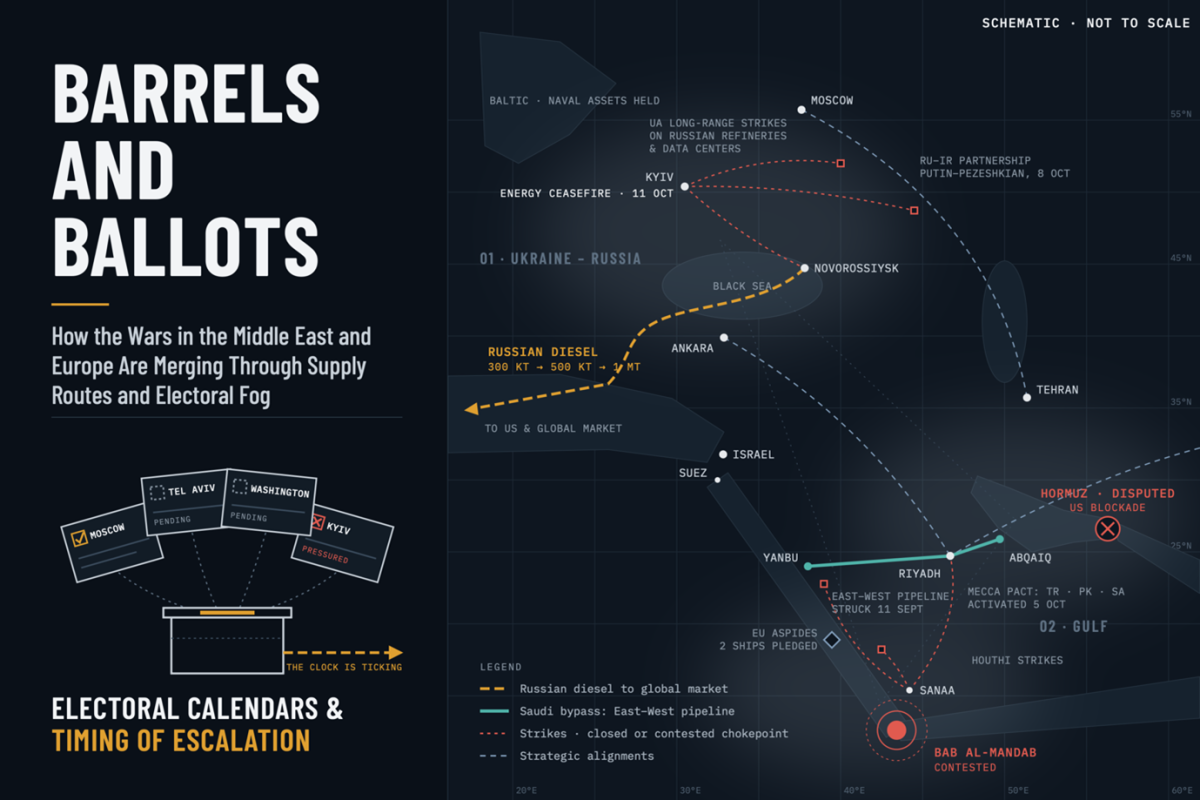

Barrels and Ballots: How the Wars in the Middle East and Europe Are Merging Through Supply Routes and Electoral Fog
October 15, 2026Egypt’s Strategic Intervention in Defense of Saudi Arabia: Deterrence, Red Sea Security, and the Limits of Escalation
Saudi Arabia, Egypt, Yemen, Red Sea security, Egyptian–Saudi strategic nexus
Analytical judgment
Egypt’s October 2026 decision to authorize defensive military support for Saudi Arabia should be understood as an exercise in calibrated deterrence and regime-security preservation, rather than as a return to open-ended ground intervention in Yemen. Following a wave of Houthi missile and drone strikes against Saudi airports and cities – including an October 10 strike in Riyadh that killed an Egyptian national and a subsequent missile launch toward Madinah – President Abdel Fattah el-Sisi convened the National Defense Council and sought parliamentary authorization under Article 152 of the Egyptian Constitution. This move gives Cairo and Riyadh greater capacity to reinforce air defense, secure Red Sea maritime approaches, and signal collective Arab resolve. Yet the strategic effect depends on whether Egypt restricts its posture to defensive shielding and maritime security, whether Houthi forces escalate against Red Sea shipping or Egyptian interests, and whether Cairo can preserve diplomatic off-ramps alongside military readiness.
Executive Summary
The intensification of Houthi cross-border strikes against Saudi Arabia in October 2026 has transformed the Red Sea crisis from a contest over maritime chokepoints into a direct test of regional defense commitments. After capturing Mokha, Dhubab, and positions around Mayyun/Perim along the Bab al-Mandab corridor in September 2026, the Iran-aligned Houthi movement expanded its campaign of aerial bombardment against Saudi infrastructure. According to regional reporting, attacks on Saudi airports have killed 19 people and wounded 364, with the deadliest strike on King Khalid International Airport in Riyadh on October 10 claiming 13 lives, including an Egyptian flight attendant, followed by an intercepted ballistic missile aimed toward Madinah on October 15 [1][2].
The central analytical question is whether Egypt’s pledge of “all necessary and possible forms of support” signals an imminent large-scale military intervention in the Yemen theatre [3]. The evidence supports a more disciplined proposition. Cairo’s interests are served by bolstering Saudi air and maritime defense, deterring further strikes on Saudi territory and Islamic holy sites, and preventing an Iran-aligned non-state actor from establishing permanent coercive leverage over the southern gateway to the Suez Canal. At the same time, Egyptian statements have carefully bounded the mission: President el-Sisi emphasized on October 17 that Egypt does not seek to attack anyone and will act solely in a defensive capacity upon an explicit request from Riyadh [4][5].
The significance of Cairo’s posture increases because it unfolds alongside a shifting regional security architecture. On August 7, 2026, Saudi Arabia, Türkiye, and Pakistan signed the Makkah Joint Defense Agreement, establishing a mutual defense clause modeled on collective security principles [6]. While Egypt has coordinated closely with Riyadh, it has remained formally outside that trilateral pact, choosing instead to anchor its commitment in bilateral coordination and its own constitutional processes.
Egypt is therefore operating at the intersection of military deterrence and diplomatic risk management. Building on the September 15 Cairo summit between President el-Sisi and Crown Prince Mohammed bin Salman, Cairo’s intervention links the defense of Saudi territorial integrity with the protection of Red Sea navigation [7]. Cairo cannot by itself terminate the Houthi insurgency, but its constitutional mobilization raises the strategic threshold for further attacks on the Kingdom while preserving Egypt’s status as an indispensable pillar of Arab and Red Sea security [8][9].
1. The Strategic Question: Defensive Shield or Regional Entanglement?
Framing Egypt’s mobilization as a binary choice between symbolic solidarity and full-scale war in Yemen obscures the operational logic of Cairo’s decision. Historically, Egyptian strategic planners have viewed expeditionary ground campaigns in Yemen with deep caution, informed both by the costly 1962–1967 intervention and by the calibrated nature of Egypt’s naval and aerial participation in the 2015 Saudi-led coalition [5]. Yet strategic restraint does not equate to passivity when core national security interests are threatened.
For Cairo, the stability of Saudi Arabia and the security of the Red Sea corridor are structural requirements rather than discretionary foreign policy preferences. When Houthi forces combine control over Yemen’s western coastline and the Bab al-Mandab approaches with sustained ballistic missile and drone strikes against Saudi airports, energy infrastructure, and holy sites, the resulting instability directly impacts Egypt’s economic lifeline through the Suez Canal and threatens the broader Gulf financial ecosystem in which Egypt is embedded [3].
The more defensible interpretation of Cairo’s October 2026 posture is therefore one of conditional defensive deterrence. By activating constitutional mechanisms to authorize force deployment, Egypt reinforces Saudi deterrence, shares the burden of territorial and maritime defense, and signals to Sanaa and Tehran that escalating pressure on Riyadh will draw in the Arab world’s largest military – without committing Egyptian ground forces to an open-ended counter-insurgency inside Yemen’s interior highlands.
2. What Has Changed on the Ground?
The trajectory from the September 2026 Bab al-Mandab crisis to the October 2026 defense mobilization reflects a sharp escalation in Houthi operational tempo. Following the breakdown of the four-year UN-brokered truce in July 2026, Houthi forces shifted their offensive toward Yemen’s Red Sea coast, seizing Mokha, Dhubab, the Hanish Islands, and Mayyun/Perim Island by mid-September [7]. While the Yemeni Presidential Leadership Council (PLC) claimed on October 5 to have recaptured parts of the Mokha corridor – a claim denied by the Houthis – the movement simultaneously intensified long-range strikes against the Saudi interior.
Three developments in mid-October altered Cairo’s calculus:
- Civilian and Egyptian casualties at Saudi airports: Repeated Houthi strikes on Saudi aviation infrastructure killed 19 people and injured 364. On October 10, a strike on Riyadh’s airport killed 13 people, including an Egyptian flight attendant, creating a direct domestic and political imperative for Cairo [1].
- Targeting of Madinah: On October 15, the Saudi-led coalition intercepted a ballistic missile launched toward Madinah. Although the Houthis denied firing the projectile, the incident triggered widespread condemnation across the Islamic world and a UN Security Council statement affirming Saudi Arabia’s right to self-defense [1][8].
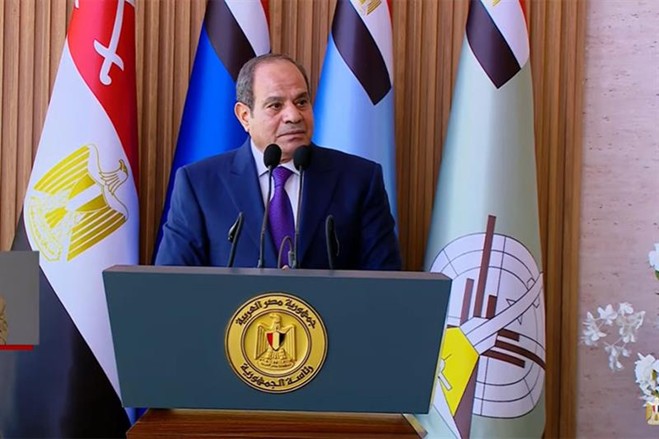
- Formal Egyptian institutional mobilization: On October 17, speaking at the Egyptian Military Academy, President el-Sisi declared that it was “inconceivable that we would allow Saudi Arabia, its security or stability to be harmed” and called for an emergency parliamentary session. On October 18, Egypt’s National Defense Council formally pledged “all necessary and possible forms of support” to defend Saudi territory, resources, and Islamic holy sites, while the House of Representatives convened closed-door sessions extending from October 18 into October 20 to debate combat authorization under Article 152 of the Constitution [10][4].
The mobilization prompted an immediate counter-warning from Sanaa. On October 17, Yahya al-Raei, speaker of the unrecognized Houthi-controlled parliament in Sanaa, sent a formal letter to the speaker of Egypt’s House of Representatives warning that Egyptian military involvement would threaten Egypt’s own national security and stability [1][4].
3. Why Saudi Arabia’s Defense Matters to Egypt
For Egypt, stepping in to defend Saudi Arabia is rooted in converging material, geographic, and strategic imperatives rather than purely diplomatic solidarity.
First, Red Sea maritime security is indivisible. As established during the September 15 Cairo meeting between President el-Sisi and Crown Prince Mohammed bin Salman, Bab al-Mandab and the Suez Canal form a single commercial artery [11][7]. With the Strait of Hormuz constrained amid the broader 2026 Iranian maritime crisis, Saudi seaborne crude exports through the Red Sea increased eightfold between March and July 2026. Houthi efforts to enforce a selective blockade on Saudi shipping at Bab al-Mandab – which pushed global oil prices above $100 per barrel – directly depress Suez Canal transit revenues, a critical source of foreign currency for Egypt’s economy [3].
Second, Egyptian and Saudi economic stability are deeply intertwined. Since 2013, Saudi Arabia and its Gulf partners have provided tens of billions of dollars in central bank deposits, energy support, and direct investments to underpin Egyptian macroeconomic stability [5]. Furthermore, Saudi Arabia hosts a vast Egyptian expatriate workforce whose remittances remain vital to Egyptian households and whose physical safety was underscored by the death of an Egyptian national in the October 10 Riyadh airport strike [1].
Third, defending the Two Holy Mosques carries profound domestic and regional legitimacy. By explicitly citing the defense of Islamic holy sites following the intercepted missile targeting Madinah, the Egyptian Presidency framed potential military deployment around a consensus obligation that commands broad domestic and parliamentary backing [3].
4. The Operational Scope – and Limits – of Egyptian Support
A rigorous assessment must distinguish between the legal authorization of force and the operational form that deployment is likely to take. While pro-government Egyptian parliamentarians noted that the National Defense Council approved sending forces on a “defensive mission,” President el-Sisi’s public remarks drew a firm boundary: “We do not want to fight or attack anyone. We will only defend Saudi Arabia” [1][10].
Operationally, a defensive mandate points toward four primary missions rather than an amphibious or ground offensive into Houthi-held highlands:
- Layered Air and Missile Defense Augmentation: Deploying Egyptian air defense units, radar networks, and early-warning assets along the Red Sea littoral and key Saudi nodes to reduce the strain on Saudi air defense batteries caused by high-frequency Houthi drone and missile salvos.
- Red Sea Naval Presence and Escort Operations: Expanding the footprint of the Egyptian Navy’s Southern Fleet around Bab al-Mandab, the Hanish Islands, and Saudi Red Sea terminals to protect commercial tankers, deter Houthi maritime interdiction, and secure freedom of navigation [7].
- Rear-Area and Critical Infrastructure Protection: Stationing rapid-deployment or defensive ground units inside Saudi territory to secure border sectors, airports, or holy sites if formally requested by Riyadh, freeing Saudi coalition forces for counter-offensive operations.
- Intelligence, Surveillance, and Reconnaissance (ISR) Integration: Establishing joint command-and-control mechanisms to track coastal Houthi launch sites in western Yemen, where Houthi forces are significantly more exposed than in the northern mountains [7].
This posture mirrors the precedent of July 2020, when Egypt’s House of Representatives invoked Article 152 to authorize external combat missions in neighboring Libya along the Sirte–Jufra red line [1]. In that case, constitutional authorization served primarily as a coercive deterrent that stabilized the front without requiring a protracted ground war.
5. Constitutional Signaling and Deterrence Dynamics
The procedural path chosen by Cairo – convening the National Defense Council on October 18 followed by multi-day parliamentary deliberations extending through October 20 – carries deliberate signaling value [4]. Under Article 152 of the Egyptian Constitution, deploying the armed forces on combat missions outside the country’s borders requires consultation with the National Defense Council and the approval of a two-thirds majority of the House of Representatives [10].
By making this process public and extending parliamentary debate so that lawmakers openly register support, Cairo achieves three strategic effects:
- Credible Commitment: Fulfilling constitutional requirements removes legal hurdles in advance, allowing rapid deployment the moment Riyadh submits a formal request.
- Escalation Control and Pacing: Conditioning deployment strictly on guidance and an official request from Saudi King Salman and Crown Prince Mohammed bin Salman ensures that Cairo retains control over the timing and scope of intervention [3].
- Diplomatic Leverage: As noted in the National Defense Council’s October 18 statement, which paired its pledge of military support with a call for intensified diplomacy to calm the region, military readiness strengthens Cairo’s hand in parallel de-escalation channels [1].
6. The Regional Alliance Context: Cairo and the Makkah Pact
Egypt’s intervention also clarifies its position within the evolving Middle Eastern security architecture. On August 7, 2026, Saudi Arabia, Türkiye, and Pakistan signed the Makkah Joint Defense Agreement, which includes a collective defense provision treating an attack on one signatory as an attack on all [1][6]. Although Ankara expressed expectations that Egypt might eventually join the pact, Cairo has thus far stopped short of formal accession [10][6].
Stepping forward bilaterally to defend Saudi Arabia allows Egypt to demonstrate that Arab collective security – and the Cairo–Riyadh axis specifically – remains the foundational bedrock of Gulf and Red Sea defense. Rather than subordinating Egyptian decision-making to a broader non-Arab trilateral treaty structure involving Türkiye and Pakistan, Cairo preserves its strategic autonomy while proving itself an indispensable security partner to Riyadh at a moment of acute pressure.
7. Houthi Overreach and the Limits of Iranian Leverage
In September 2026, the Houthi advance to Bab al-Mandab gave Iran and its Yemeni partner significant indirect leverage at a time when Tehran and Riyadh were locked in a parallel dispute over navigation mechanisms in the Strait of Hormuz [7]. However, the October escalation illustrates how tactical aggression can produce strategic overreach.
By repeatedly striking civilian airports in Riyadh and launching a missile toward Madinah, the Houthis crossed political and normative thresholds that shifted the regional balance against them:
- Consolidating Counter-Coalitions: Far from isolating Saudi Arabia or forcing unilateral concessions, the strikes catalyzed UN Security Council condemnation, mobilized the Makkah Pact signatories, and brought Egypt directly to the threshold of military intervention [1].
- Compounding Coastal Exposure: As analyzed during the September advance, holding fixed positions along Yemen’s western coast (Mokha, Dhubab, Perim) exposes Houthi supply lines and launch platforms to air and naval interdiction [7]. Adding Egyptian naval and aerial capabilities to the theatre increases the vulnerability of those coastal holdings.
- Complicating Iranian Diplomacy: While Tehran benefits when Houthi pressure raises Saudi security costs, an escalation that draws Egypt into active defense of the Kingdom – and prompts Gulf states to press Russia and international powers for a broader security framework – reduces Iran’s ability to use Yemen as a low-cost lever [1].
8. Risks and Vulnerabilities for Cairo
Despite the clear strategic rationale, Egypt’s posture carries distinct operational and political risks that explain Cairo’s insistence on a strictly defensive mandate:
- Retaliatory Threats to Red Sea Shipping: Yahya al-Raei’s letter to the Egyptian Parliament explicitly signaled that Sanaa could widen its maritime targeting beyond Saudi-linked vessels to include shipping directly tied to Egypt or Suez transit if Egyptian forces engage [4].
- Mission Creep: Differentiating between “defensive” protection of Saudi airspace and “offensive” suppression of Houthi missile launchers inside Yemen is operationally complex. Sustained defense against missile salvos often requires counter-battery or pre-emptive strikes against launch platforms on Yemeni soil.
- Diplomatic Friction with Tehran: Over recent years, Egypt has practiced a form of calibrated diplomatic risk management with Iran – maintaining functional channels to prevent accidental regional war [12]. Direct military clashes between Egyptian forces and Iran-aligned Houthi units would test the outer limits of that negative coordination.
9. Regional Security Implications
| Implication | Analytical significance |
| Activation of Arab collective deterrence | Egypt’s invocation of Article 152 demonstrates that escalating Houthi strikes on Saudi cities and holy sites trigger tangible military burden-sharing between Cairo and Riyadh, raising the cost of continued bombardment. |
| Chokepoint interdependence | With Hormuz constrained and Saudi Red Sea oil exports surging eightfold in 2026, defending Saudi territory and securing Bab al-Mandab are inseparable from protecting Egypt’s Suez Canal revenues [3][7]. |
| Alliance geometry and the Makkah Pact | Cairo’s bilateral constitutional commitment complements the August 2026 Saudi–Turkish–Pakistani Makkah Joint Defense Agreement while preserving Egypt’s autonomous leadership role in Arab security [6]. |
| Tactical overextension of the Houthis | Houthi strikes on Riyadh’s airport and toward Madinah have united regional and international actors against Sanaa at the exact moment Houthi forces must defend exposed coastal positions along the Red Sea [1]. |
| Deterrence-diplomacy balance | By conditioning deployment on a formal Saudi request and pairing National Defense Council authorization with calls for de-escalation, Egypt seeks to compel a return to negotiations from a position of reinforced strength [4]. |
10. Policy Considerations
For Egypt
- Maintain strict operational boundaries: Anchor any deployment under Article 152 to air and missile defense integration, Red Sea naval escort, intelligence sharing, and protection of Saudi territory and holy sites, avoiding ground entanglement in Yemen’s interior.
- Integrate naval deterrence at Bab al-Mandab: Coordinate Southern Fleet operations with Saudi and international naval task forces to prevent the Houthis from consolidating coercive authority over shipping lanes between Perim Island and the African coast.
- Leverage military readiness for diplomatic de-escalation: Use existing diplomatic channels with Muscat and Tehran to signal that Egyptian defensive deployment is non-negotiable if strikes on the Kingdom continue, while offering a structured diplomatic off-ramp if Houthi aerial and maritime attacks cease.
For Saudi Arabia
- Optimize coalition division of labor: Utilize Egyptian defensive capabilities – particularly in layered air defense, maritime surveillance, and rear-area security – to reduce the attrition burden on Saudi forces and protect critical economic and aviation infrastructure.
- Capitalize on international and Islamic consensus: Leverage the UN Security Council condemnation and Muslim-world outrage over the Madinah missile interception to tighten maritime interdiction of Houthi weapon supplies [8].
- Synchronize bilateral and multilateral tracks: Harmonize operational planning between the Egyptian bilateral track and the Makkah Joint Defense Agreement framework with Türkiye and Pakistan to avoid command overlap and maximize deterrent credibility.
For International Actors
- Reinforce Red Sea maritime security: Support joint Egyptian–Saudi naval efforts to keep Bab al-Mandab open to commercial shipping, recognizing that simultaneous disruption at Hormuz and Bab al-Mandab poses systemic risks to global energy markets.
- Back conditioned diplomacy: Align UN mediation efforts with the reality that sustainable de-escalation in Yemen requires halting cross-border missile strikes on civilian airports and restoring freedom of navigation in the Red Sea.
11. Analytical Conclusion
The evidence does not support treating Egypt’s October 2026 defense mobilization as a prelude to an unconstrained Egyptian ground war in Yemen. It does support treating it as a decisive strategic shift that alters the regional bargaining and deterrence environment. By invoking Article 152 of the Constitution, convening the National Defense Council, and pledging all necessary support to defend Saudi Arabia, Cairo has drawn a clear red line around Saudi territorial stability, Islamic holy sites, and Red Sea navigation.
Where the September 2026 Houthi advance to Bab al-Mandab increased Iran’s indirect leverage and heightened Saudi Arabia’s strategic exposure, the Houthis’ subsequent October bombardment of Saudi airports and launch toward Madinah triggered a countervailing regional alignment. Egypt’s intervention reinforces Saudi Arabia’s defensive shield, links Red Sea and Gulf security into a unified operational framework, and demonstrates that strategic compression against Riyadh will be met by collective regional weight. Whether this posture restores durable deterrence without wider war will depend on the discipline of Egypt’s defensive mandate, the resilience of integrated air and naval defenses, and the capacity of regional diplomacy to translate military resolve into a stabilized Red Sea order.
References
[1] The National, “Egypt pledges support for Saudi Arabia as Houthis warn Cairo against military intervention,” October 18, 2026, https://www.thenationalnews.com/news/mena/2026/10/18/egypt-pledges-support-for-saudi-arabia-as-houthis-warn-cairo-against-military-intervention/.
[2] Reuters (via L’Orient Today), “Egypt says ready to give Saudi Arabia necessary support amid Houthi conflict,” October 18, 2026, https://today.lorientlejour.com/article/1551220/egypt-says-ready-to-give-saudi-arabia-necessary-support-amid-houthi-conflict.html.
[3] Al Jazeera, “Egypt to provide ‘necessary’ support to Saudi Arabia amid Houthi attacks,” October 18, 2026, https://www.aljazeera.com/news/2026/10/18/egypt-to-provide-all-necessary-and-possible-support-to-saudi.
[4] Hurriyet Daily News, “Egypt extends debate on military support for Saudi Arabia,” October 19, 2026, https://www.hurriyetdailynews.com/egypt-extends-debate-on-military-support-for-saudi-arabia-228287.
[5] The Arab Weekly, “Sisi asks parliament to approve possible action in defence of Saudi Arabia,” October 18, 2026, https://thearabweekly.com/sisi-asks-parliament-approve-possible-action-defence-saudi-arabia.
[6] The New Arab, “Egypt, Saudi leaders meet as Houthis threaten Red Sea shipping,” September 15, 2026, https://www.newarab.com/news/egypt-saudi-leaders-meet-houthis-threaten-red-sea-shipping.
[7] Ahmad Mohee, “The Houthis’ Advance to Bab al-Mandab: Iranian Checkmate to Saudi Arabia?” Middle East Political and Economic Institute (MEPEI), September 29, 2026, https://mepei.com/the-houthis-advance-to-bab-al-mandab-iranian-checkmate-to-saudi-arabia/.
[8] Al Arabiya, “Egypt’s National Defense Council agrees to provide Saudi Arabia with all necessary support,” October 18, 2026, https://english.alarabiya.net/News/middle-east/2026/10/18/egypt-s-national-defense-council-agrees-to-provide-saudi-arabia-with-all-necessary-support.
[9] Anadolu Agency, “Egypt’s defense council pledges ‘all forms of support’ to defend Saudi Arabia amid escalating Houthi attacks,” October 18, 2026, https://www.aa.com.tr/en/middle-east/egypt-s-defense-council-pledges-all-forms-of-support-to-defend-saudi-arabia-amid-escalating-houthi-attacks/4092535.
[10] Gulf News, “Egypt approves sending troops to Saudi Arabia at defence council level,” October 18, 2026, https://gulfnews.com/world/mena/egypt-approves-sending-troops-to-saudi-arabia-at-defence-council-level-1.500714917.
[11] Informat.ro, “Saudi Arabia and Egypt warn of the Houthi threat in the Red Sea,” September 15, 2026, https://informat.ro/en/international/saudi-arabia-and-egypt-call-for-safe-navigation-in-the-red-sea-138955.
[12] Middle East Political and Economic Institute (MEPEI), “The Unacknowledged Sentinel: Egypt’s Diplomatic Absorption and the Preservation of Regional Order During the Gaza War,” 2026, https://mepei.com/the-unacknowledged-sentinel-egypts-diplomatic-absorption-and-the-preservation-of-regional-order-during-the-gaza-war-october-2023-present/.

Ahmad Mohee
Ahmad Mohee is a PhD researcher in Global and Development Studies at the University of Porto, Portugal and a Junior Researcher at the Middle East Political and Economic Institute in Bucharest. His research focuses on the intersection of international relations, security studies, political theory, and emerging technologies, particularly artificial intelligence, cyber conflict, deterrence, strategic dependence, and regional and international order. His work seeks to connect classical theories of international relations with emerging technological transformations through theoretically grounded and empirically oriented research.