
The ostensible Israeli recognition of Somaliland between breakthrough and liability: a constructivist analysis
January 20, 2026
US strikes: Backfire
January 26, 2026The Multipolar Trap in the New Middle East: How Gulf States Are Learning to Hedge in an Uncertain World Order
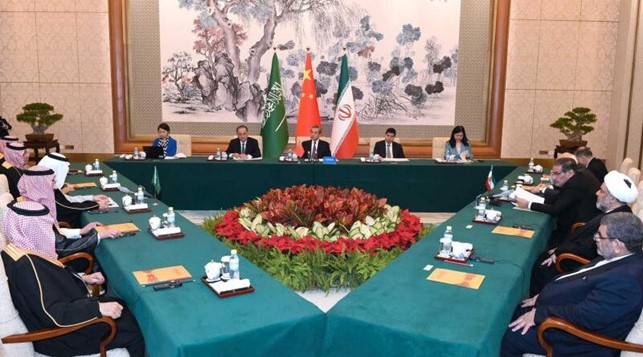
As American dominance wanes and regional powers compete directly, the changing alignment strategies in the new Middle East reveal a new era of a multipolar trap driven by necessity, not preference. Secondary states are exploring non-Western alignments and newfound independence, yet they remain tethered to the United States by the inescapable logic of hard security. Their challenge, however, is to sustain the hedging strategy that demands not picking sides and reducing overreliance on any single patron to stay safe in the perilous space surrounding them, and to continue extracting maximum benefits from all major powers.
Yemen as A Hedging Prologue
The start of serious hedging by Gulf states emerged after the Houthi drone attack on Saudi Arabia’s Abqaiq and Khurais oil installations in 2019. Followed by the Biden administration’s decision to withdraw support for the offensive Saudi-led coalition operations in Yemen, including a review of arms sales to pressure Saudi Arabia to pursue a negotiated resolution to the conflict. The United States’ responses during this period were relatively muted, not what the security-dependent allies expected.
Adding to this, recent Saudi airstrikes targeting a UAE shipment at Mukalla’s docks indicate that the economic superpower of the Middle East is ready to risk direct confrontation in pursuit of competing futures in the multipolar new disorder. Riyadh is concerned about border security and seeks a unified Yemen that is pliable. The Emirates, meanwhile, share Houthis as enemies, but due to their economic interest are focused on building a maritime-commercial empire, hence they empower secessionists Southern Transitional Council (STC) in the south to secure ports like Aden. The charge of supporting coercive non-state actors was once reserved for Tehran, but now Riyadh calls the UAE’s support for non-state actors a threat to its national security.
This is not a new phenomenon. The fragmentation among these Gulf partners existed years ago, particularly when a Saudi diplomat accused the UAE of “treason,” and Mohammad bin Salman claimed it had “stabbed us in the back” in 2019 for disagreements over Gulf foreign policies, including backing separatists in southern Yemen. The U.S. maintains its security reliance by avoiding alienating partners. Therefore, the Gulf’s need to uphold a U.S. security umbrella stays strong, even if it frustrates Washington’s limitations and conditions.
The Illusion of Choice
The U.S. capture of Venezuelan President Nicolás Maduro can be seen as a revival of the Monroe Doctrine, which President Donald Trump ironically called the “Donroe Doctrine.” The critical question is whether this reassertion of raw power will be confined to the Western Hemisphere or if it signals Washington’s intent to reclaim influence in the new Middle East and rein in Gulf states.
Disrupting a resource-rich state reinforces the idea that power still outweighs the rule of law in the twenty-first century. Washington’s liberal hegemony for spreading liberal values worldwide, including its periodic pressure on Gulf allies, serves as strategic cover for advancing its core national interests. Hence, the lesson in the new Middle East is twofold. U.S. capabilities might impress Gulf rulers, but its unpredictability, transactional and disordered approach, breeds deep anxiety that validates the Gulf’s strategic ambitions elsewhere through hedging.
The Qatar Test: Exposing the Limits of Protection
Despite hosting the largest headquarters of the U.S. Central Command at Al Udeid Air Base in the Middle East, Qatar can be attacked. Unsurprisingly, Israel’s bold breach of sovereignty received mere passive condemnation, not just from Western but also from regional partners. The absence of unconditional protection from formal alliances led the Gulf states to recognize the need to assume responsibility for their own security.
Eight days later, a declaration of an attack on one would be considered an attack on both under Saudi Arabia’s Strategic Mutual Defense Agreement with Pakistan, which broadly reflects Gulf reassessment. While such agreements typically involve extensive negotiations, the timing suggests that Riyadh is signaling the United States that it is exploring alternative partnerships, shifting the pressure of the multipolarity trap onto Washington.
Either way, partnership diversification does not mean replacing the U.S. with any other power; rather, it means reducing over-reliance on Washington. Regional connectivity aspirations and increased investment, aligned with Beijing’s “non-interference” approach, are primarily leveraged to reduce Western reliance. It enables Gulf countries to stay within the American security network, though with diluted pressure.
Back in Line or Treading a Fine Line?
The main objective is to avoid being trampled by the competing parties in the region with whom they are allied. Despite all odds, the Gulf is not abandoning the United States. Simply because it cannot. China is a wise observer that offers investment and diplomacy but deliberately avoids entanglement in regional conflicts, unlike the U.S., which has permanent active bases in the region. Absence of Chinese carrier groups at the strategic chokepoint of the Strait of Hormuz says it all. This makes the U.S. an indispensable security guarantor, even though it is increasingly unpredictable. Yet to claim Gulf loyalty, the U.S. may misread the dynamics entirely. Pressurizing tactics worked well in the past under unipolarity, but can clearly be complex tomorrow. The perception of U.S. abandonment and unpredictability compels the Gulf states to hedge, as multi-alignment becomes a necessity for their future security.
The Middle Eastern states will continue to host U.S. troops while signing billion-dollar deals with Chinese tech firms. They will buy American F-35s while conducting joint naval exercises with India. They will cautiously condemn attacks on fellow Gulf members and remain aware that their ultimate security depends not on collective efforts but on bilateral guarantees from a distant superpower. The multipolar trap creates the illusion of choice, but the truth is that it carries greater risks. The goal of the Gulf states is no longer to find a new protector but to become so deeply involved in the interests of various great powers that none can afford to let them fail. In this precarious strategy lies their best hope for sovereignty in an age of renewed giant competition.
Disclaimer. The views and opinions expressed in this analysis are those of the author and do not necessarily reflect the official policy or position of MEPEI. Any content provided by our author is of his opinion and is not intended to malign any religion, ethnic group, club, organization, company, individual, or anyone or anything.
Rabbab A. Khan
Lecturer and researcher in International Relations, focusing on political sociology and the foreign policy analysis of Saudi Arabia, particularly through the prism of US-China great-power competition. The author can be reached at rabab7j@gmail.com.