
The Ukrainian war as global competition: a 2025 contextual analysis of European stance, costs, and contemplated benefits
July 19, 2025
Overlooked Altitude: Why Oman’s Aviation Sector Deserves a Central Role in Vision 2040
July 27, 2025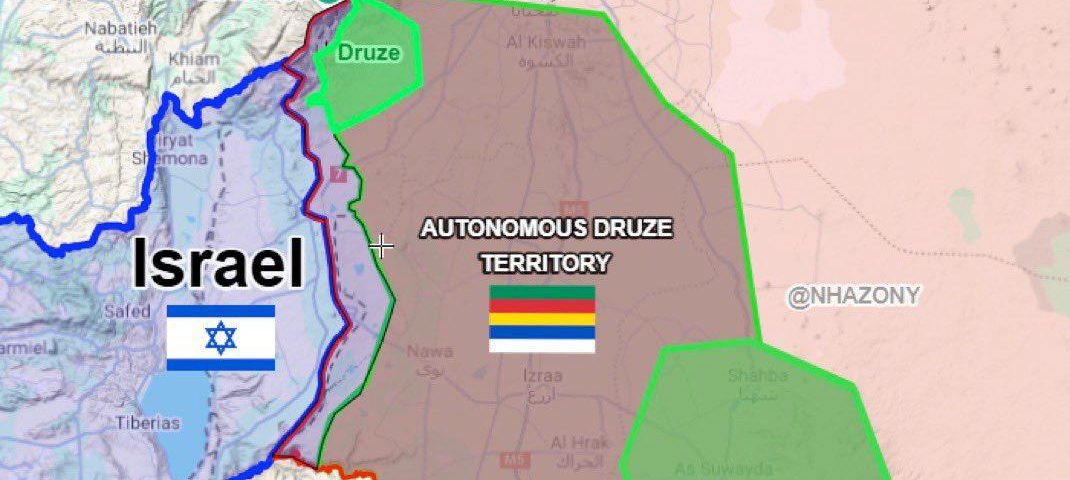
After less than a year into the post-Assad Syria, as-Suwaida (Sweida) region became the last entry on two aggression lists: chronologically, Ahmed al-Sharaa (aka Abu Mohammed al-Jawlani) regime’s deliberate or indeliberate hit list, that notably encompassed Alawite Syrian since December 2024, and many other Syrian areas before, and Israel’s hit list alongside Damascus, that historically included Palestinian Occupied Territory, Lebanon, Egypt, Iraq, Syria, and more recently Yemen and Iran. The inclusion of Syria’s as-Suwaida on Israel’s interest list is discussed in the following from two perspectives: the instrumentalization of public conscience amid a rampant automation of propaganda on the imperative to provide an alternative to the Suez Canal, and the regional geopolitical confrontation that continues to attract and project great power rivalry.
The background of Middle East conflicts is probably the longest and well known across the globe. Among others, the Persians imposed a relatively wide and encompassing peace, then the Romans, Arabs, Ottomans, while a potential Middle East peace imposed by the Americans in recent history is yet to be historically confirmed, if it existed. All other “transition” periods have been marked by large-scale wars, in recurrent waves or continuous, the crusades being among the most representative examples for the former category.
After 1967, the international community, i.e., the majority (Arbell, 2025) if not all countries have officially supported the two-state solution for the so-called “Israeli – Palestinian conflict”, which appears to be a foreign-backed long term crusade with complex, global, implications.
Except a minority of countries that did not recognize Palestine and very few that did not recognized Israel, there is a global majority consensus on the recognition of the two countries, based on the pre-1967 borders. However, due to the traditional Western domination of international relations especially in recent centuries, many analysts and observers still allow themselves to adopt a so-called “non-recognition” general and imprecise rhetoric, invoking either a lack of unanimity or the protection of traditionally powerful decision-makers that, among others, continue to try bargaining and obtaining infinite concessions to maintain or advance stances. The difference between demonstrating and selling goodwill shall be addressed more in the second part of this address.
The Israeli-Palestinian conflict is a relatively complex term, connected among others to multiple historical threads: the formation of a Jewish diaspora after several confrontations in ancient history, the selection of Historical Palestine as the place for a Jewish national state instead of British East Africa (Kenya), Argentina, Cyprus, Mesopotamia, Mozambique (Rovner, 2014) or the Jewish Autonomous Oblast, the centuries-long confrontation between Europe and the Arab and subsequently Ottoman Middle East, and more recently British and French colonial-like mandates. It must be emphasized however, that there is a clear distinction between imperial confrontations for the territory of Historical Palestine, which were neither initiated nor conducted by a Palestinian entity in the last two millennia, but by other societies and civilizations, and the proxy war taking place in this region after 1948, combined with modern components like mass propaganda, psychological warfare and lawfare. The Israeli – Palestinian conflict represents a front line between various political interests and projections that, among others, consumes important political, economic, and social conscience assets, in which the need to preserve Israel’s security is deceitfully and consciously confused in many occasions with preserving Israel’s right to carry unrestricted and expansive wars on its or others’ behalf. If the international system was used to advance peace, and in this case utilize the United Nations Security Council format to guarantee Israel’s security, clear and verifiable commitments like an international peace task force could have been established long ago. But neither Israel nor its strongest allies appeared to favor such a solution. Instead, concepts like Greater Israel are testing and gradually shaping regional opinions.
The narrative that Israel is doing West’s “dirty work” (Mendlowitz, 2025) has been both contested and defended, and while it has been recently mentioned in this form by German Chancellor Friedrich Merz, it can be identified as a theme throughout 20th century as well, in contexts like for example the nationalization of the Suez Canal by Egypt. However, such a stance acknowledges the existence and probably a need to carry out dirty work, directly or indirectly, which contrasts with European declared values, and does not account for the costs, risks, and benefits of “dirty work.” The fight for Suez was neither historically legitimate nor successful, but it created the image of an Israel allied with the West. Should the British had been able to demand a favor from Israel for Balfour Declaration, this could have well been the defense of a British Suez Canal.
In the context of China’s global infrastructure vision, the importance of this waterway dominates even today regional geopolitics, and along other factors, the relation between Israel and its Western supporters. Alternatives to the Suez Canal after nationalization included unfulfilled promises like the Ben Gurion Canal, that, in order to compete with the Suez, would have had to be both safer and overall cheaper for both Israel but also potential customers. Firstly, for approx. $ 1 trillion in goods transferred, the Suez fees amounted to less than $ 10 bln, i.e., less than 1 % in recent years, but there is still an economic incentive to pursue this project. Secondly, the argument of security of a potential Ben Gurion Canal still has to include the Yemeni component. Reports hint that Israel, along American supporters, are still floating the narrative of potential benefits for “international trade” of such an alternative channel, and connect this hypothesis with the need to ethnically cleanse or deport Gazans (Khalil, 2023), although the lowest elevation path is actually the Jordan Valley and the shortest route from the low-elevation areas to the Mediterranean would actually be in the North of Israel.
The long list of potential European cooperation and benefits narrative includes Israel’s hydrocarbon exploitation rights in the Mediterranean, at the expense of neighbors like the Gaza Strip and Lebanon, as a potential contributor to Europe’s energy supply. In recent years, Israel remained a net importer of energy and requires significant politic capital to become an energy supplier. Secondly, Europe’s ensuing energy crisis has rather political reasons which include the refusal to continue buying Russian cheap gas and opt for more expensive American supplies, and the inconsistent plan to switch to renewables.
The desperate attempt to generate any alternative to the Suez Canal, through Israel, is being reflected through the India-Middle East-Europe economic corridor (IMEEC), which among others, aimed to connect Dubai with Haifa (the so-called Peace Line), on rail, through Saudi Arabia and Jordan, ensuring a major line from Mumbai to Piraeus (Akbulut, 2023). This plan did not advance in recent years, as confronting China’s economic projects appears to metamorphose with every passing year. However, in terms of connectivity, more challenges can be identified in this context: it is not clear why European trade with India cannot be carried on the Suez, at potentially lower cost, or why China would not be able to access the IMEEC intermodal route should it prove to be more efficient. Furthermore, moving the regional entry point to Dubai from the Red Sea may require additional Iranian guarantees, and the competing New Development Road from Southern Iraqi ports to Türkiye is already under fast development. Hence, this project may prove ideological rather than driven by objective efficiency indicators, if implemented at all.
The New Development Road is not the only Turkish initiative for regional trade and hydrocarbon routes. Qatar – Türkiye natural gas pipeline was an older project that appears to have resurfaced after December 2024 (Ziaei, 2024), and Qatar is already counting on Syria as a customer for natural gas business (ZeroHedge, 2025). The Qatar – Türkiye pipeline appears to pass Syria near the as-Suwaida region, which coincidentally became the latest target of Israel’s “protection” efforts.
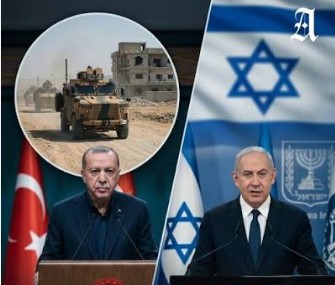
Israel has confronted, besides Arab countries separately and coalitions, Iran, and a potential confrontation with Türkiye is not excluded (Aydıntaşbaş, 2025), especially in the context of new Syrian influence spheres and planed trade routes: as-Suwaida joins conflict regions like Lebanon, North-East Syria and Iraqi Kurdistan, in which Israel and Türkiye’s diverging interests become direct and acute.
The necessity of Israel’s wars is partially justified by its security concerned, but the potential to achieve peace and a real sustainable development in the broader region or with Europe is described in terms that may amount either to wishful thinking or to outright propaganda. Decisions related to the necessity of traditional wars can be evaluated in wider frameworks like the American hegemony plans or Europe’s political and economic plans.
There are multiple reasons for European actors to support Israel’s security, but beyond these considerations, Israel is directly connected to the US in terms of economy, finance, and security/military and thus interests. Throughout the 20th century, the American investment in Israel may have contributed to a shift in region’s broader power balance, that deepened conflicts among Arabs, or between Arabs and Iranians, contained the expansion of Soviet influence and controlled in various forms resources like the Saudi and Iraqi oil, or the Qatari and Iranian natural gas.
In the context of US interests to maintain an influence in European affairs in various forms, Israel’s potential role is reflected by and depends on more aspects. In the field of energy supply, a consensus exists at least at theoretical level to deliver gas from the Chevron-operated Leviathan offshore field to Europe, but there is no known consensus between Europe, the US and Israel, to maintain the cost of these deliveries at such a low price, that would allow Europe to remain competitive in energy-sensitive industries. The as-Suwaida intervention, masked as humanitarian aid, may prevent Türkiye and Qatar from passing pipeline natural gas to Europe, and thus maintain the importance and price of American and Central Asian deliveries.
From a political perspective, reducing the connectivity between Jordan and Syria by blocking the border along as-Suwaida, through a local “independent” or puppet regime in this border region, or through the cultivation of “insurgent” groups, like the Popular Forces of Palestine in the Gaza Strip (Ott, 2025), may translate into a reduction of Jordan’s options to choose or develop, and thus more susceptibility to Israeli pressure to accept scenarios like the takeover of al-Aqsa Mosque, annexation of West Bank or the displacement of more Palestinians to Jordan.
The potential of confrontation between Türkiye and Israel cannot disregard American interests and policies. While the US has the capability to tax all dynamics, including between third parties that do business directly, due to its economic, financial, and military posture, a potential conflict between Israel and Türkiye does not appear to be in the interest of, or on the US agenda. Despite Turkish opinions on America’s influence contraction, NATO’s failure, or the alleged EU goal to bring Türkiye “on its knees” (Karan, 2025), the latter being actually a truism in the realist framework of anarchic international relations, the synchronization between Türkiye, Europe, the US, Persian Gulf countries in supporting al-Jawlani in Syria in nothing less than extraordinary. Whether Türkiye received the freedom to influence that it appears to exert, or whether the set of conditions to coordinate a wider operation in Syria on behalf of the US and other Western powers is very long, will become obvious in the next years. However, the small steps taken by Türkiye in the Gaza conflict, combined with the Saudi and Persian Gulf silence on this situation hint at a broad agreement, that may entail Middle East aspects, or other confrontation theaters like Central Asia, where Türkiye’s leverage increases, as the European, American, and Chinese interests do.
Throughout 20th century, the American ability to impose goodwill among partners and gain new partners appeared an insurmountable advantage. The flexibility in accepting developments and deals was sustained through a legal-financial-military framework that created benefits for Washington even in situations resembling less advantageous. However, various forms of economic crises and transformations appear to have increased US vulnerability to competition, subject to pressure from an emerging alliance of developing economies. Israel has never been associated to a potential 51st US state, although it benefited from massive influxes of aid, technology, capital, and direct military defense from the US. Unless another state or group overtakes the burden of paying for Israel’s wars in case of a potential US contraction, the balance of power may be gradually overturned by systemic, self-reinforcing realities that shaped the Middle East for millennia.
Therefore, while as-Suwaida may represent the next chaos theatre, bombing most neighbors, either for own interests or as “dirty work,” with the hope of controlling the region for past’s sake, could represent a step on the path of historical irrelevance for Israel and its supporters: while winning the fight confirms a warrior, picking the right one as well confirms the winner. The open war approach to international relations has become a less desirable option after World War II, and appears to be even less entertained by rising economic powers like BRICS. While Israel’s security concerns are legitimate, an increasing number of actors across the globe have been raising the question whether Israel’s approach to the ever-increasing number of conflicts it gets involved in is results-driven, justified, legal and sustainable, for Israel, the region, and the world. Or whether they lead to Israel’s security, whatsoever.
Bibliography
Akbulut, G. (2023, July 18). Connecting Continents: The proposed IMEC – India, Middle East and European Economic Corridor. Retrieved from Foreign Policy TR – DPE: https://foreignpolicy.org.tr/connecting-continents-the-proposed-imec-india-middle-east-and-european-economic-corridor/
Arbell, D. (2025, June 15). Two-state solution in the Middle East has been a core US policy for 25 years – is the Trump administration eyeing a change? Retrieved from The Conversation: https://theconversation.com/two-state-solution-in-the-middle-east-has-been-a-core-us-policy-for-25-years-is-the-trump-administration-eyeing-a-change-258753
Aydıntaşbaş, A. (2025, July 03). Türkiye and Israel risk sliding towards confrontation. Retrieved from Financial Times: https://www.ft.com/content/a0648ab9-a169-4451-bd4f-a7279b5235cf
Karan, C. (2025, April 11). ‘Blue Homeland’ architect warns: NATO has failed, and the EU wants Turkiye on its knees. Retrieved from The Cradle: https://thecradle.co/articles/blue-homeland-architect-warns-nato-has-failed-and-the-eu-wants-turkiye-on-its-knees
Khalil, S. (2023, November 17). What is Israel’s Ben Gurion canal plan and why Gaza matters. Retrieved from The New Arab: https://www.newarab.com/news/what-israels-ben-gurion-canal-plan-and-why-gaza-matters
Mendlowitz, P. (2025, June 25). Germany to Israel: Thanks For Doing Our Dirty Work. Retrieved from The Times of Israel: https://blogs.timesofisrael.com/germany-to-israel-thanks-for-doing-our-dirty-work/
Ott, H. (2025, June 06). Opponents say Netanyahu’s decision to arm “clans in Gaza” to help fight Hamas will come back to haunt Israel. Retrieved from CBS News: https://www.cbsnews.com/news/israel-hamas-war-netanyahu-arming-gangs-gaza-clans-activated/
Rovner, A. (2014). 2. Greetings from the Promised Land: Uasin Gishu, East Africa (1903–1905). In In the Shadow of Zion: Promised Lands Before Israel (pp. 45-78). New York: New York University Press.
ZeroHedge. (2025, March 17). Qatar to Supply Natural Gas to Syria via Arab Pipeline. Retrieved from Oil Price: https://oilprice.com/Energy/Natural-Gas/Qatar-to-Supply-Natural-Gas-to-Syria-via-Arab-Pipeline.html
Ziaei, R. (2024, December 28). Feasibility of Reviving the Qatar-Syria-Türkiye Gas Pipeline Project After The Fall Of Bashar al-Assad. Retrieved from IPIS: https://www.ipis.ir/en/bookview1/761478/feasibility-of-reviving-the-qatar-syria-turkey-gas-pipeline-project-after-the-fall-of-bashar-al-assad