
The New Middle East: Borders Redrawn by Markets Not Weapons
July 9, 2025
Publication of Book titled “120 Years of Diplomatic Relations between The Islamic Republic of Iran and Romania”
July 10, 2025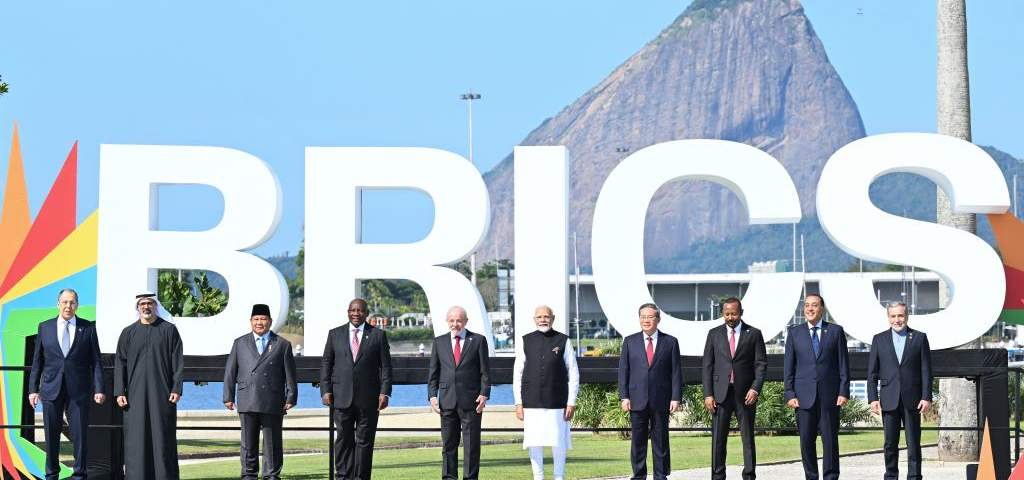
Photo: Leaders attending the plenary session of “Peace and Security and Reform of Global Governance” of the 17th BRICS Summit pose for a group photo in Rio de Janeiro, Brazil, July 6, 2025.
Introduction
The 17th BRICS Summit, held in Rio de Janeiro, Brazil from July 6th to 7th, 2025, under the theme of “Strengthening Global South Cooperation for More Inclusive and Sustainable Governance”, carried significant weight. This summit was not only the first after the BRICS’ expansion but also a crucial gathering against the backdrop of tense global geopolitical situations and the intensification of trade protectionism. The participation of Middle – Eastern countries in this summit, along with the associated challenges and opportunities, became one of the focal points attracting international attention.
1. The Status of Middle – Eastern Countries in BRICS
In 2024, Middle Eastern countries such as Egypt, the UAE, and Iran formally joined the BRICS cooperation mechanism, marking an important breakthrough in the grouping’s regional representation. Their accession not only strengthens BRICS’s overall influence but also injects new vitality into the development of the Middle East. As the global energy hub and a geostrategic linchpin, the participation of Middle Eastern countries significantly enhances BRICS’s voice in international affairs.
However, according to the article titled BRICS and Saudi Arabia: Hedging, but Why? published by the Carnegie Endowment for International Peace, Saudi Arabia’s membership status presents a completely different picture. Although Saudi Arabia received an invitation to join as early as 2023, it has neither formally accepted nor explicitly rejected it. The article notes that at the October 2024 Kazan Summit, “Saudi Foreign Minister Prince Faisal bin Farhan only committed to strengthening the nation’s partnership with BRICS—not to becoming a full member.” The article further states, “Saudi Arabia has chosen a tricky balancing act of an ambiguous approach to BRICS that leaves it room to adapt to changing global conditions, including the coming U.S. leadership change.”
2. Dynamics of Middle – Eastern Countries during the 2025 BRICS Summit
Iran
Due to certain reasons, Iranian President Masoud Pezeshkian was unable to attend the summit, and Foreign Minister Abbas Araghchi represented Iran. At the summit, the Iranian Foreign Minister strongly condemned the military strikes by Israel and the United States against Iran and called on the international community to hold Israel and the US accountable for their violations. Moreover, Iran expressed reservations about the “two – state solution” for the Israel – Palestine issue supported by BRICS.
Egypt and the UAE
The leaders of Egypt and the UAE also did not attend the summit, but both countries sent high – level representatives. Egypt hopes to maintain its status as a middle – power through the BRICS platform and promote peace and security in the Middle – East and Africa. The UAE, due to its trade ties with the US, tends to adopt a pragmatic approach.
3. Significance of Middle – Eastern Countries’ Participation in the BRICS Summit
Economic Cooperation
The entry of Middle – Eastern countries has brought new opportunities for economic cooperation within BRICS. Countries like Iran, Saudi Arabia, and the UAE play important roles in the global energy market. Their participation facilitates cooperation and coordination in the energy field among BRICS members. Additionally, their accession provides a broader market and resources for cooperation in trade, investment, and finance within BRICS.
Geopolitical Influence
The Middle – East region is one of the hotspots in global geopolitics. Its inclusion in BRICS helps enhance the group’s influence in global geopolitics. BRICS’ condemnation of the military strikes by Israel and the US against Iran at the summit demonstrates its firm support for international law and multilateralism. This stance not only contributes to maintaining peace and stability in the Middle – East but also enables the Global South countries to voice their common opinions in international affairs.
Promotion of Multilateralism
BRICS has always advocated multilateralism and the democratization of international relations, and the entry of Middle – Eastern countries further strengthens this concept. At the 2025 BRICS Summit, leaders reaffirmed their commitment to multilateralism and international law and called for the reform of the Bretton Woods system to better reflect the interests and needs of developing countries. Such appeals not only promote the reform of the global governance system but also support Middle – Eastern countries in gaining more say and influence on the international stage.
4. Challenges and Prospects
Internal Coordination Challenges
Although the expansion of BRICS brings new opportunities, it also increases the difficulty of internal coordination. Middle – Eastern countries have differences from other members in terms of political systems, economic development levels, and geopolitical interests, which may lead to difficulties in reaching consensus on some issues. For example, on the Israel – Palestine issue, the divergence in positions between Iran and some other Middle – Eastern countries may affect the unity and coordination within BRICS.
External Pressures and Challenges
The accession of Middle – Eastern countries may also trigger some external pressures and challenges. Western countries such as the US and Israel may be uneasy about the growing influence of BRICS in the Middle – East and thus take measures to counterbalance its development. In addition, the complex geopolitical situation in the Middle – East, such as the conflicts between Iran and Israel and the relations between Saudi Arabia and Iran, may impact the cooperation within BRICS.
Future Prospects
Despite numerous challenges, the participation of Middle – Eastern countries in BRICS still has broad development prospects. With the deepening of BRICS cooperation, Middle – Eastern countries are expected to conduct more extensive cooperation with other BRICS members in economic, political, and cultural fields. At the same time, BRICS can also leverage the influence of Middle – Eastern countries to further promote the reform of the global governance system and the development of multilateralism.
Disclaimer. The views and opinions expressed in this analysis are those of the author and do not necessarily reflect the official policy or position of MEPEI. Any content provided by our author is of his opinion and is not intended to malign any religion, ethnic group, club, organization, company, individual, or anyone or anything.