
Israeli Prime Minister’s public admission of supporting an ISIS-linked organization and “what’s wrong with that?”
June 17, 2025
TITAN ground station targeting system: a Palantir disruption or a predictable military progress?
July 2, 2025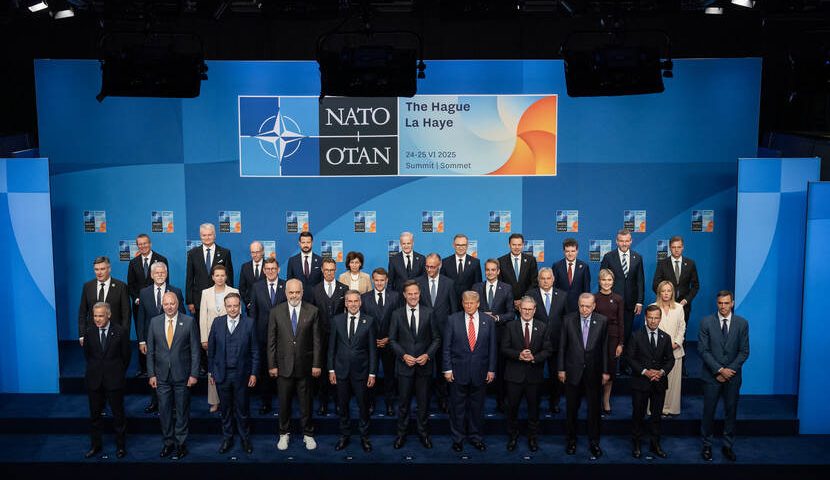
June 24th, 2025 will probably enter history as among the most security-relevant day. During a SCO meeting in Beijing, China was advocating for a “common, comprehensive, cooperative and sustainable security concept,” to address “changes and chaos” (Gokmen 2025). The US President Donald Trump was basically imposing a ceasefire in the Israel-Iran confrontation, i.e., war, and the NATO Summit in the Hague began.
NATO’s defensive stance and strive to find a role in the post-1991 world have been subject to debate. While it offered protection for Western Europe and contributed to the Fall of the Soviet Union, the enlargement policy of NATO, which appears to synchronize with European Union’s enlargement, the role of the organization challenges the fundamentals of a defensive posture, but not directly: it is not necessarily NATO who pushes for expansion, but its members in one way or another. The systematic concept of expansion/development, in terms of membership and influence, is consistent with other macroscopic indexes like for example economic growth.
There are three main subjects related to NATO’s Hague Summit that require analysis: participants, the so-called “Hague Investment Plan,” and the conflicts from Ukraine, the Gaza Strip and Israel/Iran.
- Besides representatives from NATO member states, the program included either speeches or joint sessions with representatives from Ukraine, Albania, the European Union, New Zeeland, Japan, the Munich Security Conference, as well as a meeting between the NATO Secretary General and Indo-Pacific partners(NATO 2025). Furthermore, based on reports from previous years, American companies like Oracle, RTX, Lockheed Martin, and General Atomics(Ludwig 2024), or BAE Systems attended the NATO Summit Defense Industry Forum in the past, and the 2025 list is probably expanding (Ministry of Defence 2025).
The synergy of an industrial military complex can be perceived as a new development for Europe, and renewed probably for the UK, but also as adopting the past success model of the US, which might be in the best position to absorb the enormous funds promised through the Hague Investment Plan.
Japanese Prime Minister Shigeru Ishiba did not attend (Minister of Foreign Affairs Takeshi Iwaya attended instead), in what was called an “abrupt no-show,” and neither did Australian Prime Minister Anthony Albanese and South Korean President Lee Jae-myung attend the summit, the press reporting that this hints at worsening relations with the United States and President Donald Trump (Ota 2025). The allegation that a US-Japan summit on defense was cancelled due to alleged requests from the US to increase defense spending to 3.5 % was reportedly refuted by Japan (Hilton 2025). Prime Minister Modi reportedly refused a dinner invitation from President Trump during the recent G7 Summit from Canada, and the Indian Congress appears to call upon Prime-Minister Modi to “reject” American President’s claim that he stopped the war between India and Pakistan (DESK 2025). The AUKUS nuclear submarine deal, which saw the US replace the French offer for Australia was also questioned in March 2025 (Doherty 2025), in what appears to be a projection of the bilateral deals switch the US is advancing instead of larger cooperation frameworks recently.
- Hague Investment Plan represents basically an implementation of American President’s request from the rest of NATO countries to increase military spending to a total 5 %: 3.5 % direct defense spending (hard military spending), and 1.5 % for infrastructure and other fields like research and cybersecurity. Keynotes and addresses from the General Secretary and other invitees repeat slogans like “if you want peace, prepare for war,” that the production of ammunition has proven to be essential in (Ukraine) war, or the need to address a potential aggression from Russia, and they are not new. Likewise, the importance of “partnerships” in the Pacific or Africa is also stressed.
Many European NATO members have already committed to spending, for example, for US military equipment, like F-35 fighter jets and Patriot missile systems. Besides American military giants, other countries, like the UK, appear to target these funds, through initiatives like the defense pact with Ukraine and the six ammunition factories worth approx. $ 2 billion, that are expected to function continuously (Manuel 2025). Equally, France and The Netherlands are posed to get their own share from these funds, as well Türkiye hopes – in a certain degree.
Despite a so-called deglobalization, defense industry is consolidating and the already very large companies are looking for new ventures, acquisitions, and markets. It is the case of RTX, but also BAE Systems, French companies like Airbus (NATO 2025) and the rise of Turkish military companies, that, for example, entered a cooperation with Italian company Leonardo. In the highly financialized Western economy, the financial and economic aspects of developing defense industries cannot be overlooked, especially when it is expected to be paid by large populations, although some of them exhibit a relatively high debt. Traditional players like the American companies that supported the invasion and reconstruction of Afghanistan and Iraq might be increasingly competed by British, French, Turkish and other emerging defense industry players.
The international relations scene was marked by a series of crises that hint at a potential world order/split, based on hard power projection. In the last 30 years, there were “NATO” wars in former Yugoslavia and Libya, and two major wars in which NATO members participated: Afghanistan and Iraq. Of course, the Russian Federation also carried out wars in Georgia and Ukraine. The forever war from the Occupied Palestinian Territory took place at various intensity, while bombings like the ones from Yemen, against al-Qaeda, or protracted wars like the one from Syria or Sudan were also relevant to global security.
- Present wars, like the ones from Ukraine, the Gaza Strip and Israel-Iran have long roots and follow chronical, unsolved confrontation patterns and will probably have to remain unsolved: while Iran called NATO’s Secretary General Mark Rutte remarks with respect to American action “disgraceful”(Alarabya 2025), Belgian Defense Minister Theo Francken reportedly declared that Israel must have a monopoly on nuclear weapons in the Middle East, calling Iran “a threat”. These positions hint that the underlying conflict has actually not been touched upon, and the cessation in hostilities could potentially be a pause to replenish Israeli ammunition and missile systems stocks rather than an irreversible pathway to peace. The broader conflictual landscape also suggests that the question whether Thucydides’ trap can be avoided or not remains a valid perspective in the context of an envisioned multipolar world. They may not be addressed on an emergency basis in the Hague, and counterterrorism does not hold center stage anymore. The 2025 NATO summit appears to fall in line with the 2013 Framework for NATO Industry engagement.
In 2025, the international community is confronted with a deepening crisis. In the major attempt to switch from international standards to bilateral relations, large economies like the US attempt to maintain a historical status quo through renegotiations, tariffs, and similar instruments. While before 2020 there were still requests/discussions about enlarging United Nations Security Council, this is not a mainstream topic anymore. Furthermore, the consequential roles of international organizations like WTO or International Criminal Court appear to be challenged in certain circumstances. The wars from Ukraine on one hand, and the ones from Iraq and Afghanistan cannot be compared, but both categories involved NATO countries and led to massive funding for the military industrial complex. Whether this development benefited nations entirely, on long term, or not is difficult to assess, but it certainly opened the stage for more business and financial advancement. Other aspects of the ongoing crisis are reflected by increasingly difficult democratic processes like elections in Europe, assassinations, or attempts, like in the cases of Robert Fico or Shinzo Abe, debt crises and the widening gap between rich and poor even in the traditionally advanced economies: public speech became militant overnight, in both internal and external politics of certain traditional powers.
The melancholic return to 20th century hard power patterns is reflected also in NATO’s attempt to play a broader security role, beyond the Atlantic. After 2022, NATO reemerged as a mainstream platform to confront the Russian Federation, as it did since the beginning, hence not a new international defense project. However, reviving this conflict can be perceived as justifiable when considering the outcomes of the Cold War, i.e. defeating the Soviet Union and increasing influence/domination in its former territories as part of the victory, and not justifiable considering what President Putin reaffirmed on various occasions as the agreement to respect Russian security red lines as part of the agreement to give up territory. Furthermore, it must be emphasized that an apparent return to the past might lead to different historical processes. While NATO appears to rally behind President Trump – anticipated Nobel Peace Price candidate (Kilgore, Intelligencer 2025), on the 5 % NATO spending goal, Canada has signed important bilateral cooperation agreements with the EU right before the NATO Hague summit. The security and defence partnership (Government of Canada 2025), the New EU-Canada Strategic Partnership of the Future (Prime Minister of Canada 2025) represent guarantees for Canada’s sovereignty and a source for natural resources, energy for Europe, that has been struggling with African partnerships and transiting slowly to renewable energies. Hence, NATO might remain or not what it was, or its members might be willing to develop military and infrastructure capacity while acting independently or together based on interests. From a political perspective, President Trump’s terms marked stronger discussions with European allies, when compared to Democratic terms.
Whether the expansion model from 20th century is still operable or not, in the context of cooperation frameworks like SCO and BRICS, depends also on the determination to support the envisioned multipolar world. In all cases, the NATO fast track arming and the promise to increase confrontation capacity will certainly contribute to a global arming race, instead of cooperation for disarmament, Sustainable Development Goals (SDG Agenda 2030) and the fight against climate change. The NATO 2025 Summit agenda emerges as part of the general opposition to an envisioned Asian Century, unless this contributes more to Western economic and financial systems more than it did in the past, if assuming that Europe is not able on short and medium term to become an independent military-security actor, for which it would require fundamental resources like digital and high-tech autonomy, natural resources, and financial sustainability.
In 2025, NATO prepares for war in order to pursue peace. Whether the fact that this saying emerged in the 4th century CE (i.e., during Rome’s period as empire and not republic – long after the peak economic and political period called Pax Romana), is relevant or not for the power of example, remains to be demonstrated by history.
Bibliography
Gokmen, Berk Kutay. 2025. Anadolu Agency . June 24. Accessed june 24, 2025. https://www.aa.com.tr/en/asia-pacific/china-calls-for-enhanced-security-cooperation-among-sco-member-states/3611723.
NATO. 2025. 2025 NATO Summit in The Hague. June 24. Accessed June 24, 2025. https://www.nato.int/cps/en/natohq/events_236298.htm.
Ludwig, Sean. 2024. July 10. Accessed June 24, 2025. https://www.uschamber.com/security/nato-summit-defense-industry-forum.
Ministry of Defence, Rt Hon John Healey. 2025. GOV.UK. June 9. Accessed June 24, 2025. https://www.gov.uk/government/news/first-meeting-of-defence-industry-body-to-forge-new-partnership-and-industry-mobilisation.
Ota, Kiyoshi. 2025. The Conversation . June 25. Accessed June 2025, 2025. https://theconversation.com/japanese-prime-ministers-abrupt-no-show-at-nato-summit-reveals-a-strained-alliance-with-the-us-259694.
Hilton, Alastair Gale and Sarah. 2025. June 23. Accessed June 25, 2025. https://www.afr.com/world/asia/japan-refutes-report-us-demanded-defence-spending-of-3-5pc-of-gdp-20250623-p5m9p0.
DESK, TOI NEWS. 2025. The Times of India . June 20. Accessed June 25, 2025. https://timesofindia.indiatimes.com/india/pm-modi-must-publicly-reject-trumps-claim-congress-renews-attack-after-us-president-reiterates-i-stopped-the-war/articleshow/121936531.cms.
Doherty, Ben. 2025. The Guardian . March 6. Accessed June 25, 2025. https://www.theguardian.com/world/2025/mar/07/surface-tension-could-the-promised-aukus-nuclear-submarines-simply-never-be-handed-over-to-australia.
Manuel, Rojoef. 2025. The Defense Post . June 2025. Accessed June 25, 2025. https://thedefensepost.com/2025/06/02/uk-war-ready-factories/.
- NATO. June 24. Accessed June 25, 2025. https://www.nato.int/cps/en/natohq/news_236514.htm.
Alarabya. 2025. Alarabya English. June 25. Accessed June 25, 2025. https://english.alarabiya.net/News/middle-east/2025/06/25/iran-calls-nato-chief-remarks-on-us-strikes-disgraceful-.
Kilgore, Ed. n.d. Accessed June 25, 2025. https://nymag.com/intelligencer/article/trump-gains-loses-nobel-peace-prize-nomination.html.
—. 2025. Intelligencer. June 25. Accessed June 25, 2025. https://nymag.com/intelligencer/article/trump-gains-loses-nobel-peace-prize-nomination.html.
Government of Canada. 2025. Security and defence partnership between the European Union and Canada. June 25. Accessed June 25, 2025. https://www.international.gc.ca/world-monde/international_relations-relations_internationales/eu-ue/security-defence-securite-defense.aspx?lang=eng.
Prime Minister of Canada . 2025. Canada announces new, strengthened partnership with the European Union. June 23. Accessed June 25, 2025. https://www.pm.gc.ca/en/news/news-releases/2025/06/23/canada-announces-new-strengthened-partnership-european.