
NATO’s 2025 Summit in the Hague between challenges and opportunities
June 26, 2025
The Second China–Central Asia Summit: Reshaping Strategic Dynamics at the Eurasian Crossroads
July 5, 2025TITAN ground station targeting system: a Palantir disruption or a predictable military progress?
Introduction
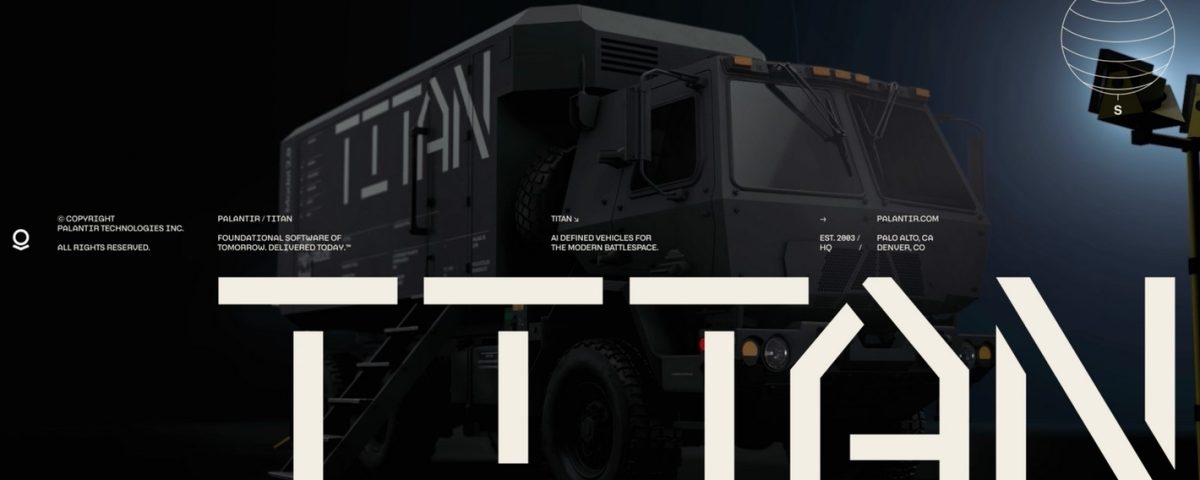
On March 6th, 2024, Palantir Inc. was reportedly awarded with the development and delivery of the Tactical Intelligence Access Node (TITAN) ground station units (U.S. Army, 2025). The design and delivery occurred reportedly on time, and the overall coverage of this project emerges as very positive. As part of Palantir’s broader coverage, this joint work marks yet another Palantir successful story in supporting the US military, among an increasing list of customers.
This article identifies Palantir’s evolution as part of the broader digitalization effort across industries, the increase if its market share and estimates the shared role it played in the development of TITAN. Furthermore, the article estimates the potential impact of a relatively new data-driven decision-making system centered on TITAN, in the context of contemporary warfare and actual conflicts. Since this article is based on OSINT only, it employs only comparison, interpolation and (potential) extrapolation techniques for estimating or projecting potential impact in various scenarios.
A review of TITAN project and evolution
The TITAN project is a U.S. Army project, hence part of the ground forces (advanced) battle management system evolution. In early 2022, the two finalists RTX (Raytheon Technologies) and Palantir Inc. were awarded each $ 8.5 million for the first year (Gill, 2023), then $ 36 million in order to deliver initial prototypes for the final decision. Among the declared aims of the project, the connection of data-gathering sensors to shooters had been mentioned, and advancing the beyond-line-of-sight targeting (Albon & Demarest, 2023).
The two variants are TITAN are basic version for division and below levels, that prioritize survivability and mobility, with secure but unclassified encrypted communications, and advanced version, supporting direct access to (more) sensors, satellite access and higher classification levels (Pomerleau, 2024). The system is part of the wider Joint All-Domain Command and Control (JADC2) concept (Gill, 2023) introduced by the US Department of Defense (DoD) to connect data from sensors to decision-makers and implementation resources, be they human or automated systems. The required modularity is reportedly expected to break a long decisional process that led to deliveries of the same system configuration across the entire branches of army, allowing thus tailoring solutions according to functions required by the commanders and in line with theatre demands (Pomerleau, 2024).
Notably, the TITAN pre-prototype has been reportedly built by Northrop Grumman, and the Army itself also built a pre-prototype in parallel, operated by the first deployment of Muti-Domain Task Force (MDTF). The first MDTF had been deployed in the Philippines for INDOPACOM operations (Gill, 2023).
In March 2024, the TITAN contract was signed by the US Army and Palantir Inc. and amounted $ 178 million (Domingo, 2025). As of Mach 2025, the latest project development was the on-time delivery of the first TITAN Basic and the second delivery of TITAN Advanced prototypes. Final prototypes, final operational tests and eventually production decision are expected in Financial Year (FY) 2026 (U.S. Army PEO IEW&S, 2025).
TITAN appears to have emerged from US Army’s Project Convergence 22 (PC22) experimental project, together with partners from the UK and Australia, assessing more than 250 technologies and devices with potential to deliver dominance on the battlefield (Thompson, 2022). Northrop Grumman participated in the PC22 program with a pre-prototype that reportedly tested space links for TITAN systems, whereas neither RTX nor Palantir took part in this preliminary phase (Hitchens, 2022). Subsequently, the Palantir-led bid expectedly became more complex, and was enabled by a partnership between Palantir and Anduril Industries, Northrop Grumman, L3 Harris, Pacific Defense, SNC, and World-Wide Technology. The overall characteristics of the TITAN system as described on Palantir’s website include reducing sensor-to-shooter timeline, integrating (data and decision-making) with fire systems within the US Army and joint task forces, optimizing soldier’s workflow, advancing sensing and ensure interoperability with modern sensors, increasing the accuracy and effectiveness of targeting, and enabling collection and processing of data “on the move” (Palantir TITAN, 2025). The TITAN system emerges thus as a more complex solution in comparison to Northrop’s initial PC22 pre-prototype, scalable and modular. The features from above do not appear to represent themselves technological leaps, but the development appears to be in line with US Army’s data-driven reorganization and the combination of mentioned characteristics is expected to deliver battlefield advantages.
In the wider picture of military systems integration, TITAN is classified as C4 solution (Anduril Industries, 2024). Anduril mentions that the system is expected to support long range fire, based on data from space, high altitude, aerial and terrestrial sensors. Northrop Grumman’s contribution amounts to leading design maturation for TITAN shelters, ensure production readiness, integration, test, and deployment with the U.S. Army (Northrop Grumman, 2024). Beyond this tactical node, C5ISR and C6ISR solutions are being offered, among others, by companies like RTX, Northrop Grumman, General Dynamics, L3Harris and Thales, in the context of network-centric warfare (Mordor Intelligence, 2025).
The overall trend to empower longer command chains and operate more variables, in real time, during battlefield operations, advances from an integration perspective with tactical nodes like TITAN, and from an efficiency perspective with the addition of new sensors, tactical weapons and operational procedures. Hence, the first and most important role of TITAN-like systems is to support new technologies, and secondly to increase their efficiency amid growing complexity. The evolution, potentially, towards singularity, and shortening “the kill chain” (Hawkins, 2023), are generally assessed from the confrontational perspective, in which winning represents the ultimate goal: it is the preparedness and development that ultimately receive funding. However, studies and assessments that frame the impact of such developments in the broader landscape of human-level and state-level interactions are also being carried out (ICRC & Geneva Academy, 2024), but their funding and applicability does not appear to be anywhere near to the one aiming to win confrontations.
Brief overview of Palantir in the context of TITAN project
As mentioned, or suggested by traditional contractors for the US military cited above, Palantir was not present from the beginning in the Project Conversion. The increasing network- and data-centric approach to warfare appears to have been key in TITAN project’s partner selection process.
In 2003, DoD DARPA’s Total Information Awareness (TIA) program was theoretically terminated (Pontin, 2006). Coincidentally or not, Palantir was founded in 2003 as a military intelligence company in 2003 as well. The founders were Peter Thiel (former PayPal associate), Alex Karp, Joe Lonsdale, and Stephen Cohen. The company received funding from Central Intelligence Agency’s investment arm In-Q-Tel, and became a trusted partner for the large defense and counter-terrorism communities (Rumage, 2025). Until very recently, the company’s finances relied very much on US government contracts, particularly defense. In 2009, JPMorgan Chase acquired Palantir software in order to detect fraud, and this opened a new commercial sector for the company, and in 2020, it was listed on the stock exchange.
Palantir did not focus on Artificial Intelligence (AI) from the beginning, although it integrates nowadays such functionality, but rather on strong data analytics and fraud detection, following up on the PayPal heritage. Its main platforms are Gotham, which has been employed since 2008 and serves (state) intelligence and defense actors in the US, and the newer Foundry, which serves industry customers since 2016. Various tools like Palantir Apollo and Artificial Intelligence Platform (AIP) round up a dynamic and growing market share that Palantir appears to champion.
There are many aspects related to Palantir’s core competencies, but data analytics is certainly the central one, in the context of Large Language Models (LLMs) development. The company supports multiple data structures and applies sound processing techniques in order to deliver actionable conclusions. The problems addressed range from logistics and supply chain optimization to battlefield support.
Whether these competences alone were sufficient to overtake experienced defense contractors like Northrop Grumman or not remains an open question. In all cases, it must be emphasized that Palantir is also known for requiring customer data in order to implement or optimize software solutions, and either state or political support has been indirectly granted for company’s survival in the broader global software competition. Unlike Cambridge Analytica, which had to dissolve in 2018 also due to allegations of elections interference, Palantir benefited from its defense and intelligence contracts, and its reputation for handling confidential information allowed to secure contracts beyond initial clients. Its list of clients include, besides US state agencies, British Ministry of Defense and National Health System, Pfizer, BP, Airbus, Ferrari, Stellantis, Morgan Stanley, Fujitsu, Axel Springer, UBS, Hertz (Ready Contacts, 2025), (McKenna, 2025) etc. Palantir sold the AI-enabled system Maven Smart System NATO (MMS NATO) to the NATO alliance as well, according to reports from April 2025 (NATO Maven, 2025).
Although Palantir’s customer list is growing, it is not without scrutiny. Iain Overton claimed in April 2025 that Palantir’s embedding in UK’s public sector, i.e. in the National Healthcare System amounts to a “quiet coup”, detailing that Prime Minister Keir Starmer’s meeting with Palantir representatives in February (2025) was set up by Labor’s Peter Mandelson, whose lobbying company lists Palantir as a customer (Overton, 2025). Furthermore, despite national contract for healthcare data with Palantir, Greater Manchester Integrated Care Board (ICB) decided in May 2025 not to adopt the platform and ask for more evidence on risks and benefits first (Clarck, 2025).
On one hand, data privacy is discussed increasingly in public venues, but despite attempts to regulate this aspect, military scope is excluded from EU’s AI policy. On the other hand, the social media hype led to enormous wealth concentration in the US, and the subsequent AI race, whatever definition is employed, appears to reinvigorate the financial benefits of American companies, at least from local market and Europe. Related to the TITAN project, there are many arguments that can be added to Palantir’s technical expertise in winning this award, and other awards in general. These may include an image of trust in handling confidential data, built around its work with American defense and intelligence agencies, lobbying and other connections with the political sphere, like the connections and donations to the Trump administration, the company being criticized by Paul Graham, an important Silicon Valley investor, for allegedly “building the infrastructure of the police state” (Allyn, 2025). What becomes apparent however, is the fact that competence and capacity alone might not have led to winning the TITAN project by Palantir.
Whether Palantir is strongly connected to intelligence and defense circles, or whether and how it supported wars, like the ones from Afghanistan, Iraq and the Gaza Strip will not be analyzed in this article, although the phenomenon of “kill lists” appears striking in a world guided by the rule of law and due process (Shihab-Eldin, 2025). However, it is to be noted that Palantir is often associated to a “militaristic” culture, and its representatives do not fully avoid political topics in public appearances. Therefore, given the mix of competence, alleged secrecy, and success stories in supporting American defense and intelligence communities, how can Palantir’s role in the development of TITAN be assessed?
The Palantir disruption and overall military progress
Amid all aspects to consider around Palantir’s governmental work, its technological strengths, which relate to (big) data acquisition, processing, and presentation, are being leveraged in project TITAN, particularly the real-time data-driven decision processes.
Besides the development of Gotham platform for miliary applications, real time surveillance networks have been reportedly developed by the company together with UK police, amassing personal information like political opinions, philosophical beliefs, health records, etc. (Wilding, 2025). This is yet another example of software deployment for data integration and analytics, led by Palantir. With every project, Palantir manages to increase the reach and robustness of its algorithms, and there are many recent examples of “partnerships” through which Palantir software is deployed in vertical AI applications. The disruption enabled by this company relies on the proven reliability of its data processing methods, and experience in supporting the military.
In terms of Large Language Models, it is the speed, flexibility, and high compatibility of Palantir software that offers an edge to the users, rather than the ownership or particular implementations. In the case of TITAN, Palantir is indeed designing terminal’s software architecture, but in Phase 3 of the project, TITAN will have to adapt to Army’s Project Linchpin (Beinart, 2024), i.e. the set of APIs, data labeling protocols and other requirements defined by the Army in cooperation with Red Hat, in what has been dubbed as an “open-source” platform enabling companies to develop software and applications directly compatible to military requirements (Freedberg Jr., 2024).
As an “operating system for AI”, Palantir will deploy software tools that are not only fast and accurate, but also open-ended, flexible, in order to accommodate innovation based on precise and clear principles. In comparison to Project Linchpin ($ 2 million award), TITAN appears a relatively expensive solution considering all project phases and lifetime, but when considering budgets for projects like Space Development Agency’s $ 1.5 billion award for the constellation of “low-cost” communication and missile tracking satellites to Lockheed Martin and Northrop Grumman (Albon, 2023), TITAN remains a relatively lower-budget project.
In the ISR (Intelligence, Surveillance and Reconnaissance) race, TITAN is expected to work with new generation sensors, platforms and programs, like for example High Accuracy Detection and Exploitation System (HADES), reportedly led as system integrator by Sierra Nevada Corp. (Pomerleau 2, 2024), in which grants have been awarded to L3 Harris for Airborne Reconnaissance and Electronic Warfare System (ARES) aircraft and to Bombardier Defense to deliver the Global 6500 business jet platform for the program (Army Technology HADES, 2024). Other tools from the HADES program are Airborne Reconnaissance Targeting Exploitation Mission Intelligence System (ARTEMIS) and Army Theater-Level High-Altitude Expeditionary Next Airborne Intelligence, Surveillance and Reconnaissance (ATHENA) platform (Pomerleau 2, 2024). Other new ISR sensor platforms include the high-altitude balloons, reportedly expected to be financed from 2025 (Judson, 2023) (Williams, 2025).
Consequently, TITAN represents an important breakthrough as data processing node, but the entire modernization process of American ISR capabilities is a much larger and complex ongoing process, that has already deployed new sensing platforms and is expected to accelerate this process in the coming years. Should these technologies be used, trained, and tested in theatres like Ukraine, Iran, or the Gaza strip, this is likely to contribute to their improvement and efficacy.
As TITAN, along the new ISR spectrum of sensors and platforms, are employing new faster, more precise, and efficient software-driven technology, the US is consolidating its military stance for the years to come, although being already by far the largest military actor in the world.
Final remarks and conclusions
While serving the entire humanity and sectors like the economy, software and Artificial Intelligence are also becoming power tools for the US (military) in the new digital era, paralleling soft power initiatives like asset management and “tokenization” pioneered, for example, by BlackRock. With TITAN and the new ISR suite, the US domination becomes more visible and will likely trigger reactions from competitors. Hence, neither the US nor the rising emerging economies are preparing for peace through disarmament, but the opposite.
This article analyzed TITAN ground station targeting system from three perspectives: data related to project requirements and its evolution, Palantir’s background and emerging leadership in this project, and the wider endeavor of US military to modernize its ISR and AI-driven operations. TITAN’s role on the future battlefield will be improved by Palantir’s innovative and efficient approach to data processing and utilization for real-time decision-making, but the wider defense modernization strives and platforms like HADES, that will likely interact with TITAN, are hinting towards a much larger technological shift that will redefine the role and capabilities of the US army. This development trend is in line with other global digitalization trends, that are expected to generate increasingly more data. There is a worldwide consensus that much more data will be generated and utilized for decision-making, but depending on the approach, this will transform not only economies but also societies, individuals, and values.
Bibliography
Albon, C. (2023, August 21). Space Development Agency awards $1.5 billion for transport satellites. Retrieved from C4ISRNET: https://www.c4isrnet.com/battlefield-tech/space/2023/08/21/space-development-agency-awards-15-billion-for-transport-satellites/
Albon, C., & Demarest, C. (2023, December 06). TITAN targeting contract to be awarded soon, Army officials say. Retrieved from C4ISRNET: https://www.c4isrnet.com/battlefield-tech/it-networks/2023/12/06/titan-targeting-contract-to-be-awarded-soon-army-officials-say/
Allyn, B. (2025, May 03). How Palantir, the secretive tech company, is rising in the Trump era. Retrieved from NPR: https://www.npr.org/2025/05/01/nx-s1-5372776/palantir-tech-contracts-trump
Anduril Industries. (2024, March 03). Army Selects Anduril and Palantir to Deliver TITAN Deep Sensing Capability for Long Range Fires. Retrieved from Anduril: https://www.anduril.com/article/army-selects-anduril-and-palantir-to-deliver-titan/
Army Technology HADES. (2024, March 14). High Accuracy Detection and Exploitation System (HADES) Programme, USA. Retrieved from Army Technology: https://www.army-technology.com/projects/high-accuracy-detection-exploitation-system-hades/?cf-view
Beinart, M. (2024, March 06). Palantir Beats Out RTX To Continue Developing Army’s TITAN Intel Ground Station. Retrieved from Defense Daily: https://www.defensedaily.com/palantir-beats-out-rtx-to-continue-developing-armys-titan-intel-ground-station/army/
Clarck, L. (2025, May 23). One of Britain’s largest health trusts says ‘no ta’ to Palantir-run data platform – for now. Retrieved from The Register: https://www.theregister.com/2025/05/23/greater_manchester_palantir_snub/
Domingo, J. (2025, March 08). US Army Taps Palantir to Build TITAN Next-Gen Targeting System. Retrieved from The Defense Post: https://thedefensepost.com/2024/03/08/us-army-palantir-titan-system/
Freedberg Jr., S. (2024, November 22). ‘Plug and play’: Army’s Project Linchpin prepares to unveil open-source architecture for AI. Retrieved from Breaking Defense: https://breakingdefense.com/2024/11/plug-and-play-armys-project-linchpin-prepares-to-unveil-open-source-architecture-for-ai/
Gill, J. (2023, April 26). Army to test TITAN prototypes this summer as it moves toward downselect. Retrieved from Breaking Defense: https://breakingdefense.com/2023/04/army-to-test-titan-prototypes-this-summer-as-it-moves-toward-downselect/
Hawkins, T. (2023, October 26). The System and the Singularity: Getting the Balance Right in Human-AI Teaming. Retrieved from Modern War Institute (West Point): https://mwi.westpoint.edu/the-system-and-the-singularity-getting-the-balance-right-in-human-ai-teaming/
Hitchens, T. (2022, November 18). Army’s Project Convergence tested space links for TITAN targeting system. Retrieved from Breaking Defense: https://breakingdefense.com/2022/11/armys-project-convergence-tested-space-links-for-titan-targeting-system/
ICRC & Geneva Academy. (2024, March). Expert Consultation Report on AI and Related Technologies in Military Decision-Making on the Use of Force in Armed Conflicts. Retrieved from ICRC & Geneva Academy: https://www.geneva-academy.ch/joomlatools-files/docman-files/Artificial%20Intelligence%20And%20Related%20Technologies%20In%20Military%20Decision-Making.pdf
Judson, J. (2023, December 06). New high-altitude spying program to come to US Army in fiscal 2025. Retrieved from Defence News: https://www.defensenews.com/air/2023/12/06/new-high-altitude-spying-program-to-come-to-us-army-in-fiscal-2025/
McKenna, G. (2025, May 06). Defense contractor Palantir says a ‘massive cultural shift in the U.S.’ has justified 20 years of thankless toil. ‘We were the freak show … and we spent 20 years for this moment’. Retrieved from Fortune: https://fortune.com/2025/05/06/palantir-cultural-shift-us-justified-20-years-thankless-toil-freak-show/
Mordor Intelligence. (2025, June 29). C6ISR Market Size & Share Analysis – Growth Trends & Forecasts (2025 – 2030). Retrieved from Mordor Intelligence: https://www.mordorintelligence.com/industry-reports/c6isr-market
NATO Maven. (2025, April 14). NATO acquires AI-enabled Warfighting System . Retrieved from NATO: https://shape.nato.int/news-releases/nato-acquires-aienabled-warfighting-system-
Northrop Grumman. (2024, March 07). Northrop Grumman Partners to Advance Deep Sensing for the US Army. Retrieved from Northrop Grumman: https://news.northropgrumman.com/sensors/northrop-grumman-partners-to-advance-deep-sensing-for-the-us-army
Overton, I. (2025, April 25). Palantir’s quiet coup: the military-industrial complex embedding itself in Britain’s public sector. Retrieved from AOAV: https://aoav.org.uk/2025/palantirs-quiet-coup-the-military-industrial-complex-embedding-itself-in-britains-public-sector/
Palantir TITAN. (2025, June 29). TITAN. Retrieved from Palantir: https://www.palantir.com/offerings/defense/titan/
Pomerleau 2, M. (2024, October 15). Here’s what pre-prototypes and deployments have taught the Army about business jet ISR program. Retrieved from Defensescoop: https://defensescoop.com/2024/10/15/army-hades-business-jet-isr-program-pre-prototypes-deployments/
Pomerleau, M. (2024, October 18). Army wants to tailor TITAN system to certain units, theaters. Retrieved from Defensescoop: https://defensescoop.com/2024/10/18/army-titan-tailor-system-units-theaters/
Pontin, M. W. (2006, April 26). The Total Information Awareness Project Lives On. Retrieved from MIT Technology Review: https://www.technologyreview.com/2006/04/26/229286/the-total-information-awareness-project-lives-on/
Ready Contacts. (2025, June 29). Palantir Customer List. Retrieved from Ready Contacts: https://www.readycontacts.com/target-account-profiling/palantir/
Rumage, J. (2025, June 05). Inside Palantir: The Tech Giant Powering Government Intelligence. Retrieved from Built In: https://builtin.com/articles/what-is-palantir
Shihab-Eldin, A. (2025, June 06). Palantir: Financed by Epstein, Fueled by Thiel, Killing in Gaza and Spying on You. Retrieved from Ahmed’s Perspective: https://ahmedeldin.substack.com/p/palantir-financed-by-epstein-fueled
Thompson, M. (2022, November 16). PC22 experimentation furthers US, partner military efforts to dominate future battlefield. Retrieved from U.S. Army: https://www.army.mil/article/262060/pc22_experimentation_furthers_us_partner_military_efforts_to_dominate_future_battlefield
U.S. Army. (2025, June 29). Army Tactical Intelligence Targeting Access Node (TITAN) Ground Station Prototype – Award. Retrieved from U.S. Army: https://peoiews.army.mil/2024/03/06/army-tactical-intelligence-targeting-access-node-titan-ground-station-prototype-award/
U.S. Army PEO IEW&S. (2025, June 29). PM IS&A : Intelligence Systems & Analytics. Retrieved from Program Executive Office – Intelligence, Electronic Warfare & Sensors: https://peoiews.army.mil/pm-isa/
Wilding, M. (2025, June 16). UK police working with controversial tech giant Palantir on real-time surveillance network. Retrieved from Liberty Investigates: https://libertyinvestigates.org.uk/articles/uk-police-working-with-controversial-tech-giant-palantir-on-real-time-surveillance-network/
Williams, E. (2025, April 13). “Unstoppable Sky Spies”: US Launches Game-Changing High-Altitude Balloons to Outmaneuver Enemy Stealth Fighters and Protect America. Retrieved from Sustainability Times: https://www.sustainability-times.com/reports/unstoppable-sky-spies-us-launches-game-changing-high-altitude-balloons-to-outmaneuver-enemy-stealth-fighters-and-protect-america/

Prof. Ecaterina MAȚOI
Prof. Ecaterina MAȚOI is a Program Director at MEPEI.