
Syria After Riyadh: A New Role in the Middle East’s Emerging Security Order
October 13, 2026Barrels and Ballots: How the Wars in the Middle East and Europe Are Merging Through Supply Routes and Electoral Fog
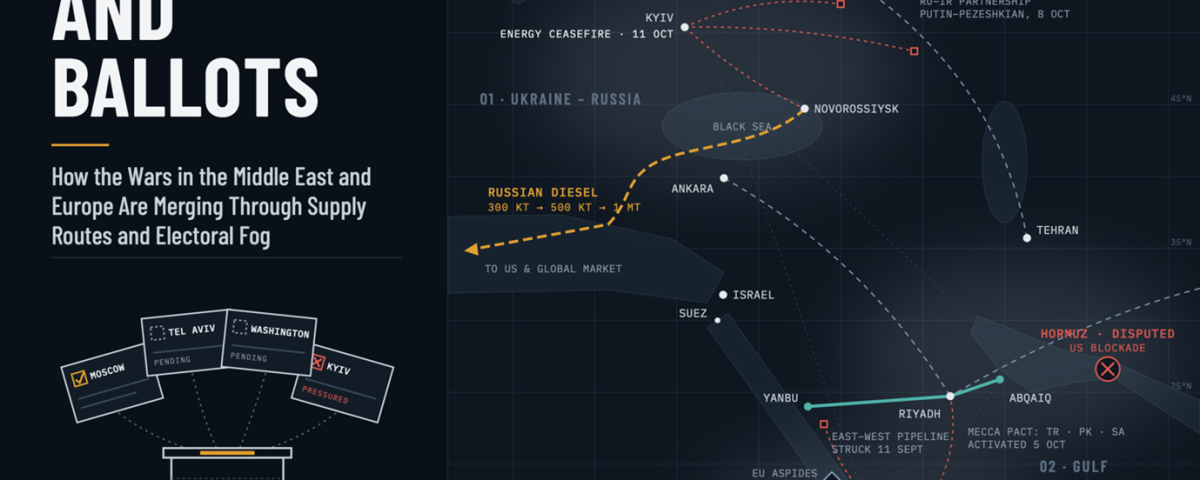
The conflicts in Ukraine, the Persian Gulf, and the Red Sea are becoming more and more openly connected, and the actors involved no longer seem to make much effort to hide it.
Washington recently announced an agreement with Moscow to reopen diesel trade, with an “energy ceasefire” between Russia and Ukraine, after growing frustration over Ukrainian strikes on Russian energy infrastructure, with the strikes on data centers seemingly triggering the reaction. With the United States needing both lower diesel prices and digital infrastructure to boost President Trump’s credibility for the upcoming midterm elections, the reaction is not surprising, and the pressure is relatively proportional. Adding this to what is happening around the Bab al-Mandeb Strait, and with the Strait of Hormuz still uncertain, it may also point to Washington trying to secure a supply line before disrupting another. For Europe, the situation is felt differently. First, in the cost of energy, and second, in the security of its supply routes, with an already stretched defense capacity over the Baltic, the Black Sea and the Red Sea at once.
The electoral calendars, or lack thereof, further complicate negotiations. The US midterms on November 3, the Duma elections held in Russia in September, the pressure on Kyiv to hold elections and the Israeli vote on October 27 all shape the timing of decisions, and partly explain why the war with Iran is, for the moment, on a relative pause.
Three questions arise:
- Will the energy ceasefire in Ukraine translate into escalation in Iran, or potentially Yemen?
- Will Washington support Saudi Arabia against the Houthis, or is the Mecca defense pact going to be put to the test just a few months after its creation?
- How much of this is Europe able, or willing to absorb?
The diesel deal and the energy ceasefire
On October 9, 2026, President Trump announced that President Putin had agreed to release 300,000 tons of diesel immediately “to the American and global marketplace”, followed by 500,000 tons in November and one million more after that, presenting the decision as a matter of domestic welfare: “Lower prices for Americans, especially our Great Farmers, Ranchers, and Truckers, is my Greatest Priority.”[i] Two days later, he announced that Russia and Ukraine had reached an “energy ceasefire”. By Monday, however, Zelensky said that Russia had already violated it, after several energy targets across Ukraine had been hit during the night and into the morning, and warned that Kyiv would respond if Moscow does not abide by the ceasefire.[ii]
The economic aspect of such a deal has been criticized. Goldman Sachs estimated that the Russian diesel released in October and November would reduce wholesale prices by only $1 to $2 per barrel on the US Gulf Coast and in Europe, and the United States is a net diesel exporter, so it does not need Russian supply in the first place. The European Union, on the other hand, has banned imports of Russian crude oil and refined products, so the effect for Europe is indirect at best, as Russian diesel would mostly ease competition for American barrels in markets such as Brazil and Türkiye. Prices have surged for reasons the deal does not address, with Ukrainian strikes on Russian refineries, and with Iran and the Houthis hitting refineries in the Middle East and disrupting exports through Hormuz.[iii]
The political moment at which the decision has emerged weighs heavier. The agreement was announced while Ukrainian, American, and European representatives were negotiating in Miami. According to media reports, US special envoys Steve Witkoff and Jared Kushner threatened during the talks to suspend intelligence sharing, citing Ukrainian strikes on Russian refinery infrastructure, which US officials denied, while Trump declared that it was time “for Ukraine to get a new president”[iv]. In recent months, long-range Ukrainian drone strikes have caused extensive damage to Russian oil facilities and fuel shortages across the country, and should they continue, Moscow is expected to frame them as harming US economic interests, as well as the Republican Party’s chances in November[v], turning Ukraine’s most effective instrument of pressure into a liability in its already tense relations with Washington. Kremlin’s objective has not changed: Ukraine’s capitulation, which the diesel deal and Trump’s growing impatience with Zelensky are expected to contribute to. The deal is already being criticized in European circles, with concerns that Russia could use the proceeds to support Iran.[vi]
On October 8, a day before the diesel deal was announced, Putin met Pezeshkian in Turkmenistan ahead of the summit of the Commonwealth of Independent States, saying that “Iran is making real efforts to end the conflict, which broke out through no fault of its own”, and noting what he called a “positive evolution” in the relations between the two countries. In a call the previous day, he had told Pezeshkian that Moscow is prepared to mediate efforts to end the war in the Middle East.[vii] The two countries, both under heavy Western sanctions, signed a comprehensive strategic partnership treaty in January 2025, covering areas from trade and military cooperation to science and education, and their ties go well beyond diplomacy. Iran has been accused of supplying Russia with Shahed drones and short-range missiles for use in Ukraine, while Russia has been accused of supplying data to Iran for its attacks on US targets in the Middle East. Moscow is thus positioning itself on both sides of Washington’s objectives at once, as a supplier that apparently helps the US lower fuel prices before the midterms, and as a partner and would-be mediator for the country the US is at war with. The same actor that provides the alternative supply line also has a say over whether the other one is disrupted, which makes the diesel deal less a concession obtained from Moscow and more a form of leverage that Moscow has gained.
Bab al-Mandeb and the Red Sea
While the diesel deal secures one alternative, the Red Sea shows what is at risk. Last month, the Houthis launched a surprise offensive along Yemen’s south-western coast and ousted pro-government forces from the areas overlooking the Bab al-Mandeb Strait. They said they posed no threat to international shipping, but that they would continue to target Saudi vessels, and the seizure of the strait contributed to a surge in global oil prices, since Saudi Arabia had been relying on the Red Sea for its oil exports ever since the war with Iran effectively closed Hormuz.[viii] The East-West pipeline, which carries Saudi crude to the Red Sea coast, had already been temporarily shut down by a drone attack on September 11, with Riyadh presenting its rapid recovery as proof of the flexibility of its energy system[ix], but even that has a limit.
On October 5, Saudi-backed government forces staged a rapid advance to retake the coast around the strait up to Mokha, with the Saudi-led coalition saying that its jets were providing “round-the-clock” air support and had destroyed 324 “high-value” targets since the start of the offensive. The Houthis rejected the claims as “Saudi propaganda” and responded by striking the King Khalid International Airport in Riyadh, an Aramco refinery in Rabigh, the Abha airport and the Khamis Mushait military base, while warning civilian airlines that Saudi airspace, except above Mecca and Medina, had become “a theatre of operations”[x]. However, reports from the ground remain conflicting, and what international actors can read is “escalation”, which translates to risk and insecurity.
The same day as the offensive, Saudi Arabia, Türkiye, and Pakistan agreed to activate “collective deterrence measures” and to rapidly deploy forces to Saudi Arabia under the Mecca defense pact, accusing the Houthis of attempting to target Islam’s holiest sites. The pact was signed only on August 7, extending the 2025 Saudi-Pakistani defense agreement to Türkiye, and this is the first time it has been invoked.[xi] But what does the pact replace, or at least try to?
Saudi Crown Prince Mohammed bin Salman reportedly urged Trump to strike the Houthis, and Trump declined, because the Houthis were not targeting US vessels[xii], once again casting doubt over American motivation to contribute to the interests of the countries hosting its military bases. Instead, Israel offered to join the campaign, both as a strategic move to try and pave the way for normalization, but also because of its own security interest. The Saudis refused the offer, as concerns over public reaction were cited.[xiii] Still, Israeli media separately reported intelligence assistance to Riyadh through US Central Command, which neither government confirmed and which does not amount to a formal alliance.[xiv] Riyadh is thus turning to a regional framework rather than to Washington or Tel Aviv, even if the strait remains an Israeli concern too, as Houthi attacks have almost halted activity at the port of Eilat and the route connects Israel with its Asian partners, India and China in particular.[xv]
Tehran has suggested that Bab al-Mandab could be closed during the war, with the Houthis controlling the strait while Iran controls Hormuz, a combined control that would give it considerable leverage over global trade and oil, and therefore over its bargaining position. The strait carries approximately 8% of global oil trade and 15% of global trade, so the scenario of a double chokepoint is precisely the one that makes alternative supplies valuable, and the one Washington would need to be prepared for before deciding anything on Iran.
Europe between cost and security
Europe is connected to both fronts, and pays for both. In February 2024, the EU launched Operation Aspides, a defensive maritime mission under its Common Security and Defense Policy, in response to Houthi attacks on merchant vessels in the Red Sea[xvi]. More than two years later, exactly when it is most needed, the mission struggles to attract reinforcements. Kaja Kallas stressed the need to have at least ten ships if Europe wants to be a credible security provider in the region[xvii], but most member states have preferred to keep their ships in the Baltic and the Black Sea, the main hotspots of Russia’s hybrid attacks, as European maritime capabilities face critical gaps, which current investments are expected to fill only after 2030. Worth noting is also the fact that on October 2, G7 leaders agreed to implement a coordinated release of 100 million barrels of oil and petroleum products through the International Energy Agency over four months, including an accelerated release of diesel during the initial 20 days.[xviii] The prices don’t reflect the agreement’s effects yet.
This is the point where the connection between conflicts becomes most visible, at least for Europe. The same navies are needed against Russia in the north and east and against the Houthis in the larger South vicinity. At the same time, Russia, whose attacks keep European capacities on other deployments, is now heading towards supplying diesel to the global market with Washington’s approval, while the EU maintains its ban. Moreover, the social impact of the war in Ukraine is starting to be felt across the continent, as unrest grows, and high fuel costs add an economic layer to an already fragile political situation. Europe has very little control over either the price or the route, and appears to be absorbing the consequences of decisions taken elsewhere.
The electoral calendar
The primary factor that holds the picture together is, for the moment, time. On October 8, Trump wrote that the US was “having productive discussions” with Iran and that “we will not be attacking Iran at any time prior to the midterm elections”, a statement made as oil prices were rising over fears of renewed fighting.[xix] The midterms are approaching, however, and if Trump is to be taken by his word, securing alternative supply chains beforehand is exactly what one would do before resuming the war. Israel votes on October 27, and the elections create divisions within a society where nobody seems willing to pay the political and electoral cost of renewed strikes on Iran, so maintaining the current relative stability is also the Israeli preference. In Russia, the Duma elections in September confirmed the Kremlin’s hold on domestic politics, while in Ukraine the pressure to hold elections now comes openly from Washington. Iran, meanwhile, has time to reorganize after the losses it took, and can either emerge with a unified negotiating position or become more reactive, which would considerably change the conditions of whatever comes after November.
Conclusions
The trajectories of the actors involved depend on how long the electoral pause lasts and on what each of them does with it. For Washington, the priority appears to be lower fuel prices before November and, possibly, a cushion of non-Gulf supply should the war with Iran resume, which would explain both the diesel deal and the pressure on Kyiv to stop striking Russian refineries. Whether it will also support Riyadh against the Houthis remains an open question, as its refusal so far has pushed Saudi Arabia towards the Mecca pact, and a Turkish and Pakistani deployment on Saudi soil would reshape the regional balance in ways that Washington does not fully control. For Russia, the deal brings revenue, a degree of legitimacy and a window to intensify strikes on Ukrainian energy infrastructure while Kyiv’s hands are partly tied. For Ukraine, the risk is that its most effective lever becomes the very thing its main partner asks it to give up. For Europe, the bill keeps adding up. For Iran, its biggest leverage might disappear. The conflicts are more connected now than they have been at any point since the war with Iran began, and a disruption in one of them would travel quickly through the others. It all depends on whether the supply lines secured are meant to prevent an escalation, or to prepare for one.
[i] https://www.bbc.com/news/articles/cjn5v21py07vo
[ii] https://www.cnbc.com/2026/10/12/russia-ukraine-energy-ceasefire-trump.html
[iii] https://www.cnbc.com/2026/10/13/trump-putin-zelenskyy-russia-ukraine-diesel-oil-price.html
[iv] https://www.dw.com/en/ukraine-and-the-us-whats-next-after-trumps-diesel-deal-with-russia/a-79650785
[v] https://www.bbc.com/news/articles/cjx2359qekrdo
[vi] https://www.dw.com/en/ukraine-and-the-us-whats-next-after-trumps-diesel-deal-with-russia/a-79650785
[vii] https://www.aljazeera.com/news/2026/10/8/putin-pledges-russias-support-to-end-us-led-war-on-iran
[viii] https://www.bbc.com/news/articles/cw8rzd6lp0xpo
[ix] https://www.arabnews.com/saudi-arabia/saudi-cabinet-backs-operations-of-coalition-forces-in-yemen-warns-houthis-over-attacks-3006135
[x] https://www.reuters.com/world/yemeni-government-forces-seize-district-by-bab-el-mandeb-military-sources-say-2026-10-05/
[xi] https://www.aljazeera.com/news/2026/10/5/mecca-alliance-agrees-to-activate-collective-deterrence-measures
[xii] https://studies.aljazeera.net/en/policy-briefs/expansion-and-exposure-paradox-houthi-control-bab-al-mandeb
[xiii] https://www.haaretz.com/middle-east-news/2026-10-12/ty-article/.premium/netanyahu-seeks-to-join-saudis-fight-against-houthis-crown-prince-opposes-move/000001a1-3117-d20b-a1ff-f557b0810000
[xiv] https://www.jpost.com/opinion/article-911362
[xv] https://studies.aljazeera.net/en/policy-briefs/expansion-and-exposure-paradox-houthi-control-bab-al-mandeb
[xvi] https://agsi.org/analysis/operation-aspides-the-european-unions-response-to-the-red-sea-crisis/
[xvii] https://www.euronews.com/2026/10/12/eu-struggles-to-ramp-up-red-sea-mission-as-houthis-escalate-attacks
[xviii] https://www.hgvireland.com/brussels-steps-up-monitoring-of-europes-diesel-supply-crisis/
[xix] https://www.aljazeera.com/news/2026/10/9/trump-says-us-will-not-strike-iran-before-midterm-elections

Larisa-Nicoleta PĂTRAȘCU
Junior Researcher at the Middle East Political and Economic Institute (MEPEI). Her research and professional interests center on peacebuilding, diplomacy and conflict resolution, international cooperation, and MENA geopolitics.