Interactions among Major Countries amid a Turbulent Middle East: An Analysis of China-U.S. Policy Dialogue on Middle East Affairs during Trump’s Visit to China in 2026
May 26, 2026
The Unacknowledged Sentinel: Egypt’s Diplomatic Absorption and the Preservation of Regional Order during the Gaza War (October 2023 Present)
June 3, 2026Interactions among Major Countries in a Evolving Landscape: An Analysis of President Putin’s 2026 State Visit to China
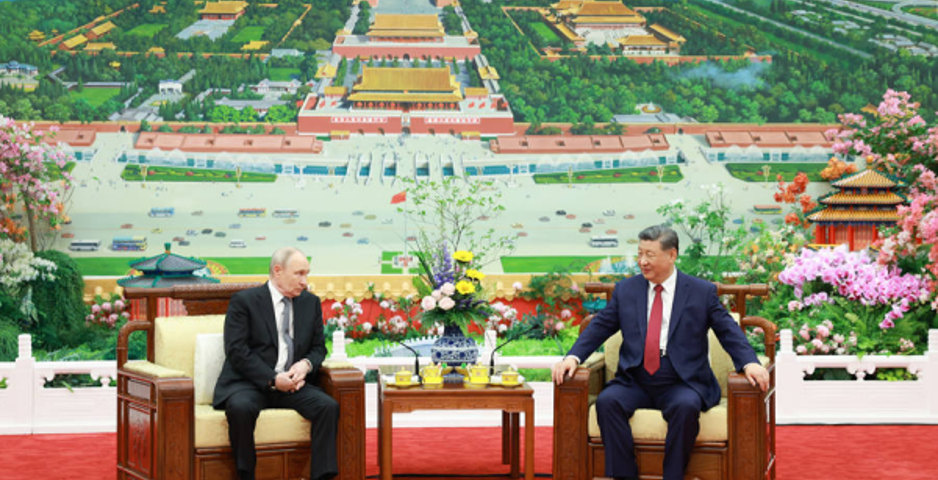
Photo Source: Ministry of Foreign Affairs, People’s Republic of China
Introduction
At present, profound changes unseen in a century are accelerating across the globe, accompanied by a profound shift in international power dynamics. Unilateralism, power politics, hegemonism, and bloc confrontation are on the rise, posing severe challenges to the global governance system and causing increasing instability and uncertainty in the global economy. Against the backdrop of a world increasingly defined by geopolitical fragmentation, unilateral sanctions regimes, and renewed conflict-driven volatility across multiple regions, Russian President Vladimir Putin’s May 2026 state visit to Beijing—his twenty-fifth trip to China—was never going to be treated by either side as routine diplomacy. China and Russia, as permanent members of the United Nations Security Council and globally influential major powers, have a decisive bearing on world peace and stability through the trajectory of their relations. It is more important and urgent than ever for China and Russia to strengthen strategic coordination and practical cooperation.
At the invitation of Chinese President Xi Jinping, Russian President Vladimir Putin paid a state visit to China from May 19 to 20, 2026, which marked the first face-to-face meeting between the two heads of state in 2026. The timing of this diplomatic engagement was laden with symbolic significance and came at a special historical node. It coincided with two symbolic and substantive milestones: the thirtieth anniversary of the establishment of the China–Russia strategic partnership of coordination and the twenty-fifth anniversary of the signing of the China-Russia Treaty of Good-Neighborliness and Friendly Cooperation, which is the legal and political anchor of the entire bilateral architecture. Over the past 30 years, China-Russia relations have achieved leapfrog development, from a constructive partnership to a strategic partnership of coordination, and then to a comprehensive strategic partnership of coordination in the new era. The meeting between the heads of state attracted widespread attention from the international community as they conducted in-depth strategic communication on bilateral relations and major international and regional hotspots. During the visit, President Xi Jinping held extensive talks with President Putin, including small-group meetings, large-group discussions, and a private tea conversation, while Chinese Premier Li Qiang also met with President Putin to discuss practical cooperation.
Core Expectations and Overarching Objectives of Both Sides
From the perspective of both governments, the 2026 visit was guided by a set of shared, overarching strategic objectives aimed at advancing the China-Russia Comprehensive Strategic Cooperative Partnership for a New Era to a higher level and injecting stability and positive momentum into international relations. These expectations were focused on a stable four-pronged framework consisting of consolidating high-quality political mutual trust, upgrading high-quality practical cooperation, cementing public support through people-to-people exchanges, and building consensus through international coordination.
The expectations surrounding the visit were shaped by a simple but heavy structural reality: for Moscow, China has become the indispensable economic and diplomatic counterweight to Western containment; for Beijing, Russia remains a critical energy supplier, a logistical flank for Eurasia-oriented connectivity, and a fellow permanent member of the UN Security Council whose vision of a multipolar order overlaps with China’s own rhetoric and interests. The visit’s objectives, therefore, could be read on two levels: first, there was the choreography of strategic signaling—demonstrating that the “new era” comprehensive strategic partnership is not only surviving Western pressure but operating at what Putin himself described as an “unprecedented level”; second, and more concretely, there was a deliverables agenda focused on trade resilience, energy security, financial de-risking, transportation corridors, and the broadening of people-to-people channels.
In terms of consolidating political mutual trust, China and Russia sought to deepen high-level strategic communication, summarize the successful experiences of the past 30 years, and clarify the direction of bilateral development for the next stage. Centered on the extension of the landmark Treaty of Good-Neighborliness and Friendly Cooperation, both sides aimed to reinforce the legal and political foundations of their relationship. That these anniversaries produced not merely ceremonial rhetoric but a formal agreement to further extend the treaty’s life underscores how both capitals view institutionalized continuity as a strategic asset rather than a diplomatic courtesy. This involved reaffirming firm mutual support on issues involving each other’s core interests and major concerns, particularly regarding sovereignty, territorial integrity, security, and independent development path, to ensure long-term stability resilient to external disruptions.
For high-quality practical cooperation, the two sides strove to expand, deepen, and elevate mutual interaction across economy, trade, energy, science and technology, transportation, and agriculture. This objective aimed to deepen the alignment between China’s 15th Five-Year Plan covering 2026–2030 and Russia’s development strategy through 2030, promote the alignment of the Belt and Road Initiative with the Eurasian Economic Union, enhance the resilience of industrial and supply chains, and foster new growth points in new productive forces. From Russia’s specific viewpoint, expanding energy exports to China, attracting Chinese investment, and promoting the de-dollarization process of bilateral trade were crucial objectives to reduce the severe impact of Western sanctions on the Russian economy. Both countries prioritized addressing physical bottlenecks in cross-border connectivity and improving trade and investment facilitation mechanisms.
The composition of the Russian delegation clarified where the emphasis lay, as observers noted a line-up that included five deputy prime ministers, eight ministers, and senior figures from the Central Bank, the finance ministry, and leading systemic banks. This unusually heavyweight economic and financial contingent for a head-of-state visit was a clear indicator that beyond geopolitics, the core objective was to stabilize and upgrade the machinery of bilateral economic interchange. In a climate where secondary sanctions and compliance risk have raised transaction costs for Chinese firms operating in or trading with Russia, the presence of monetary and financial authorities signaled Moscow’s desire to lock in more robust settlement mechanisms, insurance arrangements, and project-financing pathways that can keep turnover growing despite the external drag.
Enhancing people-to-people exchanges served as the third pillar, with both nations viewing the visit as an ideal opportunity to launch the national theme year between the two countries to expand educational exchanges, increase two-way student flows, and deepen cooperation in scientific research and talent cultivation. Deepening these bonds across culture, education, tourism, youth, media, and sports was aimed at fostering greater mutual understanding, cultivating young successors, and consolidating the social foundation of China-Russia friendship so it continues from generation to generation.
Finally, regarding international coordination, China and Russia aimed to enhance strategic coordination in international and regional affairs to jointly defend the United Nations-centered international system and uphold the purposes and principles of the UN Charter. Facing external security threats, the two sides aimed to strengthen coordination within multilateral platforms such as the United Nations, the Shanghai Cooperation Organization, and BRICS to jointly oppose hegemonism, unilateral sanctions, long-arm jurisdiction, trade protectionism, and bloc politics. Their core international objective was to issue a joint statement articulating a shared vision for world multipolarity and the democratization of international relations. Additionally, Russia sought to strengthen cooperation with China in high-tech fields like artificial intelligence, aerospace, and new energy to make up for the technological gap caused by Western sanctions.
Major Achievements of the Visit
When measured against those objectives, the results of the visit look deliberate rather than decorative, producing substantial, fruitful outcomes that exceeded pre-visit expectations across all dimensions of bilateral interaction. The two heads of state signed and issued two historic, landmark joint statements and witnessed the signing of a large volume of intergovernmental, departmental, and commercial cooperation documents. In total, the visit yielded 20 intergovernmental and inter-departmental cooperation documents alongside 22 additional agreements and consensus reached between enterprises and departments, bringing the total to 42 outcomes.
- Political and Strategic Achievements
The most important political and strategic achievement of the visit was the official extension of the Treaty of Good-Neighborliness and Friendly Cooperation Between the People’s Republic of China and the Russian Federation, reaffirming the non-aligned, non-confrontational, and not directed against third parties’ character of the relationship while embedding it in a longer-term legal horizon. This momentous decision translated high-level political mutual trust into a long-term institutional arrangement, ensuring the legal foundation of bilateral relations for another 25 years regardless of changes in the global environment. For planners in both capitals, that extension does something mundane but vital: it reduces ambiguity about durability. Investors, regional governments, and border-zone enterprises all price in political risk; a treaty that persists is a signal that cooperation frameworks are meant to outlast cyclical frictions.
The two leaders signed and issued two core political documents that charted a clear course for the next 10 to 20 years. First was the Joint Statement on Further Strengthening Comprehensive Strategic Coordination and Deepening Good-Neighborliness and Friendly Cooperation, which outlined the future roadmap for political, economic, security, and cultural interactions through 2030. Second was the Joint Statement on Championing World Multipolarity and a New Type of International Relations, which groundbreakingly articulated their shared position on global affairs and called for an end to bloc confrontation. The visit also solidified the mechanism of regular high-level exchanges, with President Xi Jinping accepting an official invitation to visit Russia later in 2026.
- Economic, Trade, and Infrastructure Upgrades
In the economic sphere, the practical cooperation displayed large scale, wide-ranging fields, profound depth, and institutionalization, strongly supporting high-quality development. The numbers already provided a strong pre-existing floor, which the visit sought to reinforce rather than reinvent. Bilateral trade surpassed the 200 billion US dollars threshold and, by official accounts, exceeded it for the third consecutive year, reaching 227.9 billion dollars in 2025, with China remaining Russia’s largest trading partner for sixteen years running. In the first four months of 2026 alone, reported bilateral trade rose sharply year-on-year, fueled by a mix of hydrocarbon and commodity exports from Russia and diversified manufactured, automotive, electronics, and machinery exports from China.
The visit’s outcome documents and accompanying announcements leaned into this momentum—pledging to upgrade practical cooperation in trade, investment, energy, transport, and scientific and technological innovation, while also emphasizing frontier fields and new growth drivers. The two sides agreed to further expand the scale of bilateral trade, striving to achieve a goal of 300 billion US dollars in trade volume by 2030. Trade facilitation was significantly boosted by a pledge to expand the use of national currencies in bilateral trade settlements. At present, the proportion of local currency settlement in China-Russia trade has exceeded 95%, which effectively reduces the risk of cross-border financial transactions.
To optimize the business environment, a Joint Statement on Supporting Open Trade and Multilateralism was issued to oppose trade protectionism, accompanied by signed documents on the sustainable trade of industrial goods, customs cooperation, intellectual property protection, and anti-monopoly collaboration. Investment cooperation was enhanced through a commitment to fully implement the 2025 China-Russia Investment Promotion and Protection Agreement, deepening collaboration in the development of Russia’s Far East region and establishing agricultural cooperation demonstration zones.
A major highlight in infrastructure connectivity was a cross-border breakthrough: the signing of the Agreement on the Joint Construction of the 1435mm Gauge Second Line of the Manzhouli-Zabaikalsk Cross-Border Railway. This represents a historic solution to the long-standing gauge difference problem that has plagued cross-border trade, significantly improving the operational efficiency of the China-Europe Railway Express and cross-border customs clearance. Once completed, the port’s cargo throughput capacity will more than double, increasing to 39 million tons by 2030, which will greatly improve cross-border logistics and strengthen the Central Eurasian Transport Corridor. Local and urban cooperation was also deepened through a memorandum of understanding on urban development, promoting coordinated regional development between the Beijing-Tianjin-Hebei region and Moscow, and between the Yangtze River Delta and St. Petersburg.
- Comprehensive Energy and Nuclear Power Alliances
Energy, predictably, remains the ballast, and the cornerstone of practical economic relations. During the visit, the two sides agreed to continue to consolidate and develop their comprehensive energy partnership, expanding cooperation from traditional oil and gas to clean, low-carbon, and cutting-edge technology fields by shifting from a model of single supply to whole industrial chain collaboration. The Power of Siberia eastern gas corridor has been highlighted as a backbone line already operating near design capacity, while discussions around further pipeline capacity, LNG, and Arctic-related logistics continue to frame Russia’s role in China’s broader strategy of supply-source diversification away from maritime chokepoints.
In traditional energy, the sides signed a long-term crude oil supply agreement, extending the existing annual supply scale of 30 million tons to 2035, and pledged to expand the capacity of the China-Russia crude oil pipeline to 40 million tons per year. Furthermore, the two sides confirmed that the political issues related to the construction of the Power of Siberia-2 natural gas pipeline have been fully resolved, allowing the project to officially enter the technical demonstration stage. This pipeline will have an annual transmission capacity of 50 billion cubic meters, complement the existing Power of Siberia-1 pipeline, and eventually bring Russia’s total natural gas supply capacity to China to over 90 billion cubic meters per year, equivalent to roughly one-third of China’s total natural gas imports in 2025.
In the nuclear energy sector, the two sides reaffirmed their commitment to the construction of the Tianwan Nuclear Power Plant and the Xudabao Nuclear Power Plant, agreeing to deepen collaboration in fast reactors, closed nuclear fuel cycles, and the peaceful use of nuclear energy. They also agreed to advance cooperation in renewable energy, including green electricity and hydrogen energy. A critical highlight was the signing of a memorandum of understanding on scientific and technological cooperation in the field of controlled nuclear fusion, marking a major high-tech energy breakthrough.
- Scientific, Technological, and Industrial Innovations
In science and technology, the visit marked a significant expansion of cooperation into frontier fields. The two sides agreed to strengthen cooperation in cutting-edge areas such as 6G communication, artificial intelligence, big data, quantum technology, and biotechnology, aligning China’s 15th Five-Year Plan with Russia’s Far East development strategy. In the aerospace sector, the two sides actively committed to implementing the 2026-2030 China-Russia Satellite Navigation Cooperation Roadmap, promoting the complementary advantages and interoperability of the Beidou and GLONASS systems to provide more accurate navigation services for global users. Additionally, they pledged to continue jointly promoting the construction of the International Lunar Research Station and deepening cooperation in deep space exploration.
- Expansion of People-to-People and Cultural Exchanges
What distinguishes the results of the 2026 visit from earlier summits is the degree to which connectivity and mobility moved from aspiration to administered policy. To cultivate young successors and nurture non-governmental friendship, the two heads of state jointly attended the opening ceremony of the 2026–2027 China-Russia Year of Education, which serves as the 10th national theme year between the two nations. Ten thematic national years into the relationship, the pattern itself has become an instrument of long-term socialization between societies, not just a cultural garnish. A series of major initiatives were announced under this framework, including expanding two-way student mobility to reach a total of over 100,000 students from both countries by 2027. The plan facilitates direct partnerships between 100 Chinese and Russian universities to carry out joint training, dual-degree programs, and scientific research collaboration, including the establishment of university innovation research institutes.
With the mutual visa-free regime fully operational, the two sides are clearly betting that people-to-people flows—tourism, student mobility, regional exchange—can serve as a mass base for relational resilience that purely elite-level deals cannot replicate. To facilitate these personnel exchanges, China announced an extension of visa-free treatment for Russian citizens through December 31, 2027. The two sides also pledged to strengthen cooperation in culture, tourism, film, sports, and health, hosting cultural festivals, art exhibitions, and youth forums, while continuing the tradition of alternating the hosting of the China-Russia Winter and Summer Youth Games.
- Global Governance and International Coordination
On the global-governance plane, the results were less about a single negotiated text and more about a shared narrative reinforced at the top. The Joint Statement on Championing World Multipolarity and a New Type of International Relations represents the most significant outcome in global governance. The statement explicitly opposes unilateralism, bloc confrontation, and interference in other countries’ internal affairs, calling for the reform of global financial institutions to increase the representation and voice of developing countries. Both sides framed their coordination as a stabilizer for a world drifting toward unilateralism and the law of the jungle, pledging tighter collaboration inside the UN, SCO, BRICS, and across Global South–oriented formats, and calling for a more just and equitable global governance system rooted in international law and the post-war order.
The two sides had in-depth exchanges of views and reached a high degree of consensus on major international issues, including the Middle East situation, climate change, Asia-Pacific security, the Korean Peninsula, and the Ukraine crisis, with China reiterating its position of promoting peace talks and a political settlement for the latter. They firmly pledged to safeguard the post-war international order, jointly opposing acts that deny the outcomes of World War II or whitewash fascism and militarism. Both sides agreed to strengthen coordination in multilateral frameworks such as the United Nations, the Shanghai Cooperation Organization, BRICS, APEC, and the G20 to safeguard the common interests of developing countries. As a sign of mutual support, Russia reaffirmed its backing for China’s hosting of the 2026 APEC meeting. Crucially, however, both capitals continued to stress the non-bloc, non-alliance character of the partnership—an expectation-management exercise aimed at third parties as much as at home audiences, designed to prevent the relationship from being rhetorically forced into a Cold War–style axis framing that would justify still harsher Western measures.
Impact, Significance, and Limitations of the Visit
The extensive cooperation outcomes achieved during the 2026 summit carry far-reaching significance across multiple dimensions of global, regional, and bilateral affairs. Stepping back, the proper metric for judging a visit like this is not whether every line of a joint declaration instantaneously materializes, but whether the trip widens or narrows the corridor of feasible cooperation under pressure. By that standard, the 2026 summit delivered: it extended the treaty logic, broadened the deliverables from hydrocarbons into education, transport, tech, and finance, and projected a public image of synchronized steadiness at a moment when many regional conflicts and great-power rivalries are producing the opposite.
- Implications for China-Russia Bilateral Relations
The visit successfully elevated the China-Russia comprehensive strategic partnership of coordination for a new era to a new stage and height, illustrating a relationship that has learned to run on more than crisis-driven convergence. It now runs on scheduled summits, treaty extensions, thematic years, layered financial dialogues, and an increasingly routinized commercial machine. This engagement solidified a stable, four-pronged framework of political mutual trust, practical cooperation, people-to-people bonds, and international coordination, ensuring that bilateral relations remain free from external interference, provocation, and disruptions. The extension of the friendship treaty sent a clear signal to the world that their friendship is unbreakable and their cooperation is long-term and stable. The fruitful economic, energy, and technological results enhance the endogenous power and anti-risk capacity of bilateral relations, making this relationship a key constant in the changing global landscape and an important pillar of world peace. It directly benefits the economies and livelihoods of both countries, supporting China’s high-quality development and Russia’s economic revitalization through mutually beneficial, common development.
- Implications for Eurasian Regional Stability
The deepening of China-Russia strategic coordination has played an important role in maintaining peace and stability in the Eurasian region. By jointly advocating a new security concept that is common, comprehensive, cooperative, and sustainable, the two countries oppose the use of force to resolve disputes. This high degree of strategic mutual trust has formed a strong source of stability in the hinterland of Eurasia, effectively curbing the spread of regional conflicts, addressing transnational crime and terrorism, and maintaining a regional strategic balance. Concurrently, practical cooperation in infrastructure connectivity and energy security promotes economic integration across the Eurasian continent, opening up fresh opportunities for regional development and prosperity.
- Implications for the Global Geopolitical Pattern
On a global scale, the high-level strategic cooperation between China and Russia is not a threat, but a stabilizing factor for world peace; it is not bloc confrontation, but a driving force for the democratization of international relations. Putin’s own characterization of the relationship as a paradigm of comprehensive strategic coordination dovetailed with Beijing’s emphasis on using the relationship’s stability as a buffer against external turbulence. The joint statements have won wide recognition from the international community, especially developing countries, by demonstrating that the trend toward world multipolarity is irreversible, providing a clear alternative to a unipolar order, and signaling that the era of a few countries dominating world affairs is gone forever.
Furthermore, it provides a new paradigm and model for major-country relations in the 21st century. Characterized by non-alignment, non-confrontation, and non-targeting of third parties, it proves that nations with different social systems, historical backgrounds, and development stages can achieve mutual respect, equality, and win-win cooperation. This offers important reference value for promoting the reform of the global governance system and building a community with a shared future for mankind, explaining precisely why the Beijing–Moscow axis will remain one of the central reference points in any serious mapping of the emerging international order.
- Challenges and Limitations
Yet an honest analysis must also note where expectations are being managed downward or deferred. Despite these fruitful results, the development of China-Russia cooperation still faces certain challenges and structural constraints. Many of the breakthrough projects that appear in every joint statement—most notably large-scale infrastructure such as additional cross-border pipelines or complex transit corridors—remain sensitive to financing constraints, sanction-induced caution among Chinese commercial actors, and occasional frictions over market access and local-content requirements. External pressures from Western countries that seek to contain, isolate, and suppress both nations will continue to exist, and the implementation of some cooperation projects may be affected by the international economic situation and technical conditions.
There remain structural issues in bilateral economic cooperation, such as the persistent need to further diversify trade beyond energy and raw materials. Russian analysts themselves acknowledge that economic nationalism and bureaucratic hurdles inside Russia, paired with elevated compliance risk for Chinese firms, create a gap between the scale of ambition and the speed of implementation. Additionally, the two sides recognize the need to further strengthen specific communication and coordination to ensure the smooth, long-term implementation of major infrastructure and technical agreements. In that sense, the 2026 visit did exactly what successful summitry is supposed to do: it relocked the high-level consensus, refreshed the treaty framework, and produced a fresh stack of signed texts—while leaving the harder, slower work of bank-level, firm-level, and regional implementation to the intergovernmental commissions and business councils that now have clearer political cover to operate.
Conclusion
President Putin’s state visit to China in May 2026 represents a resounding diplomatic success and a strategic milestone in the history of China-Russia relations. Occurring at the milestone intersection of the 30th anniversary of the strategic cooperative partnership and the 25th anniversary of the Treaty of Good-Neighborliness and Friendly Cooperation, the visit comprehensively summarized the successful experiences of the past three decades and mapped out a resilient blueprint for the next generation. It successfully translated long-term strategic mutual trust into concrete cooperation outcomes across political, economic, energy, technological, cultural, and global governance fields.
The extension of the friendship treaty and the signing of the two historic joint statements have provided a clear direction and solid legal foundation for bilateral relations through 2030 and beyond. The approximately 40 cooperation documents signed will bring tangible benefits to the peoples of both nations, support high-quality economic development, and contribute to regional stability and global prosperity. From China’s perspective, the relationship is a strategic partnership based on equality, mutual respect, good faith, and mutual benefit. It does not target any third party, but rather serves as a key constant and a stabilizing factor for world peace in an increasingly turbulent world. Under the strategic guidance of the two heads of state, both nations remain committed to implementing the consensus reached during the visit, continuously expanding the breadth and depth of their interactions, and working together to meet global challenges and promote common global prosperity.
Disclaimer. The views and opinions expressed in this analysis are those of the authors and do not necessarily reflect the official policy or position of MEPEI. Any content provided by our authors is of their opinion and is not intended to malign any religion, ethnic group, club, organization, company, individual, or anyone or anything.