US strikes: Backfire
January 26, 2026
Reassessing Saudization: Localisation and Labour Market Nationalisation in Saudi Arabia
February 2, 2026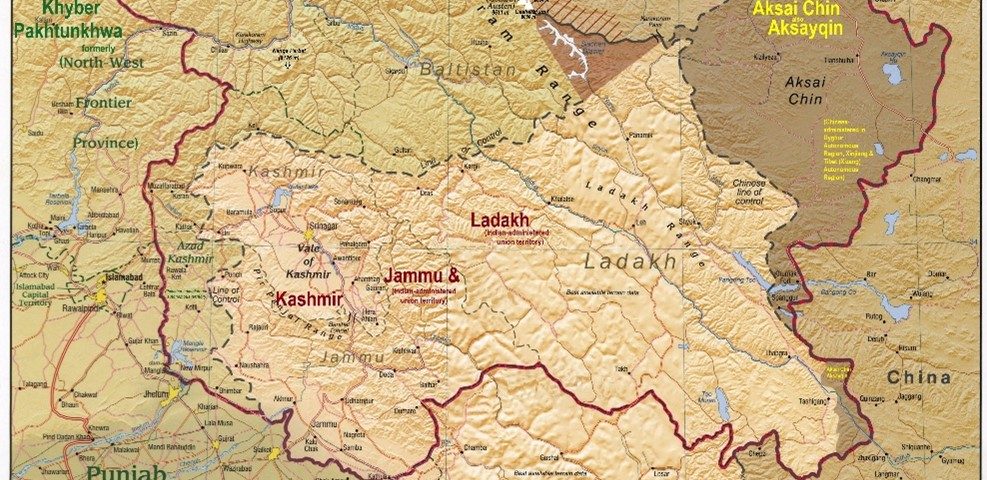
Jammu and Kashmir has moved beyond primordial territorial disputes and the nuclear flashpoint between Pakistan and India. It has become the global fault line where three existential crises converge, specifically the erosion of international law and the weaponization of both nuclear deterrence and climate security. To address these existential threats, the world must also move past outdated diplomatic frameworks and face the interconnected emergencies centered in Kashmir.
Legal Ground Zero: The Fiction of Integration
New Delhi permanently integrated Jammu and Kashmir under the 1947 Instrument of Accession, signed by the Maharaja on October 26. This also legitimizes its unilateral revocation of Kashmir’s special autonomy by Articles 370 and 35A in 2019. Although these amendments are claimed to promote development and equal rights, they appear more as legal impunity than true integration.
Detention, torture, and extrajudicial killings are covered by laws like the Armed Forces Special Powers Act (AFSPA) and the Public Safety Act (PSA). Last year, India banned 25 influential books by well-known authors on Kashmir. It exposes the government’s insecurity about the conflicting historical narrative it exports. Real political integration, though, does not require any forced policies.
Some historians highlight a discrepancy and contest the accession altogether. Andrew Whitehead in “A Mission in Kashmir” cites witnesses and logistical analyses that suggest the Maharaja fled Srinagar and could not have signed until the 27th in Jammu, after Indian troops had arrived. Debates over signing under duress during an invasion raise questions on whether Delhi’s control was a lawful agreement or a military fait accompli later disguised as legal.
More critically, its own actions revealed the territory’s disputed status because it was India that first brought Kashmir to the United Nations. It also accepted the UN Security Council Resolutions that promised a plebiscite on self-determination. Therefore, by unilaterally altering the territory’s demographic and constitutional status, it has not settled the dispute but violated the core principle of those resolutions.
Either way, UN resolutions are inert in resolving frozen conflicts. They may be symbolically potent but serve mainly as diplomatic artifacts with little practical impact. History shows many grim examples, e.g., UNSC resolutions demanded the withdrawal of occupying forces from Nagorno-Karabakh for decades, but enforcement only materialized when local forces created new realities on the battlefield, prompting regional and major powers to shape the final outcome. Similarly, resistance of Kashmiris can eventually push other states to enforce resolutions, even if they generally prioritize stability over intervention.
Strategic Ground Zero: The Hypocrisy That Fuels the Flashpoint
The West, led by the United States, shares a geopolitical interest in India as a counterbalance to China. They describe India as a responsible democratic power, thereby granting it exemptions from international nuclear standards, such as the US-India Civil Nuclear Agreement and membership in the Nuclear Suppliers Group (NSG), without signing the Non-Proliferation Treaty (NPT). Yet numerous uranium theft incidents have been reported from 1994 to 2021, contradicting its responsible nuclear image.
Responses would have been different if any of these happened in Iran or Pakistan. Tehran faces decades of sanctions and isolation over its civilian enrichment, while Islamabad is labeled a proliferation pariah for the A.Q. Khan network.
The point is not in non-proliferation logic but in geopolitical convenience; risks are managed for strategic allies, but for others, they are potential sources of conflict. Double standards of this kind may encourage powers like China and Russia to expand their nuclear commitments in the region. With Kashmir’s ongoing tensions, it is the most likely catalyst for a nuclear chain reaction.
Climate Ground Zero: When Sovereignty Drowns
Treating environmental governance and shared rivers as extensions of national sovereignty is a critical flaw in New Delhi’s policy. The catastrophic floods of 2025 killed hundreds of people across the divided region after India unilaterally suspended the pillar of stability, the Indus Waters Treaty. Islamabad claims that the treaty’s suspension directly crippled cross-border flood warning systems.
The lack of real-time data sharing from Indian-administered Kashmir to downstream communities in Pakistani-administered valley turned a natural disaster into a man-made catastrophe. This action transformed a shared river system into a political weapon, proving that environmental security has now become the first casualty of conflict. Independent verification is yet to come, but given India’s established conduct, such an act is entirely consistent. After all, who will hold this giant economy accountable?
Hydrological warfare demonstrates that the 20th-century concept of hard borders is catastrophically useless against 21st-century climate chaos. Sovereignty cannot stop a monsoon cloud or a glacial surge that ignores passports. Instead of encouraging cooperative action, the world remains paralyzed by short-term strategic interests and a rigid adherence to sovereignty that the climate itself does not recognize.
The Pathway
Hoping that the flashpoint will not ignite is futile. The world can either accept the status quo, which is dangerously developing, or adopt a collective crisis-management strategy. Climate change and the nuclear threat are the main areas where Pakistan can work to secure serious international cooperation. This can happen from abandoning the exhausted bilateral pleas for a grand political settlement and military posturing; instead, pursuing a focused multi-prolonged diplomatic offensive to create inescapable pressure that makes global inaction too costly to ignore.
In launching non-negotiable climate diplomacy, Islamabad can urge the World Bank to reactivate data-sharing under the Indus Waters Treaty, propose a UN-backed joint glacier study, and collaborate on a Kashmir climate resilience fund. This strategy forces India to decide whether to cooperate or expose itself as an obstacle to essential aid.
Similarly, reframing the nuclear threat in every global forum by arguing that de-escalating Kashmir is essential for global nuclear stability, and that current Western hypocrisy is boosting the very proliferation it claims to prevent. In all cases, the world’s attention can only be steered from hope to action by synchronizing legal pressure, climate coercion, and strategic framing.
Disclaimer. The views and opinions expressed in this analysis are those of the author and do not necessarily reflect the official policy or position of MEPEI. Any content provided by our author is of his opinion and is not intended to malign any religion, ethnic group, club, organization, company, individual, or anyone or anything.

Rabbab A. Khan
Lecturer and researcher in International Relations, focusing on political sociology and the foreign policy analysis of Saudi Arabia, particularly through the prism of US-China great-power competition. The author can be reached at rabab7j@gmail.com.