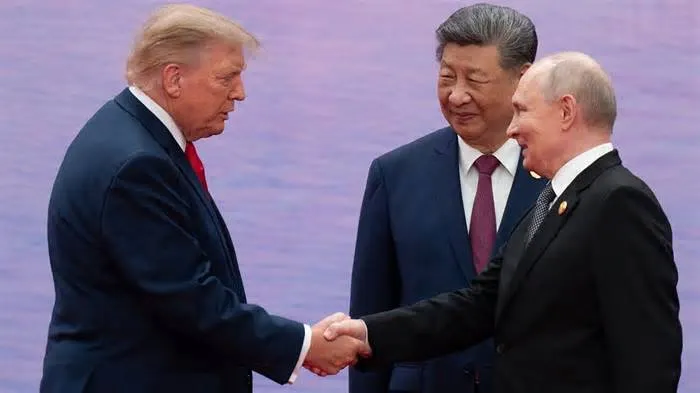

Inconclusive trilateral summit
November 25, 2026
Direct military clashes between the United States (US), Israel, and Iran spilled over into the Gulf Cooperation Council (GCC) states in 2026. The fighting has directly disrupted daily life and economic stability across Saudi Arabia, the United Arab Emirates (UAE), Qatar, Bahrain, Kuwait, and Oman. After the war broke out in February 2026 and hostilities resumed in November, Iranian forces and allied regional groups extended their targets beyond Israel to commercial ships, industrial facilities, and urban centers across the Arabian Peninsula. Because Gulf countries host key American military bases and supply global oil markets, their official neutrality failed to keep them out of missile and drone attacks.
- A Balance That Collapsed
For decades, the six GCC monarchies managed to keep major regional wars outside their borders. Even as conflicts unfolded in Iraq, Syria, and Lebanon, Gulf rulers maintained a stable environment that allowed them to build global financial hubs and launch ambitious economic plans such as Saudi Arabia’s Vision 2030. To protect those investments, they pursued regional diplomacy; in fact, in March 2023, Saudi Arabia and the UAE restored formal diplomatic relations with Iran through an agreement brokered by China. Their aim was straightforward: lower tensions with Tehran so that Gulf cities and oil fields would stay out of regional fighting, while still relying on the US military for protection against external threats. That balance collapsed when the confrontation between Iran, Israel, and the US turned into open war. On February 28, 2026, joint US and Israeli military operations against Iran ignited a full-scale regional conflict. Over the following six weeks, Iranian forces fired thousands of missiles and drones across the region, targeting seven Arab countries alongside Israel. An initial truce in June 2026 temporarily reopened shipping lanes, but diplomacy stalled again in November and a wave of attacks hit the Gulf.
II. Attacks on Infrastructure and Shipping
The spillover has directly affected urban centers, industrial sites, and international maritime trade routes. The most immediate threats came from ballistic missiles and armed drones launched by Iran and by the Houthi movement, an Iran-backed armed group based in Yemen. After new clashes between the Houthis and the Saudi-led coalition, Houthi forces restarted cross-border strikes deep inside Saudi territory. In November 2026, a Houthi strike damaged a high-rise tower in Riyadh’s financial district, and on November 21st, Saudi air defenses intercepted three more ballistic missiles fired toward the capital. Two days later, the Houthis claimed an attack on Saudi Arabia’s Rabigh oil refinery on the Red Sea coast while in Bahrain, authorities reported that an Iranian strike hit a civilian industrial facility, causing a fire and injuring two residents.

Maritime traffic in the Strait of Hormuz, through which roughly one-fifth of global petroleum passes, faced unprecedented disruption following the 2026 regional escalation. (Photo: Anadolu Agency)
Water and power infrastructure are also major vulnerabilities. The Arabian Peninsula has almost no natural freshwater rivers or lakes, so Saudi Arabia, the UAE, and Kuwait rely on coastal desalination plants for most of their drinking water. Military analysts warn that even limited damage to these plants, or to the power grids that run them, could cause severe water shortages in major cities. Commercial shipping has faced unprecedented disruption as well. In the initial phase of the war, in March 2026, tanker traffic through the Strait of Hormuz fell from roughly 37 vessels per day to nearly zero, prompting the Kuwait Petroleum Corporation to declare force majeure on oil shipments. After ceasefire talks broke down in mid-November 2026, attacks on oil ships spiked again in the Strait of Hormuz and the Gulf of Oman. The UAE and Oman had to launch emergency search-and-rescue operations, and Brent crude climbed past $92 a barrel. Roughly one-fifth of the world’s petroleum passes through the strait, so any military tension there is an immediate threat to global energy stability.
- Tehran and the Gulf Capitals
Tehran, Washington, and Gulf capitals view responsibility for the escalation in sharply different terms. From the perspective of Tehran and its regional allies, targeting facilities and shipping lanes in the Gulf is a strategic response to Western military pressure and the US naval blockade of Iranian ports. Iranian officials and military commanders have repeatedly stated that countries hosting US airbases cannot claim to be neutral while American forces conduct operations against Iranian territory. In Tehran’s view, strikes near Gulf logistics hubs and energy corridors are meant to raise the economic cost of the war for Washington and its partners.
On the other hand, Gulf officials strongly reject this logic. Throughout the conflict, governments in Riyadh, Abu Dhabi, and Doha denied the use of their territory and airspace for offensive operations against Iran and refused to retaliate militarily even after suffering direct strikes. Gulf leaders view missile and drone attacks on civilian buildings and industrial facilities as unprovoked violations of their national sovereignty.
Within the GCC itself, individual member states have responded differently depending on their geographic location and political ties:
- Saudi Arabia and the UAE have focused heavily on air defense, deploying interceptor systems to shoot down incoming drones and missiles before they reach populated areas and key energy terminals.
- Bahrain and Kuwait, which are close to Iranian territory and host large US military contingents, including the US Navy’s Fifth Fleet in Bahrain, have put their security forces on high alert while dealing with attacks on industrial sites and disruption to energy exports.
- Oman and Qatar have kept serving as peace mediators and emergency rescue teams at sea. Using their open lines of communication with both the U.S. and Iran, officials from both countries have worked to set up private talks to arrange local ceasefires and reopen shipping routes.
- Gulf Vulnerabilities
Relying on the US for military protection has clear limits. For decades, Gulf states traded oil access and military bases for American security. US forces have shot down many incoming attacks, but their defense systems still struggle under large, coordinated waves of drones and missiles. Hosting US bases also carries a cost: when the US and Iran clash directly, the bases become targets and pull retaliatory strikes onto nearby Gulf cities. Economic modernization also depends on regional security. Programs like Vision 2030 and the UAE’s economic diversification plans rely on foreign investors and stable trade routes. Whenever missiles target Riyadh’s financial district, airlines cancel regional flights, or tankers are struck in the Strait of Hormuz, international investors raise their risk assessments. Borrowing costs go up and major infrastructure projects get delayed.
Coordination among the six GCC countries remains the weakest point. Although the bloc has a joint military unit, the Peninsula Shield Force, and a Joint Defense Council, member states still mostly handle air defense and intelligence on their own instead of through a single unified command. Without shared radar networks and joint crisis planning, individual Gulf states face fast-moving air attacks alone. Researchers at the Middle East Council on Global Affairs were blunt about the political cost in their July 2026 assessment of the conflict: “The war’s most uncomfortable lesson concerns the GCC itself. The GCC issued statements; it did not act collectively” (MECGA 2026).
- Recommendations
Policymakers in the Gulf and their international partners need to adjust their long-term defense and foreign strategies in three areas:
- Collective defense: GCC governments need to move past political statements and set up a permanent, shared intelligence center with secure communications to track missile and drone threats together. At the same time, the region’s sovereign wealth funds, which hold nearly $5 trillion, should prioritize protecting vital infrastructure such as desalination plants, power grids, and ports.
- Security partnerships: Gulf states should diversify their partners by working more closely with European and Asian countries to build locally run, connected air and missile defense networks, without giving up deterrence.
- Maritime security: European countries and other key international partners should work with Gulf states to create lasting security frameworks for the Persian Gulf and the Red Sea, keeping trade ships and global energy flows safe from future regional shocks.
Conclusion
The expansion of the US-Israeli-Iran conflict into the Arabian Peninsula has changed the security reality of the Middle East. Diplomatic normalization agreements and official declarations of neutrality did not stop missile and drone attacks from reaching Gulf capitals, industrial sites, and vital energy corridors. As long as the fighting continues, the Gulf’s economic plans will depend on whether these governments can protect their water, power, and shipping routes, and finally coordinate their own defense.
References:
Alzou’bi, M. S. (2026, July 23). Securing a Permanent Exit from the Iran War: 12 Steps and a Gulf Anchor. Politics and Society Institute. https://politicsociety.org/2026/07/23/securing-a-permanent-exit-from-the-iran-war-12-steps-and-a-gulf-anchor/?lang=en
Anadolu Agency. (2026, May 11). Divided Under Fire: The GCC as Six States, No Bloc.https://www.aa.com.tr/en/opinion/divided-under-fire-the-gcc-as-six-states-no-bloc/3933789
Bakir, A. (2026, July 14). Lessons Learned by GCC States in the 2026 US-Israel-Iran War (Issue Brief). Middle East Council on Global Affairs (MECGA). https://mecouncil.org/publication/lessons-learned-by-gcc-states-in-the-2026-us-israel-iran-war/
Coates Ulrichsen, K. (2026, March 23). The GCC States and the War on Iran: Rethinking Responses to Unwanted Consequences. Arab Center Washington DC. https://arabcenterdc.org/resource/the-gcc-states-and-the-war-on-iran-rethinking-responses-to-unwanted-consequences/