

Same War, Different Prices: How the Gulf Borrowed Through the Iran War
November 14, 2026
Pakistan’s mining ecosystem & QAU
November 17, 2026
The upcoming trilateral summit in the Chinese city of Shenzhen, scheduled for November 19, 2026, between US President Donald Trump, Chinese President Xi Jinping, and Russian President Vladimir Putin, derives its significance from more than the international circumstances surrounding it. Its deeper importance lies in what it reveals about China’s changing position in the international system. Beijing is not simply hosting a meeting between three leaders representing the world’s major nuclear powers. It is placing itself at the center of a strategic interaction involving states that compete over the future structure of the international order while holding fundamentally different understandings of security, stability, and power.
The summit can be examined from a perspective that goes beyond the conventional question of the balance of power: Which state is stronger, and which can extract greater concessions? A more consequential question concerns who possesses the ability to organize relations among competing powers, influence the conditions of their interaction, and identify areas where conflicting interests can converge. This is where one of the emerging characteristics of Chinese foreign policy becomes visible: the gradual shift from using economic and diplomatic resources primarily to expand influence towards using China’s international position to shape the strategic environment in which other powers operate.
The Power to Organize Competition
In international relations, power has traditionally been associated with the possession of military, economic, and technological resources and the ability to translate them into political influence. Contemporary developments, however, require greater attention to another dimension of power: the ability to organize international interactions. This form of influence rests on bringing competing parties together, providing platforms for negotiation, shaping agendas, and influencing the political framework within which strategic bargaining takes place.
From this perspective, China does not need to present itself as a neutral mediator between Washington and Moscow to gain strategic benefits from the summit. It is enough for Beijing to become a state that neither side can bypass when discussing issues affecting their shared strategic interests. This differs from traditional mediation, which generally requires proposing settlement formulas, offering reciprocal guarantees, and assuming responsibility for implementing agreements.
Beijing understands that its international position is determined not only by the size of its economy, trade volume, or military capabilities, but also by the extent to which other states must incorporate Chinese interests into their strategic calculations. The United States needs China to manage economic and technological competition, while Russia relies on its partnership with Beijing to expand its economic and diplomatic options under Western pressure. China, in turn, needs to prevent its relations with either power from becoming an alignment that forces it into an exclusive strategic choice.
This position provides Beijing with an opportunity to manage contradictions without necessarily assuming responsibility for resolving them. China can remain an economic partner of Russia, a strategic competitor of the United States, and simultaneously an interlocutor with Washington on nuclear stability, trade, and international security. Its approach involves maintaining a degree of separation between areas of cooperation and competition rather than transforming relations with either country into an all-encompassing alliance or confrontation.
Why Does China Need Both Washington and Moscow?
The deepening of Chinese-Russian relations in recent years may suggest the emergence of a strategic alignment capable of counterbalancing American influence. Yet an examination of China’s interests reveals that Beijing has little incentive to turn this partnership into a closed military alliance or an international front defined primarily by opposition to the United States.
The Chinese economy remains deeply connected to global markets, technology, investment, and international trade. A sharp fragmentation of the global economy would impose considerable strategic costs on China’s development objectives. Beijing therefore needs a stable relationship with Washington, even amid competition, just as it needs to preserve its partnership with Moscow.
Russia remains an important partner for China in energy, continental security, and diplomatic coordination. Nevertheless, it cannot replace the extensive international economic networks upon which Chinese power depends. This explains Beijing’s interest in maintaining its partnership with Moscow without allowing it to become an unconditional strategic commitment.
Russia, meanwhile, needs international recognition of its status and wants to demonstrate that its relationship with China does not reduce it to a subordinate position in an international system shaped by Beijing and Washington. The summit therefore reflects three different strategic agendas. Trump seeks to demonstrate his ability to achieve progress on arms control and major international disputes. Putin wants to reaffirm Russia’s position among the principal global powers. Xi Jinping, by contrast, seeks to establish that China has become central to the management of international affairs rather than merely an emerging economic power demanding adjustments to the existing order.
These competing interests make the meeting significant, but they also impose clear limits on what it can realistically achieve.
The Dilemma of Mediation and the Limits of Chinese Leadership
Hosting the summit presents China with a political dilemma. Beijing wants to portray itself as a defender of international pluralism, state sovereignty, and opposition to hegemonic practices. Yet it is simultaneously hosting a meeting that could evoke the tradition of great-power diplomacy, in which the interests of states absent from the negotiating table are discussed and potentially determined.
The comparison with the 1945 Yalta Conference is neither historically nor politically exact, but it reflects a deeper concern among smaller and middle-ranking states. An international order based on state sovereignty cannot remain stable if relations among major powers become a mechanism for distributing spheres of influence. Ukraine and several European states have expressed concern that the summit could create space for understandings concerning the future of the conflict in Ukraine without the meaningful participation of the parties directly concerned. Beijing itself appears cautious about allowing the Ukrainian issue to dominate the agenda, partly because doing so could expose China to commitments and pressures it does not wish to assume.
This reveals a central challenge for Chinese diplomacy: how can Beijing present itself as a supporter of a multipolar international order without appearing to participate in the reproduction of a system dominated by agreements among major powers?
The answer lies not simply in diplomatic language, but in China’s willingness to provide other states with a meaningful role in shaping international arrangements. Multipolarity does not merely mean increasing the number of major powers sitting at the negotiating table. It also means preventing those powers from monopolizing the authority to determine the future of others.
Strategic Stability Before Agreements
This dilemma is particularly evident in the nuclear file. Trump wants to expand nuclear arms control negotiations to include China, while Beijing argues that the substantial disparity between its arsenal and those of the United States and Russia makes participation in formally equal negotiations fundamentally unfair. The expiration of the New START Treaty in February 2026 has further complicated the situation, leaving the world’s two largest nuclear arsenals without a binding bilateral framework governing their strategic limits.
For China, the priority is not to enter arrangements that might constrain its nuclear capabilities without addressing the existing imbalance. Rather, Beijing seeks to ensure that strategic competition with Washington does not develop into an arms race that undermines the external environment necessary for continued economic development. Chinese thinking about strategic stability therefore extends beyond weapons control. It also encompasses technological competition, the avoidance of military confrontation, and the preservation of a minimum degree of predictability in the behavior of major powers.
Maintaining communication channels and preventing strategic miscalculation may consequently prove more realistic than reaching a comprehensive agreement at this stage. The summit’s political value may lie in reaffirming the principle of continued dialogue even when substantive agreement remains difficult.
The same logic applies to the war in the Middle East. China is concerned with the stability of energy supplies and maritime security. Russia views developments in energy markets through the lens of its economic and strategic interests, while Washington seeks to preserve its freedom of action in managing regional security issues. These interests do not fully converge, but they create common incentives to prevent escalation that would impose substantial costs on all three powers.
From Shenzhen to the International Order
Another dimension of the summit deserves attention: its location in Shenzhen, one of the most significant symbols of China’s economic and technological transformation. Once a special economic zone, the city has become a global center of advanced manufacturing, innovation, and technology companies. Hosting a meeting of this level carries symbolic significance, reflecting the type of international power China seeks to project: one combining productive and technological capabilities with diplomatic presence.
Turning these assets into international leadership, however, is a different challenge. Possessing resources does not automatically confer legitimacy, and the ability to bring rivals together does not necessarily translate into the ability to resolve their disputes. Nor does successfully hosting the summit prove that China has become capable of providing international security or assuming responsibility for managing global crises.
It is therefore important neither to exaggerate the summit’s implications nor to underestimate its significance. China will not reshape the international order through a single meeting. Nevertheless, it is using the summit to test a form of international engagement that combines economic influence, diplomatic initiative, and the capacity to shape the strategic calculations of other powers.
Ultimately, the summit may not produce a historic agreement. Its deeper significance, however, lies in testing a question that extends beyond its immediate outcomes: Can China move from being a power demanding a greater place within the international system to becoming a power that helps organize its relationships and manage its contradictions?
Such a transformation will not be achieved simply by hosting world leaders or issuing joint statements. It will depend on Beijing’s ability to reconcile national interests with international responsibility, and its commitment to multipolarity with respect for the independence of less powerful states. A power capable of bringing rivals together can acquire considerable influence. But a power capable of establishing fair rules for their interaction is the one that can acquire the legitimacy of international leadership.
Perhaps this is China’s most important test in Shenzhen: not proving that it has become a power that others cannot bypass, a status that is already increasingly evident, but demonstrating that its rise can make the international system more stable without turning China’s own ascent into another source of strategic competition and systemic imbalance.
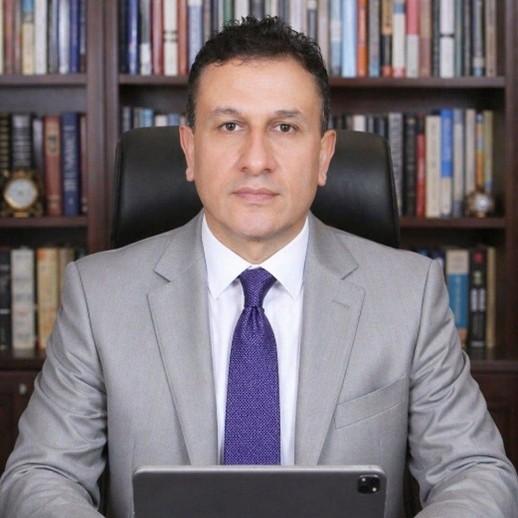
Prof. Shaher Al Shaher
Dr. Shaher Al SHAHER is an Associate Professor at the School of International Studies, Sun Yat-Sen University, China. Shaher@mail.sysu.edu.cn.

