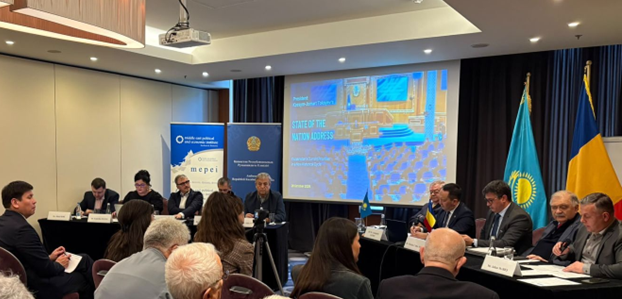
Round Table – “Kazakhstan’s Current Priorities in a New Historical Cycle”, 17 November 2026
November 18, 2026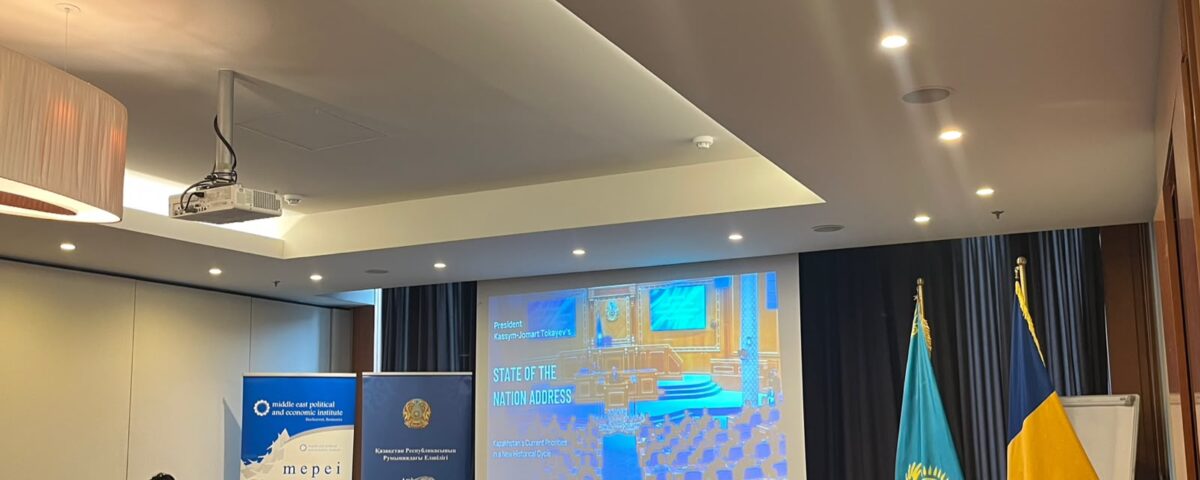
Roundtable Discussion on the Address of the President of the Republic of Kazakhstan, Kassym-Jomart Tokayev: “Kazakhstan’s Current Priorities in a New Historical Cycle (17 November 2026, Bucharest)
Dear heads and directors-general of Romanian institutes and think-tanks,
Dear participants of the roundtable!
I am very pleased to see you all on this wonderful day.
Thank you for coming together today to discuss the Address of the President of Kazakhstan, Kassym-Jomart Tokayev, to the people of the country, devoted to the topic “Kazakhstan’s Current Priorities in a New Historical Cycle”.
This shows the great interest that the Romanian expert community has in Kazakhstan and, I am sure, in our entire large region.
The Address of the President of the Republic of Kazakhstan, Kassym-Jomart Tokayev, dated 28 October 2026 and titled topic “Kazakhstan’s Current Priorities in a New Historical Cycle” is not simply a program of further social and economic reforms. In essence, it presents a strategic vision for the country’s continued modernization, stronger economic independence and a better quality of life for its citizens.
The main idea of the Address is to move from the economic potential we have built up to putting that potential into practice. The President has set an important task: we must pass on to future generations not only financial resources, but also a modern country with advanced technology, a competitive economy, good infrastructure and strong human capital.
As the Head of State emphasized in his Address, Kazakhstan today needs to move from strategic intentions to tangible results. Consistency, a systematic approach, and accountability for the implementation of the objectives set must become the guiding principles of further transformation. It is important not only to identify promising areas for development, but also to ensure their practical implementation, with tangible benefits for every citizen of the country.
- The first key priority is large-scale infrastructure modernization.
The President announced the launch of the nationwide “People’s Construction” project, which is expected to cover all regions of Kazakhstan.
The scale of the planned changes is reflected in clear financial figures. By the end of 2029, around 13 billion EUROis expected to be allocated from the National Fund for infrastructure modernization. At the same time, 3 billion EUROis planned for social projects during the current year and the first two months of 2027.
At the first stage, around 70 healthcare facilities and about 50 education, sports and cultural facilities are planned to be built.
It is especially important that this is not only about building new facilities, but also about creating a modern social environment, particularly in rural areas.
At the same time, the scale of public investment calls for special attention to the effective use of funds, transparent project delivery and clear social and economic results.
- The second priority is economic diversification and the development of the country’s transit and logistics potential.
Kazakhstan has major competitive advantages. According to the International Monetary Fund forecast mentioned in the Address, the country’s GDP will approach 400 billion DOLLARS in 2026, while GDP per capita will exceed 19 thousand DOLLARS. The share of manufacturing has already exceeded 14 percent.
According to the IMF’s October forecast, Kazakhstan’s real economic growth in 2026 is expected to reach 4.4 percent, above the projected global average of 3.1 percent.
These figures show the country’s strong economic potential. However, further development requires a move away from a raw-material-based model towards an economy based on productivity, technology and the creation of added value.
Transport and logistics are becoming especially important. Kazakhstan is steadily strengthening its position as one of Eurasia’s key transport and logistics hubs. The country’s geographic location makes it possible to connect the markets of China, Central Asia and Europe.
The Address notes that around 85 percent of cargo shipments from China to the European continent pass through Kazakhstan.
This is a major competitive advantage that needs to be turned into real economic gains, the growth of domestic logistics companies, the creation of new industries and a stronger position for Kazakhstan as a Eurasian transport hub.
In this regard, cooperation with Romania is especially important. Thanks to its geographic location and access to the Black Sea, Romania is an important gateway for Kazakhstan to the European market. The Middle Corridor offers new opportunities to strengthen transport and logistics links between our countries, expand trade flows and build reliable supply chains between Asia and Europe.
We are interested in the active involvement of Romanian companies in developing this route. We invite Romanian businesses to cooperate in transport and logistics, port infrastructure, trade, industry and joint investment projects. I am confident that combining Kazakhstan’s transit opportunities with Romania’s logistics potential will create new economic opportunities for both countries and strengthen our strategic partnership.
- The third priority is energy security and technological independence.
The President clearly pointed to the shortage of energy capacity needed for further industrial development and large-scale digitalization.
Today, Kazakhstan produces around 123 billion kilowatt-hours of electricity. At the same time, the strategic goal is to achieve a stable energy surplus by 2029.
In this context, the development of nuclear energy, the modernization of existing power plants, the construction of new power generation facilities and the development of renewable energy sources are especially important.
A reliable energy supply is becoming not just a sectoral issue, but a basic condition for economic independence, industrial growth and the use of artificial intelligence.
The President has set the goal of achieving a stable energy surplus by 2029. To do this, the plans include modernizing existing power plants, building new energy facilities, and developing renewable and nuclear energy. Long-term energy planning through 2035 must take into account the growing needs of industry, digitalization and data centers.
I would like to note that Kazakhstan is moving ahead with plans to build its first nuclear power plant in the Almaty Region, while projects for additional nuclear power plants are also being considered. In the future, this will help create a reliable basis for the country’s electricity supply, reduce the shortage of power generation capacity and support further industrial development.
In this context, Romania’s experience is also worth noting. The country has well-developed energy infrastructure and significant potential in oil refining. Rompetrol, which is part of the international KMG International group and represents Kazakhstan’s energy presence in Europe, plays an important role in supplying petroleum products to Romania and other European markets. This is a clear example of how Kazakh investments and international partnership can help strengthen Europe’s energy security.
I am confident that our experience of cooperation in the energy sector creates further opportunities to expand ties between Kazakhstan and Romania — from oil refining and petrochemicals to the development of new energy technologies.
- The fourth priority is digital transformation and the development of human capital.
The Address stresses the need to speed up the introduction of artificial intelligence, digital technologies and modern methods of public administration.
Kazakhstan is actively building digital infrastructure to move towards an economy based on knowledge and technology. Under the Digital Qazaqstan programme, two supercomputers have been put into operation, and the launch of a third is planned by the end of 2026.
The fiber-optic cable across the bottom of the Caspian Sea has been completed, and data center infrastructure is also being developed. An important area is the use of artificial intelligence in public administration, industry, transport, agriculture and the financial sector. The main task is to ensure that digitalization brings not only technological upgrades, but also a real increase in labor productivity and the competitiveness of the economy.
- The fifth priority is improving the effectiveness of public administration and strengthening the principle of “Law and Order”.
Large-scale reforms require not only financial resources, but also strong institutions and a sound institutional environment.
It is necessary to ensure coordination between government agencies, their accountability, transparency in investment decisions and regular monitoring of the tasks set.
At the same time, public investment should help attract private capital, rather than replace business initiative.
Dear colleagues!
I would also like to highlight Kazakhstan’s financial stability. The country’s total gold and foreign currency reserves, together with the assets of the National Fund, exceed 130 billion dollars. This is a significant resource that creates opportunities to carry out strategic initiatives.
However, financial reserves alone do not guarantee sustainable development. What matters most is how effectively these resources are used to develop the production base, infrastructure, science, education and technology.
I would particularly like to emphasize the President’s point regarding the need to enhance the effectiveness of public administration and strengthen accountability for decisions made. In the current environment, assessing the performance of government bodies solely on the basis of formal indicators is no longer sufficient. Priority must be given to tangible changes in the economy, improvements in the well-being of the population, and the quality of public services delivered.
In my view, the most important conclusion of the Address is this: Kazakhstan is entering a stage where the main measure of effective government policy is not the number of decisions made, but the concrete results they deliver.
The President’s Address sets the strategic direction. Our task is to give it practical meaning through clear content, professional assessments and practical proposals.
I am convinced that cooperation between the state, business, science and the expert community will make it possible to ensure Kazakhstan’s sustainable development and build a strong foundation for the well-being of future generations.
Thank you for your attention!