
Round Table “Kazakhstan in the Era of Artificial Intelligence”
October 6, 2025
The 80th session of the United Nations General Assembly:The High-level Meeting to Launch the Global Dialogue on AI Governance
October 8, 2025The 80th session of the United Nations General Assembly: The First Biennial Summit for a Sustainable, Inclusive and Resilient Global Economy: Implementing commitments on financing development

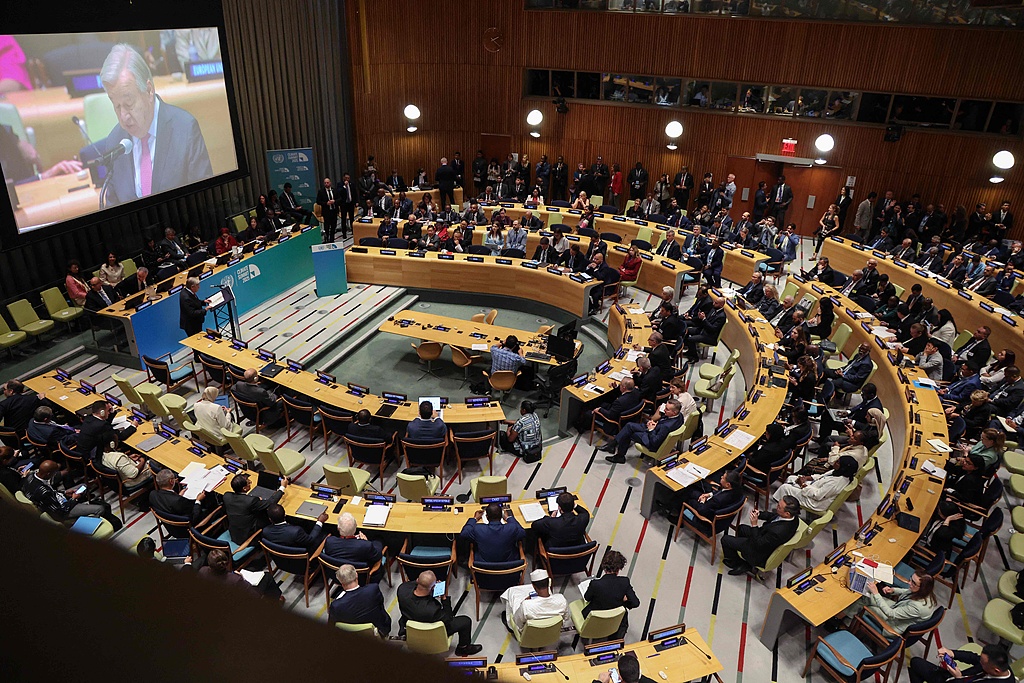
Source: UN Secretary General Antonio Guterres addresses the “Climate Summit 2025” on the sidelines of the United Nations General Assembly at the UN headquarters in New York City
Convened during the eightieth session of the United Nations General Assembly, the First Biennial Summit on a Sustainable, Inclusive, and Resilient Global Economy marked the first time since the adoption of the Future Pact that the issue of “financing for sustainable development” was elevated to a level of dialogue between heads of state and international financial institutions. While the summit did not produce staggering figures or groundbreaking agreements, it showed a new sense of realism and collaborative energy into global economic governance in a measured manner (Ahluwalia, 2000).
What set this summit apart from previous similar gatherings was its emphasis on “shared accountability.” For the first time, leaders from the IMF, the World Bank, regional development banks, and dozens of countries engaged in discussions within a unified framework on how to strike an operational balance between social equity and sustainable development within the multilateral financial system (Gallagher & Kozul, 2021). This structure served not only as a platform for political negotiation but also as an institutional experiment, seeking to give tangible form to the abstract concept of “inclusive resilience.”
For Global South nations, the summit represented more than just political symbolism which was an opportunity to drive tangible reforms. Representatives from Africa, Asia, and Latin America collectively called for expanded concessional financing, revised credit rating criteria, and enhanced representation for emerging economies in international financial institutions. Although proposals such as the “Joint Financing Dialogue Mechanism” and the “Micro-Resilience Fund” were limited in scale, they signaled a shift from a model of “aid dependency” toward one of “risk-sharing and responsibility-sharing.” This pragmatic institutional innovation was regarded by many participants as a new direction for international economic cooperation.
The tone of the summit also differed markedly from past meetings. In the wake of the pandemic, climate shocks, and inflationary crises, countries have begun to recognize that economic recovery is no longer a zero-sum game but a process of mutual adaptation and shared stability (FSDO, 2024). For example, Matamela Cyril Ramaphosa, president of South Africa, called on the African Union, the G20, international financial institutions, and other global financial bodies to actively coordinate. He stated that global rules must be jointly formulated by all member states rather than just a few, and that the commitment of “ensuring no one is left behind and no country is left behind” must be fulfilled.
However, the constructive tone did not preclude criticism. Multiple representatives cautioned that reforms must not remain confined to political declarations but should be backed by measurable mechanisms (Biswas, 2015). For instance, some member states proposed establishing an annual financing accountability reporting system within the UN framework to conduct independent reviews of sustainable development fund flows and debt relief implementation. If realized, such a mechanism would transform the biennial summit into a genuine “policy review platform” rather than a venue for ceremonial declarations (Caliari & Schroeder, 2004).
The summit also reflected a re-evaluation of the private sector’s role. Kristalina Georgieva, managing director of the International Monetary Fund, believes that the global economic system is undergoing restructurings. She said by the year 2030, global public debt as a proportion of GDP is expected to approach 100 percent, and many countries will lose their fiscal space. Therefore, structural reforms are needed to unleash more investment power from the private sector. However, many representatives stressed that such cooperation must be grounded in fairness, not profit motives. As one African finance minister stated, “If sustainability lacks equity, it will not bring stability.”
The significance of this summit lies not in its ability to reshape the global economy overnight, but in its establishment of a sustainable institutional pathway for cooperation. Through technical coordination, information transparency, and inclusive participation, it laid the groundwork for continuity and accountability in future biennial meetings (Stiglitz & Greenwald, 2014).
In the aftermath of the summit, participants broadly agreed that the legitimacy of global governance hinges on its ability to deliver both growth and trust (D’arista, 2000). While the first biennial summit may only represent a starting point, it has prompted the world to rethink the true meaning of “cooperation”, moving from aid-based relationships to equal partnerships, and from crisis response to institutional co-creation.
In an era marked by intertwined challenges of debt, conflict, and inequality, the very act of reopening dialogue in a constructive manner signifies a new possibility. As one Latin American representative concluded, “We may not have changed the world, but we have finally begun planning it at the same table.”
References
Ahluwalia, M. S. (2000). Reforming the global financial architecture (Vol. 41). Commonwealth Secretariat.
Biswas, R. (2015). Reshaping the financial architecture for development finance: the new development banks.
Caliari, A., & Schroeder, F. (2004). Reform proposals for the governance structures of the international financial institutions. New Rules for Global Finance, Mimeo (May).
D’arista, J. (2000). Reforming international financial architecture. Challenge, 43(3), 44-82.
FSDO, D. (2024). Financing for Sustainable Development Report 2024. UN Department of Economic and Social Affairs. https://desapublications. un. org/publications/financing-sustainable-developmentreport-2024.
Gallagher, K. P., & Kozul-Wright, R. (2021). The case for a new Bretton Woods. John Wiley & Sons.
Stiglitz, J. E., & Greenwald, B. C. (2014). Creating a learning society: A new approach to growth, development, and social progress. Columbia University Press.
United Nations Conference on Trade and Development (UNCTAD). (2023). Trade and Development Report 2023: Growth, Debt, and Climate: Realigning the Global Financial Architecture. UN.
Disclaimer. The views and opinions expressed in this analysis are those of the author and do not necessarily reflect the official policy or position of MEPEI. Any content provided by our author is of his opinion and is not intended to malign any religion, ethnic group, club, organization, company, individual, or anyone or anything.
Ms. Lu DONG
Ms. Lu DONG: master at University College London and intern at MEPEI.