

Who Governs Global Football? The Rise of Arab Influence Inside FIFA: The August 2026 FIFA crisis and the rise of institutional influence in global football governance
August 16, 2026
Mapping the International Relations of Romania with Middle Eastern Countries: A Policy Analysis
September 17, 2026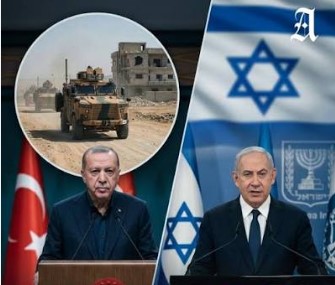
Relations between Türkiye and Israel are no longer merely a troubled diplomatic relationship affected by the war in Gaza or by the personal and political dispute between Recep Tayyip Erdoğan and Benjamin Netanyahu. What is happening today is much deeper: an escalating competition over the balance of power, the shape of the new Syrian state, the boundaries of military and security influence, and who possesses the ability to influence the regional order taking shape in the Middle East.
This competition has entered a more dangerous phase in recent days following the Israeli airstrike on the Abu al-Duhur military base in north-western Syria on 18 August 2026. Israel said that the strike was aimed at preventing a potential Turkish military deployment at the base. Türkiye rejected the Israeli account, while Damascus stated that there were no plans to establish a Turkish military base there.
What matters in this incident is not the extent of the damage caused by the strike, but rather the strategic message it conveyed: Israel is prepared to use force to prevent what it considers a transformation in Syria’s military environment that could provide Türkiye with a deeper foothold close to Israel’s strategic sphere.
The question, therefore, is bigger than a military base or an airstrike: Could the Turkish-Israeli competition for influence turn into an open regional confrontation?
- Syria: The Most Dangerous Point of Friction
If Gaza triggered the political crisis between Ankara and Tel Aviv, Syria is giving this crisis its strategic and military dimension.
Following the fall of Bashar al-Assad’s regime at the end of 2024 and the emergence of new leadership in Damascus, Syria’s geopolitical environment changed dramatically. Türkiye has become one of the leading supporters of the new Syrian authorities and has sought to contribute to rebuilding state institutions, the army and security services, while Israel has intensified its military operations inside Syria in an effort to prevent the emergence of a military structure that it considers a threat to its security.
For Ankara, Syria is not simply a neighbouring country; it is a direct component of Türkiye’s national security framework. The stability of the Syrian state, border control, preventing the return of armed organisations, addressing the Kurdish issue, and the return of refugees are all matters that make Syria’s future directly connected to Turkish interests.
Israel, however, views the issue from a different perspective. It does not want the new Syria to become a strong military state capable of developing advanced air, missile and air-defence capabilities. Nor does it want Syrian territory to become a platform for competing regional influence. For this reason, the reconstruction of the Syrian army itself has become a geopolitical issue.
The Abu al-Duhur airstrike exposed this contradiction clearly. Israel said that Damascus was moving towards allowing Turkish forces to deploy at the base, and that such a move would violate the security arrangements Israel considers necessary. Türkiye, on the other hand, denied that there was any plan to establish a Turkish military base, while Syrian Foreign Minister Asaad al-Shaibani said that Damascus had made clear to Israel that there was no plan to establish a Turkish base at Abu al-Duhur.
But even if there was no final plan to establish a Turkish base, the mere possibility of a more entrenched Turkish military infrastructure in Syria is sufficient to alter Israeli calculations. This is where the problem lies.
Israel is no longer facing only Iran and its allies in Syria, as was the case in previous years. It is increasingly confronted with the possibility of the emergence of a major Sunni regional power, a NATO member with an advanced military, a sophisticated defence industry and close relations with the new Syrian government.
This is fundamentally different from the Iranian challenge.
- Abu al-Duhur: A Strike against Türkiye or a Message to Damascus?
The Israeli strike on Abu al-Duhur can be interpreted on three levels:
The first level: Military. Israel sought to prevent the establishment or development of a Syrian military infrastructure that could benefit from Turkish support.
The second level: Political. The strike was a message to Damascus that rebuilding the Syrian state would not be an unrestricted process, and that Israel would seek to influence the nature of the security arrangements inside Syria.
The third level: Turkish-Israeli. This is the most dangerous dimension. Israel is no longer dealing with Syria merely as an arena of confrontation with Damascus, but as a space where Israeli and Turkish interests can directly intersect.
The seriousness of this development has prompted the United States to seek the establishment of a mechanism to prevent friction between Türkiye, Israel and Syria. US Special Envoy for Syria Tom Barrack said that Washington was working to establish a trilateral communication channel to avoid miscalculation and unintended confrontation. This is significant in itself.
When Washington begins looking for a mechanism to prevent friction between two regional powers, it means that the problem has moved beyond political statements and now carries genuine military risks.
Even more significantly, Barrack said that the Israeli strike had not been preceded by US notification, which he regarded as unusual given the close military relationship between Washington and Tel Aviv. Israel, meanwhile, said that it had exchanged intelligence and issued warnings to the Syrian side.
The danger of Abu al-Duhur, therefore, does not lie in the base itself, but in the possibility that Syria could become a theatre for an unintended confrontation between two major powers.
III. Gaza: From Political Disagreement to Rupture
If Syria has elevated the dispute to the strategic level, Gaza has deepened the political rupture between the two countries.
Since the outbreak of the war, Türkiye has become one of the most vocal critics of Israeli policy in Gaza. The level of political and legal confrontation has risen significantly, while the Palestinian issue has become a central element of Turkish foreign policy towards Israel.
In August 2026, the confrontation acquired a new legal dimension when Türkiye announced that it would request an Interpol Red Notice against Israeli Prime Minister Benjamin Netanyahu in a case related to the interception of an aid flotilla heading towards Gaza. The Turkish Justice Minister said that arrest warrants had been issued in Türkiye against Netanyahu and another Israeli official over allegations including genocide, crimes against humanity and torture, while Reuters confirmed that Interpol would examine the request before deciding whether to issue a Red Notice.
This step does not mean that Netanyahu has automatically become wanted by Interpol; the final decision does not rest with the Turkish government alone. Nevertheless, it represents a major legal and political escalation in bilateral relations.
Netanyahu’s office responded to the Turkish move by portraying it as an attempt to exert pressure on the Israeli leadership. The relationship has therefore moved from diplomatic disagreement towards the use of international legal instruments as tools of political confrontation.
The dispute is also no longer confined to rhetoric. Türkiye suspended its bilateral trade with Israel in May 2024, after trade between the two countries had reached approximately $6.2 billion in 2023, according to Reuters. This means that the political rupture has also carried an economic cost.
- From Strategic Partnership to Rivalry
The historical irony is that Türkiye and Israel were once a model of strategic cooperation in the Middle East.
During the 1990s, relations developed into an advanced military and security partnership. The two countries signed military cooperation and defence-industrial agreements, while their relationship included joint exercises, intelligence cooperation and the transfer of defence technology. The partnership reached its peak in the mid-1990s.
At that time, both sides viewed Syria and Iran as important sources of concern, and shared security interests were among the main reasons for their rapprochement.
But the regional environment changed.
Relations gradually deteriorated as disagreements over the Palestinian issue intensified. The Gaza war of 2008–2009, the Davos crisis and the Mavi Marmara incident in 2010 pushed the relationship into one of its worst periods. Academic studies indicate that these developments represented major turning points in the transition from cooperation to political confrontation.
The problem today is that the dispute is no longer related to a single event.
The two countries now have different perceptions of what the Middle East itself should look like.
Türkiye wants a regional order in which it functions as a central power capable of influencing Syria, the Caucasus, Iraq, the Eastern Mediterranean and the Gulf, while Israel views the rise of any major regional military power near its borders through the lens of deterrence and Israeli security.
The competition has therefore become structural.
- Has Türkiye Become Israel’s “New Iran”?
The comparison may be exaggerated if taken literally, but it is important for understanding the transformation in Israeli strategic thinking.
For years, Iran was the most prominent regional threat in Israeli security doctrine because of its nuclear programme, missile capabilities, network of allies and ability to operate through regional proxies.
Türkiye is fundamentally different. It is a member of NATO, possesses a large military and an advanced defence industry, has a growing industrial and technological base, and has direct military experience in Syria, Iraq, Libya and other areas.
Türkiye is also not entirely outside the Western system. Rather, it remains part of its security institutions, even though its relations with the United States and Europe are marked by repeated disagreements.
The more accurate comparison, therefore, is not: Türkiye = Iran. Rather: Türkiye could become a regional competitor of a fundamentally different kind from Iran.
This type of competition is more complicated for Israel because Türkiye does not operate outside the Western system; it operates both within it and through it.
In June 2026, Erdoğan said that Israeli attacks on Syria and Lebanon had become a threat to Türkiye itself, indicating that Ankara was increasingly viewing Israeli military operations in its neighbourhood as a Turkish national-security issue.
The dispute, therefore, is no longer simply:
Israel versus Türkiye over Gaza.
It is increasingly becoming a more dangerous equation:
Türkiye and Israel have competing definitions of regional security.
- Why Does Direct War Remain Unlikely?
Despite the rising level of tension, a direct war between Türkiye and Israel remains a relatively low-probability scenario. There are several reasons.
- Türkiye’s NATO membership: Türkiye is not a regional state detached from the Western security system. It possesses one of the largest militaries in the alliance, meaning that any major military confrontation between Türkiye and Israel would have consequences extending beyond the Middle East.
- The American factor: The United States maintains strategic relations with Israel while also relying on Türkiye on NATO, Syria and wider Middle Eastern issues. Washington will therefore be among the actors most determined to prevent the competition from turning into war. This is precisely why the attempt to establish a mechanism to prevent friction between Türkiye, Israel and Syria is particularly significant.
- Military costs: Türkiye possesses substantial military capabilities, while Israel enjoys qualitative superiority in air power, intelligence and advanced military technology. Neither side has a clear interest in testing the limits of this balance through direct war.
- Economic and strategic interests: Even during the most tense periods, mutual interests do not disappear completely. Trade has declined sharply, but economics is not the only factor. Türkiye’s relations with the West, Israel’s position within the American security architecture, and the interconnected interests of both sides across multiple regional and international issues also matter.
Therefore, a full-scale war is not the most likely scenario.
But this does not mean that the risk is low.
VII. The Real Danger Is a “Cold War” in Syria
The most likely scenario is not a full-scale Turkish-Israeli war, but rather a cold struggle for influence that could occasionally turn into limited hot confrontations.
Such a struggle could take several forms:
- Mutual intelligence operations.
- A competition to build influence within Syrian state institutions.
- A struggle over rebuilding the Syrian army.
- Competition over bases, airports and radar sites.
- Israeli air operations aimed at preventing the deployment of certain military capabilities.
- Increased Turkish military involvement in Syria.
- Mutual political and diplomatic pressure in Washington and European capitals.
- An information and media war over Syria’s future.
- The use of local and regional partners.
This scenario can sometimes be more dangerous than conventional war because it may continue for years without a formal declaration of hostilities.
VIII. The Syrian Factor Is the Key to the Crisis
Ultimately, the Turkish-Israeli conflict cannot be understood without understanding Syria’s future.
If Damascus succeeds in building a strong central state, with a unified army and balanced relations with Türkiye, Israel, the Arab states and the United States, Syria could become a stabilising factor.
If, however, Syria becomes an arena of competing regional influence, it could become the principal theatre of Turkish-Israeli confrontation.
Türkiye wants a stable and unified Syria capable of rebuilding its institutions because it sees this as a matter of national security.
Israel wants a Syria that does not become a source of military threat and seeks to prevent the emergence of a military structure capable of hosting hostile capabilities or competing regional influence.
Between these two visions, Damascus is attempting to navigate.
Here lies the greatest danger: that the new Syrian state could shift from being a project of state reconstruction into an arena for the redistribution of regional influence.
- Four Scenarios for the Future
The future of Turkish-Israeli relations can be envisaged through four principal scenarios.
Scenario One: Containment
The United States intervenes to establish a permanent mechanism for preventing friction, while Türkiye and Israel reach informal rules of engagement in Syria.
This would be the most rational scenario for all sides.
Scenario Two: A Struggle for Influence
There is no direct confrontation, but competition inside Syria intensifies through political, intelligence, and indirect military instruments.
This is the most likely scenario in the medium term.
Scenario Three: Limited Confrontation
An intelligence error or military incident could result in the deaths of Turkish or Israeli personnel, leading to a limited confrontation before Washington intervenes to contain it.
This is the most dangerous scenario because it could begin without a prior political decision to go to war.
Scenario Four: Regional Confrontation
This is the least likely scenario, but also the most dangerous.
It could emerge if the Syrian arena becomes interconnected with Gaza, Lebanon, Iran and the Eastern Mediterranean, turning Türkiye and Israel into opposing parties within a network of interconnected conflicts.
At that point, the question would no longer concern a single incident in Syria, but rather a comprehensive restructuring of the regional balance of power in the Middle East.
- What Do Israel and Türkiye Want?
The essence of the competition can be reduced to two strategic equations.
Israel wants: to prevent the establishment of a powerful military front in Syria, prevent the unrestricted reconstruction of major Syrian military capabilities, preserve freedom of air operations, and prevent any regional power from establishing a military infrastructure that threatens Israeli security.
Türkiye wants: a unified and stable Syria, a strong central government, a Syrian army capable of exercising state authority, reduced threats along its borders, and the preservation of its influence in the process of rebuilding the Syrian state.
The problem is that some of these objectives can coexist, while others are directly contradictory.
If Türkiye seeks to rebuild Syrian military capabilities, Israel may perceive this as a threat.
If Israel seeks to keep Syrian military capabilities limited, Türkiye may regard this as an obstacle to the emergence of a stable Syrian state.
Syria thus becomes a Turkish-Israeli security dilemma.
Conclusion: Are We Heading Towards War?
Not yet.
But we are witnessing something that may be more significant than a mere diplomatic crisis: the beginning of a new strategic rivalry.
Türkiye and Israel are not merely competing over Gaza or over individual military incidents. They increasingly disagree over a larger question:
Who has the right to shape the rules of the emerging regional order?
Türkiye wants to become one of the central powers in this order, drawing on its geographical position, military weight, relations with the Muslim world, NATO membership and growing influence in Syria.
Israel, meanwhile, seeks to reshape the regional security environment in a way that prevents the emergence of powerful military threats along its borders while preserving its strategic superiority.
Syria will therefore most likely be the real testing ground for the new relationship between Ankara and Tel Aviv.
The Abu al-Duhur strike did not mark the beginning of a Turkish-Israeli war. But it demonstrated that the strategic room for manoeuvre is narrowing and that the risk of miscalculation is increasing.
The central question is therefore no longer simply whether Türkiye and Israel will go to war.
The more important question is whether Ankara and Tel Aviv can manage their strategic rivalry before a tactical incident in Syria becomes a strategic crisis.
In the Middle East, major wars do not always begin with guns; sometimes, they begin with changing maps of influence.
Disclaimer. The views and opinions expressed in this op-ed are those of the author and do not necessarily reflect the official policy or position of MEPEI. Any content provided by our author is of her opinion and is not intended to malign any religion, ethnic group, club, organization, company, individual, or anyone or anything.

Prof. Shaher Al Shaher
Dr. Shaher Al SHAHER is an Associate Professor at the School of International Studies, Sun Yat-Sen University, China. Shaher@mail.sysu.edu.cn