China’s Egyptian Pivot: Is Cairo Becoming a New Geopolitical Hub in the Middle East?
September 17, 2026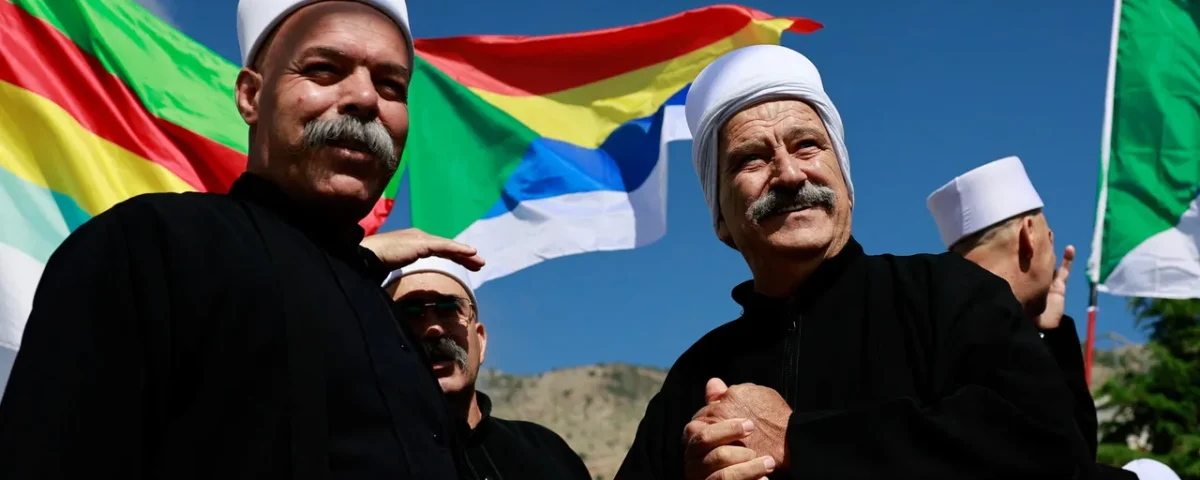
Executive Summary
On 25 August 2026, the Syrian Democratic Forces announced their own dissolution, folding the last independent Kurdish-led military structure in Syria into the armed forces of Ahmed al-Sharaa’s government. Three days later, al-Sharaa appointed former SDF commander Mazloum Abdi as a presidential adviser. A decade-long partnership between Washington and Syria’s Kurds, one that produced one of the most capable non-state militaries in the modern Middle East, ended not in independence but in negotiated absorption.
At almost the same moment, a different externally backed minority military structure is consolidating four hundred kilometers to the south. In Sweida, Druze factions remain armed, much of the governorate sits outside Damascus’s effective control, and Israel has spent close to two years supplying weapons, cash and political backing to Druze armed groups. This article asks whether Sweida risks reproducing the logic that eventually caught up with the SDF: a “proxy protection trap,” in which foreign patronage strengthens a vulnerable minority today while quietly making its political future dependent on a patron’s own, shifting calculations. The comparison is deliberately not literal. It is offered as a warning about a mechanism, not a prediction of fate.
Introduction: One Partnership Ends, Another Takes Shape
On 25 August 2026, Mazloum Abdi stood before cameras and declared, in effect, that his own creation was finished. “We announce today the end of the mission of the Syrian Democratic Forces and its dissolution as an independent military force,” he said, closing a chapter that began in the campaign against the Islamic State and had, at its height, given Washington a partner controlling roughly a quarter of Syrian territory.1 Two days later, President Ahmed al-Sharaa issued Decree No. 164, naming Abdi an adviser to the presidency, a step down from what Damascus had offered him in January 2026: deputy defence minister and governor of Hasakah province.2 Between that offer and the eventual settlement lay months of stalled negotiations, a government military offensive that recaptured Raqqa and Deir ez-Zor, and a fourteen-point ceasefire plan that finally delivered integration on Damascus’s terms rather than Washington’s.2 For more than a decade, Syria’s Kurds had enjoyed sustained American airpower, financing, equipment, diplomatic cover and something close to recognition as a governing authority over several million people. None of it secured a permanent political settlement on Kurdish terms; it secured a negotiated integration, on the strength of the moment in which that integration finally happened.
Four hundred kilometers south, in the Druze-majority province of Sweida, a comparable experiment is entering its own defining phase, in something closer to the opposite direction. Since the sectarian violence of July 2025, Israel has become the principal external backer of local Druze armed factions, most consistently the National Guard associated with Sheikh Hikmat al-Hijri.3 Reporting from the Washington Post, Reuters, the UK Home Office and the EU Agency for Asylum describes Israeli weapons transfers, monthly payments to roughly three thousand fighters, and Israeli air strikes against Syrian government forces carried out in the name of protecting Druze communities.3,4,5 Much of Sweida still sits outside Damascus’s effective authority.5
Only two days before the SDF’s dissolution, Syrian and Israeli officials sat down in Jordan for renewed, US-mediated talks aimed at reviving a security arrangement between Damascus and Jerusalem.6 The juxtaposition is not an accident of the calendar; it is the argument of this article in miniature. One externally protected minority military order is being folded into the Syrian state at almost the exact moment a second is consolidating, financed by a patron simultaneously negotiating its own accommodation with that same state. The question is not whether Israel currently supports Druze factions; it clearly does, in multiple documented forms. It is what happens to that support once a stable Israeli-Syrian security arrangement becomes, for Israel, more valuable than an armed enclave in Sweida.
1. Why Israel Moved into the Druze Question
Israel’s involvement did not begin as a grand design. It began as a response to a specific, brutal episode. In mid-July 2025, a wave of kidnappings between Bedouin tribesmen and Druze residents in Sweida spiraled into large-scale sectarian violence involving government forces, tribal fighters allied with Damascus, and Druze militias.7 The UN Independent International Commission of Inquiry, reporting in March 2026, found that more than 1,700 people were killed and around 200,000 displaced over roughly a week of fighting, in three overlapping waves: government forces and allied tribesmen attacking Druze civilians, Druze armed groups retaliating against Bedouin communities, and tribal fighters then burning homes across dozens of villages.7,8 Violations by all sides, the Commission concluded, may amount to war crimes and, in some instances, crimes against humanity.7 The fear driving Druze demands for protection is not manufactured, and it is not confined to one faction’s rhetoric.
Israel had, in fact, already been supporting Druze factions before July 2025. According to the Washington Post’s investigation, published in December 2025, Israeli helicopters began airdropping rifles, ammunition and body armor to Druze fighters within days of Assad’s fall, drawing partly on weapons seized from Hezbollah and Hamas, followed by monthly payments of $100 to $200 to an estimated 3,000 Druze militiamen and funding to help establish a Military Council command structure.3 Shipments reportedly peaked in April 2025, as clashes between Druze factions and Islamist-aligned forces intensified, and Israel intervened militarily in July with strikes on Syrian military units and the Ministry of Defense in Damascus.3,7
None of this makes Israeli policy purely humanitarian, and none of it makes it purely cynical; both can be true at once, and the reporting suggests they are. Israel has genuine reasons to care about the Druze, including a substantial Druze citizen population that serves in its own military, which gives events in Sweida real domestic resonance.13 But strategic considerations run alongside these ties. Israel wants a secure northern frontier and a demilitarized southern Syria, ideally stretching, in the words of one Carnegie Endowment analysis, “from Damascus to the Golan.”13 It distrusts Ahmed al-Sharaa, a former Islamist militant whose security forces reportedly still include foreign fighters Damascus has been slow to remove.10 It wants leverage over a government it does not yet trust, wants hostile or Islamist-aligned armed formations kept away from the Golan Heights, and is positioning itself, by design or improvisation, in an unresolved contest with Türkiye over whose security architecture will define the new Syria.13,14
These interests point in the same direction as Hikmat al-Hijri’s, at least for now. That is why the relationship exists. It is not why it will necessarily last.
2. What the Kurdish Experience Actually Teaches
The US-SDF partnership is often summarized as an alliance. It is more accurately described, as I have argued elsewhere, as a situational partnership built on asymmetric mutual instrumentalization: both sides used one another, but one side had far more freedom to walk away.18 Washington needed a capable ground force to defeat the Islamic State without deploying large numbers of American troops, and the Kurdish-led YPG, expanded into the multi-ethnic SDF, provided exactly that. In return the SDF obtained air support, weapons, funding, training, international legitimacy and, for a decade, effective control over roughly a quarter of Syria. It was never a passive instrument; its leadership converted a counterterrorism partnership into governing structures and a level of political visibility Syria’s Kurds had never previously achieved.
But it was never a permanent political commitment. Washington’s support was calibrated to a specific requirement: defeating a territorial caliphate. Once that requirement changed, first through the erosion of Islamic State’s territorial presence, then through Assad’s fall and Washington’s decision to engage Damascus rather than isolate it, American investment in Kurdish autonomy diminished. Türkiye’s long-standing objection to an autonomous, YPG-led entity on its border added consistent pressure in the same direction, and Damascus moved from negotiation to a military offensive in January 2026 once talks stalled, retaking Raqqa and Deir ez-Zor before the two sides settled on the terms that produced August’s dissolution.2
The lesson is not that Washington betrayed the Kurds; this article does not argue that it did. The lesson is narrower, and more useful: military partnership, however extensive, is not the same thing as political commitment. A patron can supply a partner with real power for a long time without ever promising to preserve that power once its own priorities change. Geography completes the asymmetry: the United States could redirect its Syria policy from a continent away; the SDF could not relocate itself out of northeastern Syria. That is where the Kurdish warning begins, and it is the exact structure worth testing against Sweida.
3. The Proxy Protection Trap
Call the underlying mechanism a proxy protection trap. An external patron protects and strengthens a vulnerable local armed actor, typically in response to a genuine security emergency. That protection improves the actor’s immediate survival prospects and bargaining position against the central state. Over time, however, protection can also reduce the incentive to compromise, since compromise now competes with the apparent safety of continued patronage; it can encourage larger political ambitions, since armed strength and international attention make maximalist demands feel newly realistic; and it deepens dependency, since the actor’s security increasingly rests on decisions made in a foreign capital rather than on arrangements negotiated with its own state. If the patron’s strategy later shifts, for reasons that may have nothing to do with the local actor’s own conduct, that actor can discover it has accumulated harder enemies and larger expectations without ever having secured a durable guarantee. In plain terms: external protection solves today’s vulnerability. It can just as easily create tomorrow’s dependency.
There is already early, concrete evidence of this inside Israel’s relationship with Druze factions, from the same Washington Post investigation. Weapons shipments peaked in spring 2025 and then declined from August onward, correlating with a shift in Israeli calculation after a meeting between Donald Trump and Ahmed al-Sharaa in May 2025; officials reportedly shelved plans to formalize the Druze as an organized armed proxy, even as smaller shipments and the monthly payments to about 3,000 fighters continued.3 The investigation also captures open disagreement inside Israel’s own security establishment: one faction argued for treating the Druze as a long-term strategic proxy, while a more cautious camp invoked Israel’s difficult experience backing the South Lebanon Army against Hezbollah, and questioned committing to defend “a population that’s 100 kilometers away from the border.”3 One former official was blunter still: “The Israelis know they have no one to work with on the other side, certainly not in any long-term capacity.”3
That sentence belongs at the center of this analysis. It is not proof Israel intends to abandon Sweida; it is proof that, inside the government providing the protection, there is no settled consensus that this protection is permanent. Protection is not the same thing as commitment, and the gap between the two is precisely where the trap operates.
Patronage also does not only shape relations between a minority and the state; it can reshape politics inside the minority itself. Both the Washington Post investigation and the Washington Institute’s analysis describe a Druze political landscape that fractured further as Israeli backing concentrated around al-Hijri’s National Guard. Tareq al-Shoufi, the former Military Council leader through whom earlier support flowed, was later accused of collaborating with Damascus and went into hiding as al-Hijri consolidated control.3,11 Other Druze figures, such as Sheikhs Jerboa and Hinnawi and Laith al-Balous, have at various points served as Damascus’s preferred interlocutors, taking more accommodating positions on integration, sometimes at real personal risk.11 Where external backing concentrates behind the faction least willing to compromise, it can, without anyone intending it, make compromise politically more expensive for every Druze leader who might otherwise consider it. This is a pattern worth watching, not a proven causal claim; the evidence does not establish that Israeli support alone determines Druze internal politics, only that the two have moved together in a way that deserves scrutiny.
4. Why the Druze Are Not the New SDF
The title of this article poses a question, not an answer, and an honest answer requires taking the differences seriously. Treating Sweida as simply “the new Rojava” would be a lazy comparison, and a wrong one.
The SDF controlled a vast, contiguous territory, roughly a quarter of Syria, including agricultural land, oil fields and border crossings, and built extensive governing institutions there over nearly a decade.1 Sweida’s Druze factions control a far smaller, geographically concentrated province with none of that resource base. The SDF also became militarily indispensable to a global, US-led coalition fighting the Islamic State, supplying tens of thousands of fighters to a campaign with no ready alternative ground force. Druze factions in Sweida offer Israel no equivalent battlefield function. They are not fighting Israel’s wars, and they are almost entirely a local, communal phenomenon, operating within a bilateral, largely covert relationship with a single patron that is itself a direct party to a wider Israeli-Syrian confrontation, not the leader of a global counterterrorism campaign.
Geography cuts the other way too, in a way that strengthens rather than weakens the comparison. Sweida sits far closer to Israel’s own border and its own Druze citizens than northeastern Syria ever sat to the United States, giving Israel’s engagement a domestic intensity Washington’s Kurdish policy never had. Jordan, not Türkiye, is the most immediately affected neighbor, worried above all about smuggling and instability rather than political precedent, a different dynamic from the Turkish anxiety that shadowed the SDF.12
None of these differences erase the comparison; they clarify what is actually comparable. The relevant similarity is not ethnic identity, ideology, territorial scale or organizational structure. It is the political architecture of conditional foreign protection: a vulnerable minority gains real, usable power from an external patron whose own strategic interests, not the minority’s political aspirations, set the terms and duration of that power.
5. What Happens if Israel’s Priorities Change?
Three broad trajectories seem plausible, and none is foreordained.
The first is negotiated integration: Sweida reaches an arrangement with Damascus involving genuine local security guarantees, some decentralized authority, credible accountability for the July 2025 violence, and political inclusion in national institutions, without necessarily replicating the SDF’s exact model. The eventual SDF settlement, reached only after a government military offensive forced the issue, suggests this is possible but rarely comes cheaply or early. This is probably the outcome most likely to produce durable security for Sweida’s population, if credible guarantees can actually be built and enforced.
The second is prolonged protected autonomy: Israel continues arming and financing Druze factions and deterring Damascus from reasserting control by force, and Sweida persists as a de facto, externally guaranteed enclave. This could last for some time, but it would remain hostage to Israeli policy rather than to any guarantee Sweida itself controls. Charles Lister’s May 2026 analysis for the Middle East Institute documents how the resulting governance vacuum has coincided with the province becoming a significant hub for narcotics and arms smuggling, prompting repeated Jordanian cross-border strikes against trafficking infrastructure.12 Externally protected autonomy does not automatically produce good governance; it can produce the opposite, and an unresolved Sweida risks becoming a fixed point of friction between Israel and Türkiye as well as Israel and Damascus.
The third is patron recalibration: Israel reaches a broader security understanding with Damascus, of the kind now being explored in the US-mediated talks in Jordan, and gradually scales back support for the more hardline Druze factions in favor of stability with the Syrian state.6 If Sweida’s leadership has, meanwhile, rejected earlier compromises on the assumption that Israeli protection was effectively permanent, it could find itself negotiating later from a considerably weaker position than it holds today. This is where the SDF precedent becomes most directly relevant, not because abandonment is inevitable, but because it illustrates the risk of confusing present strategic usefulness with a future political guarantee.
6. Europe Should Not Wait for Another Abandonment Crisis
Europe has a real stake here, and a real dilemma to manage. The European Union has consistently called for respect for Syria’s unity, sovereignty and territorial integrity alongside an inclusive transition and minority protection, positions restated both after the July 2025 violence and after the UN Commission’s March 2026 report.15,16 It lifted broad economic sanctions on Syria in 2025 to support reconstruction, and in May 2026 renewed remaining targeted measures for a further year while delisting Syria’s defense and interior ministries, signaling deeper engagement with Damascus.17
The Sweida violence, however, exposes the limits of treating state consolidation as a synonym for stability. Damascus cannot credibly ask Sweida’s Druze to disarm and simply trust a state whose own forces, according to the Washington Institute’s Andrew Tabler, reportedly still included foreign fighters and were themselves accused of executions, arson and looting during the July 2025 fighting.10 At the same time, an indefinitely financed armed enclave is no substitute for a political settlement; it risks the governance vacuum documented in southern Syria, and it risks turning a domestic minority question into a standing regional proxy contest between Israel and Türkiye, undermining the very stabilization Europe is now financing.
The better European position sits between “Damascus must control everything immediately” and “foreign-protected armed enclaves are an acceptable substitute for a settlement.” Brussels should make deeper normalization, reconstruction assistance and economic engagement conditional on credible, enforceable protections for Sweida: local policing arrangements, decentralized administrative authority, real accountability for the 2025 violence and, where feasible, international monitoring. Europe should press for mediated integration rather than forced centralization, and should be candid, including with Ankara and Jerusalem, that a Syrian south turned into an arena of Turkish-Israeli competition serves nobody’s declared interests, least of all Syria’s own.
Conclusion
The SDF’s dissolution does not prove that Israel will abandon Sweida, nor that every foreign-backed minority project ends the same way. It demonstrates something narrower, and more important. Military protection and political commitment are not the same thing. For more than a decade, Syria’s Kurds possessed one of the most extensive foreign partnerships available to any non-state actor in the modern Middle East, yet when the regional order shifted, geography ultimately mattered more than partnership. Syria’s Druze should not have to choose between trusting a state that already failed, catastrophically, to protect them in July 2025, and depending indefinitely on a neighbor whose interests may look very different once its own negotiations with Damascus mature. The task now is to build a political settlement sturdy enough that today’s protection does not quietly become tomorrow’s vulnerability. Israel can change its Syria policy. The Druze cannot change their geography. That asymmetry, more than any single alliance or any single betrayal, is the real inheritance of the Kurdish experience, and it is the warning Sweida cannot afford to ignore.
Notes
1. Reuters, “Syria’s Kurdish-led SDF dissolves as part of integration with Damascus,” 25 August 2026.
2. Reuters, “Syrian president names former commander of Kurdish-led force as adviser,” 27-28 August 2026.
3. The Washington Post, “How Israeli covert activities in Syria seek to thwart its new government,” 23 December 2025.
4. UK Home Office, “Country Policy and Information Note: Religious Minorities (excluding Alawites), Syria,” version 2.0, 11 February 2026.
5. European Union Agency for Asylum, “Syria: Security Situation,” July 2026, sections 1.2.4, 1.3.2, 2.13.2 and 2.13.3.
6. Reuters, “Syria, Israel hold US-mediated talks to ease tensions, Syria news agency says,” 23 August 2026.
7. United Nations Independent International Commission of Inquiry on the Syrian Arab Republic, “International Human Rights Law and International Humanitarian Law violations committed during the July 2025 violence in Suwayda, Syria,” A/HRC/61/CRP.7, 27 March 2026.
8. Reuters, “UN says 1,700 killed in Syria’s Suweida violence, cites possible war crimes,” 27 March 2026.
9. European Union Agency for Asylum, “Syria: Country Focus,” July 2026.
10. The Washington Institute for Near East Policy, Andrew J. Tabler, “Making Sure Damascus Learns the Right Lessons from the Suwayda Clashes,” 21 July 2025.
11. The Washington Institute for Near East Policy, Erik Yavorsky, “Implications of the Recent Violence in Suwayda,” August 2025.
12. Middle East Institute, Charles Lister, “How Israel-Backed Sweida Became Syria’s Narcotics Capital,” 19 May 2026.
13. Carnegie Endowment for International Peace, “Israel’s Ring of Buffer Zones,” December 2025.
14. Carnegie Endowment for International Peace, “The New Struggle for Syria,” November 2025.
15. European External Action Service, “Syria: Statement by the Spokesperson,” 16 July 2025.
16. European External Action Service, “Syria: Statement by the Spokesperson on the report of the Independent International Commission of Inquiry on the July 2025 violence in Sweida,” 27 March 2026.
17. Council of the European Union, “Syria: Council renews restrictive measures targeting the former al-Assad regime for one year and de-lists certain entities,” 18 May 2026.
18. Rafael Marcou, “The Possible U.S.-Iranian Kurdish Partnership: Lessons from Syria and Implications for Europe,” MEPEI, 17 June 2026.