
Saudi Arabia’s mBridge Exit: Balancing China, Trump, and the Future of Global Finance
September 29, 2026
New technologies and deterrence
September 29, 2026The Houthis’ Advance to Bab al-Mandab: Iranian Checkmate to Saudi Arabia?
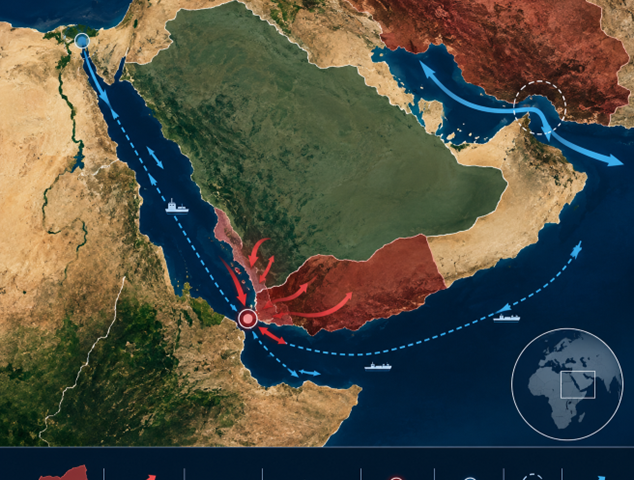
Figure 1.AI generated: The strategic geography linking Hormuz, Bab al-Mandab and Suez. Conceptual illustration generated for this analysis.
Yemen, Red Sea security, Gulf maritime chokepoints, and the Egyptian–Saudi strategic nexus
| Analytical judgment The September 2026 Houthi advance should be understood as a major change in the regional bargaining environment, but not as an uncontested Iranian “checkmate.” The Houthis’ capture of Mokha and positions around Mayyun/Perim and the southern Red Sea gives an Iran-aligned actor greater capacity to threaten or condition maritime access. Yet the strategic effect depends on whether the movement can consolidate exposed coastal positions, whether Saudi Arabia and its partners can restore deterrence, and whether the crisis becomes linked to the parallel contest over the Strait of Hormuz. |
Executive Summary
The Houthi movement’s rapid expansion along Yemen’s western coast in September 2026 has changed the strategic geography of the Red Sea. Reuters reported that the group captured Mokha and advanced toward the Bab al-Mandab area, while subsequent reporting documented control of Mayyun/Perim and additional coastal positions. These gains matter because Bab al-Mandab is not simply a Yemeni battlefield: it is the southern maritime gateway linking the Red Sea with the Gulf of Aden and, through Suez, with European and Mediterranean markets (Reuters 2026; AP 2026).
The central analytical question is whether the advance amounts to an Iranian “checkmate” against Saudi Arabia. The evidence supports a narrower proposition. Tehran benefits from an Houthi position that can increase Saudi security costs without requiring direct Iranian deployment. At the same time, the Houthis’ coastal expansion creates new vulnerabilities: fixed coastal positions are more exposed than the mountainous terrain from which the movement historically derived much of its defensive advantage, and control of a chokepoint does not automatically translate into uncontested control of international navigation.
The significance of the September crisis increases because it coincides with a dispute over proposed arrangements for the Strait of Hormuz. Reporting indicates that Saudi Arabia objected to aspects of an Iran-Oman proposal and sought postponement of regional talks. This temporal overlap makes strategic linkage plausible, but public evidence does not establish that Tehran directly ordered the Houthi advance as punishment for Saudi Arabia’s position on Hormuz (Critical Threats Project 2026; The Guardian 2026).
Egypt is therefore central to the analysis. The 15 September Cairo meeting between President Abdel Fattah el-Sisi and Crown Prince Mohammed bin Salman explicitly addressed maritime security and freedom of navigation. Egypt’s position is distinctive because it connects the northern Red Sea and Suez Canal to the Bab al-Mandab security problem while maintaining diplomatic access to actors including Oman and Iran. Cairo cannot by itself resolve the Saudi-Iranian rivalry, but it can help connect maritime security, Yemen diplomacy and Red Sea risk management into a single regional framework (Egyptian Presidency 2026; SPA 2026).
1. The Strategic Question: Checkmate or Leverage?
“Checkmate” is a useful hypothesis because it captures the possibility that Iran can create simultaneous pressure at two maritime chokepoints without assuming direct control over both. Iran’s position near Hormuz and the Houthis’ position near Bab al-Mandab could, in principle, generate a form of strategic compression for Saudi Arabia: the eastern gateway from the Gulf and the western Red Sea alternative would both become vulnerable to disruption. But the metaphor becomes misleading if it implies that Saudi Arabia has no remaining strategic options.
Saudi Arabia retains substantial military, financial and diplomatic resources, while the United States, Egypt, Oman and other regional actors have strong interests in preventing the permanent militarisation of either chokepoint. The more defensible interpretation is therefore one of strategic leverage. The Houthi advance increases the bargaining value of Yemen and raises the costs of Saudi security policy; it does not by itself determine the final regional settlement.
2. What Has Changed on the Ground?
The geographical change is significant. Reuters reported on 10 September that Iran-aligned Houthi forces had captured Mokha and reached the Hanish islands, while subsequent reporting placed the group at Dhubab and Mayyun/Perim. These locations bring the Houthis into direct proximity to the maritime corridor at the southwestern tip of Yemen (Reuters 2026).
The distinction between proximity and complete control is essential. Bab al-Mandab is an international waterway whose security depends on geography on both sides of the strait. Yemen’s western shore is only one component of the maritime environment; Djibouti and Eritrea occupy the African side, while other Yemeni and regional forces retain positions elsewhere. Houthi control of Perim or adjacent coastal territory therefore gives the movement an ability to threaten, monitor or condition traffic, but it does not eliminate the wider international security architecture around the strait.
The strategic change is nevertheless real because maritime coercion does not require physical closure of every lane. The possibility that a non-state actor can selectively threaten vessels, impose informal restrictions or raise insurance and routing costs can alter commercial behaviour even when the waterway remains technically open. The Houthis’ own statements that some non-Saudi shipping could pass safely underline the point: the issue is not merely whether the strait is open, but who claims authority to determine the conditions of passage (Critical Threats Project 2026).
3. Why Bab al-Mandab Matters to Saudi Arabia
For Saudi Arabia, Bab al-Mandab is part of a wider redundancy problem. The Red Sea offers an alternative maritime outlet for Saudi energy exports that can reduce dependence on the Strait of Hormuz. If Hormuz is simultaneously constrained from the east and Bab al-Mandab becomes vulnerable from the southwest, the value of that redundancy falls. AP noted that Saudi Arabia has used the Red Sea route as an alternative to Hormuz and that disruption has already affected shipping patterns and export logistics (AP 2026).
This does not mean that the loss of Bab al-Mandab would automatically stop Saudi exports. Pipelines, storage facilities, alternative ports and other routing options remain relevant. The strategic issue is resilience rather than binary access. Each additional chokepoint constraint reduces the number of low-cost alternatives available to Riyadh and increases the premium attached to infrastructure protection, air defence, maritime surveillance and diplomatic coordination.
The implications also extend beyond Saudi Arabia. The Red Sea crisis affects Egypt through Suez Canal traffic, international shipping through insurance and routing costs, and energy markets through the possibility that several maritime bottlenecks become contested simultaneously. The strategic value of Bab al-Mandab therefore lies partly in its position inside a network rather than in the strait considered in isolation.
4. Iran’s Strategic Gains — and Their Limits
The Houthi advance creates several forms of indirect leverage for Iran. First, it allows Tehran to impose or threaten costs on Saudi Arabia through an aligned partner rather than through direct Iranian military action. Second, it increases the bargaining relevance of Yemen in regional maritime negotiations. Third, it creates a geographic complement to Iran’s position around Hormuz. The combination is strategically more important than either theatre alone.
Yet the proxy relationship should not be treated as perfect command and control. The Houthis have their own organisational interests, battlefield calculations and political objectives. Their campaign against Saudi Arabia has been framed around demands concerning the Yemen war, the blockade and compensation, while Iranian and Houthi objectives overlap without necessarily being identical (Critical Threats Project 2026).
The advance also creates a classic exposure problem. Coastal positions are easier to identify and target than dispersed positions in difficult interior terrain. The more territory the Houthis hold, the more they must defend supply lines, ports and fixed installations. Strategic leverage can therefore coexist with tactical overextension. The movement may gain bargaining power while simultaneously becoming more vulnerable to counter-coercion.
5. The Hormuz Connection: Strategic Linkage Without Proven Causation
The timing of the Yemen escalation and the Hormuz dispute is too close to ignore. In September, Iran and Oman were working around a proposed mechanism for navigation through Hormuz, while Saudi Arabia reportedly objected to provisions that could create a new Iranian role in the strait. The meeting was postponed amid the escalation in Yemen (Critical Threats Project 2026; The Guardian 2026).
Three interpretations should remain analytically distinct. The first is deliberate coordination: Iran may have viewed pressure through the Houthis as a way to increase Saudi costs during maritime bargaining. The second is strategic exploitation: the Houthi campaign may have originated primarily in Yemen’s own conflict dynamics, with Tehran subsequently benefiting from the results. The third is systemic convergence: Iran, the Houthis and Gulf states may be responding to the same regional struggle over maritime rules, energy security and the distribution of power.
The public record is stronger on linkage than on direct causation. It is reasonable to examine the two theatres together because their strategic effects interact; it is not yet justified to state as fact that Tehran ordered the Bab al-Mandab advance specifically to punish Riyadh for opposing the Hormuz proposal.
6. Saudi Arabia’s Strategic Exposure
The immediate Saudi problem is multidimensional. The Houthi advance threatens Red Sea infrastructure and maritime access while missile and drone attacks place pressure on Saudi cities and energy facilities. On 19 September, Saudi Arabia confirmed that a Houthi ballistic missile had been launched toward Riyadh and reported that it was intercepted (AP 2026). Reuters subsequently reported continued Houthi claims of attacks on Saudi targets and broader market concern (Reuters 2026).
The significance is not simply the number of attacks. Repeated low- or medium-scale attacks can force a state to spend disproportionately on air defence, intelligence, infrastructure hardening and maritime protection. The resulting security burden can interact with economic objectives, particularly when Saudi Arabia is simultaneously pursuing large-scale investment and diversification projects that depend on stable energy exports and investor confidence.
Saudi Arabia therefore faces a strategic trade-off. Escalation may impose costs on the Houthis and restore deterrence, but deeper military involvement can widen the war and increase risks to shipping. Diplomacy may reduce escalation but can also require concessions or arrangements that Riyadh would otherwise resist. The strategic problem is consequently one of managing interdependence rather than simply defeating an adversary on the battlefield.
7. Why Egypt Matters More Than the Geography Suggests
The 15 September Cairo meeting between President el-Sisi and Crown Prince Mohammed bin Salman demonstrated that the Bab al-Mandab problem is not exclusively a Saudi-Yemeni issue. Saudi and Egyptian officials discussed maritime security and freedom of navigation, while the Egyptian side reaffirmed support for Saudi security and a political settlement in Yemen (Egyptian Presidency 2026; SPA 2026).
Egypt’s strategic value comes from its position within the maritime chain. Suez is the northern gateway of the Red Sea system; Saudi Arabia occupies much of the eastern Red Sea coast; Yemen sits beside Bab al-Mandab; and Djibouti and Eritrea control the African side. Egypt therefore has an unusually strong incentive to prevent a permanent deterioration in Red Sea navigation because disruption at the southern gateway eventually appears as pressure on the northern gateway.
Cairo also possesses a diplomatic asset that is distinct from its geography. President el-Sisi met Iranian President Masoud Pezeshkian in New Delhi on 13 September and publicly emphasized de-escalation and regional sovereignty. That does not make Egypt a mediator with guaranteed leverage, but it provides a communication channel that can complement Saudi and Gulf deterrence rather than replace it.
The most credible Egyptian role is therefore threefold: maritime coordination, diplomatic de-escalation and political management of the Yemen file. It is less realistic to expect Cairo to resolve the Saudi-Iranian rivalry alone or to become the principal military actor in Yemen.
8. Regional Security Implications
| Implication | Analytical significance |
| Chokepoint interdependence | Hormuz and Bab al-Mandab should be analysed as connected elements of one maritime-security system. Vulnerability at one chokepoint increases the strategic importance of alternatives; simultaneous vulnerability reduces the value of those alternatives. |
| Regionalisation of the Yemen war | The conflict can draw in Saudi Arabia, Egypt, Pakistan, Türkiye, the United States, European maritime powers and Gulf states. More participants increase both available capabilities and escalation pathways. |
| Energy and shipping exposure | The effect of disruption is transmitted through routing, insurance, freight rates, inventories and energy prices. The strategic effect can therefore appear in markets before a formal closure of a waterway. |
| Humanitarian risk | A maritime-security strategy that treats Yemen primarily as a chokepoint may underweight the political and humanitarian conditions that reproduce the conflict. Military stabilisation without political settlement can leave the underlying source of instability intact. |
| Normative and legal risk | If an armed non-state actor claims authority to decide which vessels may pass, the issue extends beyond ordinary insurgency. It becomes a contest over who exercises effective authority over an international maritime corridor. |
9. Strategic Scenarios
Scenario 1 — Houthi consolidation: The Houthis entrench along the coast and use the new geography primarily as bargaining leverage. Maritime risk remains persistent but can be managed through surveillance, convoying, diplomacy and selective deterrence.
Scenario 2 — Counter-coalition pressure: Saudi Arabia and the internationally recognised Yemeni government seek additional military, intelligence and air-defence support. The Houthi advance may be contained, but escalation and retaliation risks rise.
Scenario 3 — Negotiated regional package: Oman, Egypt, Saudi Arabia and other actors connect Yemen de-escalation with arrangements for Bab al-Mandab and Hormuz. This treats the two chokepoints as components of a shared security problem rather than separate disputes.
Scenario 4 — Dual-chokepoint escalation: Pressure around Hormuz and Bab al-Mandab persists simultaneously. This would create the highest systemic risk for energy markets, shipping insurance, Suez traffic and regional military planning.
10. Policy Considerations
For Saudi Arabia
Strengthen layered air and maritime defence, diversify protection of Red Sea export infrastructure, and preserve diplomatic channels that can separate Yemen de-escalation from broader Saudi-Iranian rivalry where possible.
For Egypt
Treat Suez, the Red Sea and Bab al-Mandab as one security-economic system; strengthen maritime information-sharing with Saudi Arabia and international partners; and use diplomatic access to support de-escalation without assuming the role of principal mediator.
For Gulf states
Develop contingency arrangements for shipping, energy storage, insurance and alternative routing that assume partial—not necessarily total—chokepoint disruption.
For external maritime powers
Focus on protection of commercial navigation and critical infrastructure while avoiding measures that inadvertently transform a limited maritime crisis into a wider regional war.
For Yemen diplomacy
Pair maritime-security measures with a political process addressing the incentives of the Yemeni parties. Maritime stability without a political settlement is likely to remain fragile.
11. Analytical Conclusion
The evidence does not support treating the Houthi advance as a completed Iranian checkmate. It does support treating it as a significant strategic development that increases Iran’s indirect leverage and complicates Saudi Arabia’s maritime-security calculus. The key change is not that Iran has acquired direct control of Bab al-Mandab, but that an Iran-aligned actor now occupies a more consequential position from which it can threaten, condition or bargain over maritime access.
The strongest evidence for an Iran–Saudi strategic connection lies in the interaction of three developments: the Houthi-Iran alignment, the sudden expansion toward Bab al-Mandab, and the parallel dispute over the governance of maritime access through Hormuz. The weakest evidentiary link is the claim of direct Iranian intent to punish Saudi Arabia for its Hormuz position. That distinction should remain explicit in any policy analysis.
The strategic question is consequently shifting from “Who controls Yemen?” to “Who sets the rules of security around the maritime corridors linking the Gulf to the Mediterranean?” Saudi Arabia cannot answer that question alone because the system extends through Yemen, Bab al-Mandab, the Red Sea and Suez. Iran cannot impose a new maritime order without provoking counter-balancing. The United States can provide deterrence and maritime capacity but cannot indefinitely substitute military management for regional political arrangements.
Egypt’s importance follows from this geography and diplomacy. Cairo is not the sole answer to the crisis, nor is it necessarily the decisive military actor. Its value lies in its ability to connect theatres that are often treated separately: Suez, the Red Sea, Bab al-Mandab, Saudi security, Yemen diplomacy and the wider Gulf-Iranian relationship. The most sustainable response is therefore likely to be a regional framework in which maritime security and political settlement are treated as mutually reinforcing rather than sequential problems.
| Bottom line The Houthi advance is best conceptualised as a new bargaining position in a connected maritime-security system. It gives Iran additional indirect leverage, increases Saudi exposure, and raises Egypt’s strategic relevance. Whether that leverage becomes durable depends less on the initial territorial advance than on consolidation, counter-coalition capacity, commercial adaptation, and the evolution of the parallel Hormuz dispute. |
References
Associated Press. 2026. “The Houthi advance in Yemen raises concerns about a key shipping choke point.” September 2026.
Associated Press. 2026. “Saudi Arabia confirms Yemen’s Houthi rebels tried to attack its capital with a ballistic missile.” September 19, 2026.
Critical Threats Project. 2026. “Iran Update, September 11, 2026.” Institute for the Study of War.
Critical Threats Project. 2026. “Iran Update, September 14, 2026.” Institute for the Study of War.
Critical Threats Project. 2026. “Iran Update, September 17, 2026.” Institute for the Study of War.
Egyptian Presidency. 2026. “President El-Sisi Meets KSA Crown Prince HRH Prince Mohammed bin Salman.” September 15, 2026.
Reuters. 2026. “Yemen’s Houthis close in on Bab el-Mandeb Strait in new threat to shipping.” September 10, 2026.
Reuters. 2026. “How Yemen’s Houthis went from a small mountain militia to a big regional threat.” September 17, 2026.
Reuters. 2026. “Saudi, Gulf stocks fall after Houthis claim Riyadh attacks.” September 20, 2026.
Saudi Press Agency. 2026. “HRH the Crown Prince, Egyptian President Hold Bilateral Meeting, Expanded Talks.” September 15, 2026.
S&P Global. 2026. “Factbox: Houthi advance on Yemen port threatens key oil shipping route.” September 11, 2026.
The Guardian. 2026. “Gulf states postpone Strait of Hormuz talks with Iran as Yemen conflict intensifies.” September 14, 2026.

Ahmad Mohee
Ahmad Mohee is a PhD researcher in Global and Development Studies at the University of Porto, Portugal and a Junior Researcher at the Middle East Political and Economic Institute in Bucharest. His research focuses on the intersection of international relations, security studies, political theory, and emerging technologies, particularly artificial intelligence, cyber conflict, deterrence, strategic dependence, and regional and international order. His work seeks to connect classical theories of international relations with emerging technological transformations through theoretically grounded and empirically oriented research.