
The Price of Peace: From Balfour to Blair, is the Mandate Returning in Gaza?
October 10, 2025
The 11th MEPEI Forum “Middle East: From Chaos to the New (Dis)Order”
October 26, 2025A Layered Analysis of the 2025 Afghanistan-Pakistan Crisis: History, Internal Politics, and the Return of Great Power Competition
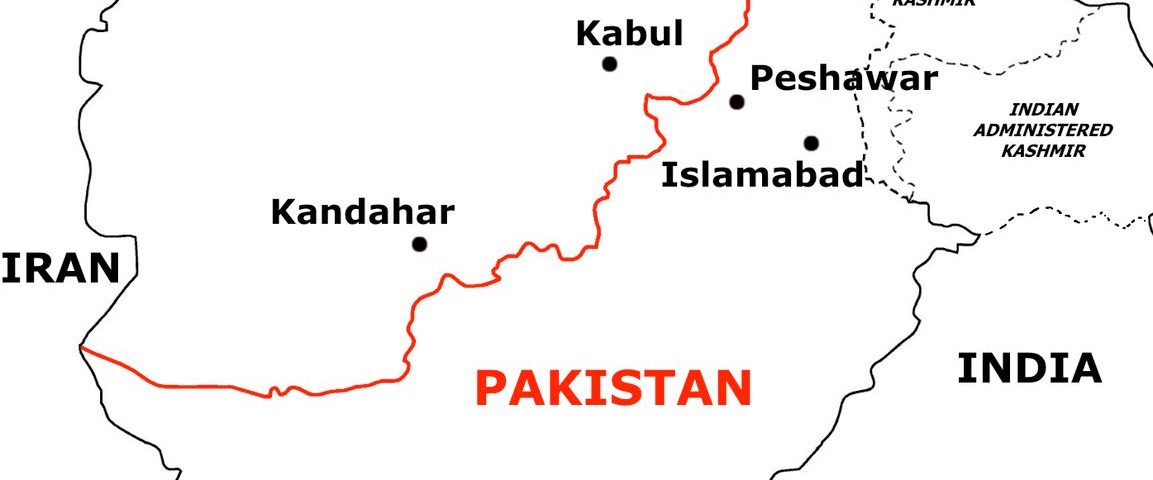
Photo’s source: https://commons.wikimedia.org/wiki/File:Afghanistan-Pakistan_border.png
Introduction
In October 2025, fighting erupted between Afghan and Pakistani militaries, signaling an aggravation of a complex and chronical conflict, or conflicts (Ali & Yawar, 2025). Subsequent rounds of ceasefire negotiations, initiated at the request of Persian Gulf states such as Saudi Arabia and Qatar, indicate that the acute phase of this conflict arises from precise and specific causes, which may ultimately be addressed.
Earlier this year, Pakistan was involved in a short-term, intensive clash with India, amid a confrontational pattern dating back to the British-driven partition of the Raj. As Europe and Western Asia, among others, the two countries and large neighbors like India and Iran have long and rich histories, and their territories host cosmopolite societies for centuries or even millennia. Consequently, historic achievements represent sources of pride, but also potential vulnerabilities requiring constant measures in order to maintain peace and security. An updated research on multiple layers of conflict(s) that determined the October 2025 crisis between Afghanistan and Pakistan has the potential to identify more precisely geopolitical developments at national, regional, and global level.
In the broader context of a rising confrontational rhetoric on the international scene, in which the line between facts and propaganda becomes ever thinner and large media empires aim to support political agendas besides informing, establishing who initiated the crisis remains paramount, but might require additional elements in order to address the underlying causes. Furthermore, recent challenges of the international community to swiftly address wars/conflicts like the one from Ukraine or the Gaza Strip hint at the increasing role of regional peace initiatives until the international system manages to recalibrate for to 21st century realities and deliver security guarantees.
Methodology and conceptual framework
This research employs a (conflict) layer analysis approach to identify key factors of the October 2025 crisis between Afghanistan and Pakistan, from a classical-realist perspective (Lebow, 2013). Newer approaches like structural realism, that distinguish between defensive and offensive powers rather than operating with the more general concept of power balance may have also delivered theoretical findings, but the two main actors of analyzed crisis are neither offensive powers, like the US, the Soviet Union or former colonial powers were, nor purely defensive power from a classification standpoint, unless their motivations are clearly connected with values and policy goals. Consequently, the balance of power framework, along stability, order, and the process of (historical) change, are considered when defining representative layers of the 2025 crisis between Afghanistan and Pakistan: history and demographics, contemporary internal politics, regional and global geopolitical dynamics, the latter dominated by large-scale tendencies and transformations.
The review of selected layers aims to identify and analyze factors contributing to the crisis, and determine potential synergies among various developments, as confirmed by literature and reports. Furthermore, the analysis of past and ongoing transformations, i.e. (historical) change in classical-realist terms, aims to identify which secondary factors contributed to the crisis and in which manner.
A contextual review of the 2025 crisis between Afghanistan and Pakistan
In early October 2025, the militaries of Afghanistan and Pakistan became entangled in deadly exchanges of fire, with early reports claiming, for example, at 58 Pakistani soldiers and 200 Afghan fighters killed (Davies, Lau, & Anbarasan, 2025). Although disputed, the numbers may be representative for the scale of military confrontation, that resulted reportedly in confiscation of military equipment as well. Each side blames the other for starting the crisis, both states reportedly claiming that they were “retaliating to armed provocations from the other” (Arab News AF PK, 2025). While Afghanistan’s government blamed Pakistan for drone attacks on Kabul (Arab News AF PK, 2025), Pakistan accused Afghanistan of allowing armed groups hostile to Islamabad to use its territory, particularly Tehrik-e Taliban Pakistan (TTP), i.e. Pakistan Taliban, but also Balochistan Liberation Army (BLA) and Islamic State in Khorasan Province (ISKP), a charge the Taliban government reportedly denies (Hussain, 2025). Hussain’s news report addressed two main aspects of the crisis: firstly, the term “new-normal” is associated by the author with a potential systematic change in Pakistani approach to regional balance of power, hinting that Pakistan may have decided to increase retaliation measures to a rising number of attacks on its population and security forces by organizations based also in Afghanistan, and secondly, the comparison between Pakistan’s hard power approach to the security situation, that had been reportedly deteriorating after August 2021, resembles that of India against Pakistan, that had also claimed Pakistan was hosting violent organizations on its territory (Hussain, 2025).
Both Afghanistan and Pakistan are fragile states, subject to both internal and external pressure. Multiple competing interests, along historical confrontation patters, pressure their security and defense apparatus with challenges that can be considered above the average when compared with other states. Surviving the Cold War, or the War on Terror (WoT) cannot be precisely defined, since the persistence of a certain political group in either Afghanistan or Pakistan cannot be equated to either country’s development trajectory, but from an international relations perspective, both countries faced challenges to internal order and stability and are particularly sensible to any security and defense challenge that arises on short term.
The classical realist term “balance of power” can be associated to a relatively static or recognizable set of power relations between a number of international actors, impacting historical transformation. When analyzed from a historical process perspective, the balance of power may also be equated to an explanatory framework that justifies significant changes within international relations. In the particular context of Afghanistan – Pakistan 2025 crisis, a preliminary balance of power may be defined as the determining factor that led to analyzed crisis, but from a second perspective, it can be hypothesized that the crisis itself has the potential to determine a change in the power balance between the two states, and potentially impact other balances of power. The two perspectives are not mutually exclusive, but in both cases, defining factors for the balance of power and historical change require consideration. In the following, factors impacting the crisis and its potential evolution, and factors that may arise from the crisis and have the potential to impact various power balances, are identified and analyzed across considered layers.
History and demographics as layers of the 2025 crisis between Afghanistan and Pakistan
Since extensive reviews of Afpak region’s history have been published already, from various perspectives, this section aims to identify and contextualize main historical factors contributed to the 2025 crisis ensuing between Afghanistan and Pakistan.
In early 18th century, the Mughal Empire had begun to disintegrate, while the Durrani Empire was rising to prominence. At its peak, the (Afghan) Durrani Empire was stretching over large parts of contemporary Pakistan, and among its historical legacies, the increase of pre-existing Pashtun population on cotemporary Pakistani territory can be mentioned.
Pashtun tribes represent the largest population of Afghanistan in contemporary era, with approximately 42 % from total population, and second largest population if Pakistan, with approximately 18.24 % from total Pakistani population (EPFL Graph Search, 2025). There are various estimates to the total number of Pashtuns worldwide, a separate source indicating 15 million in Afghanistan and over 36 million in Pakistan. The second ethnical group that is present in both Afghanistan and Pakistan are the Balochs, with 0.5 – 2 million estimated to live in Afghanistan, 6.8 million in Pakistan (SAT Editorial Desk, 2022), the latter being present in the millions in Iran as well.
The Pashtun population from Pakistan is smaller than the Punjabi population from this country, but larger than the Pashtun population from Afghanistan, where it represents the majority. The ethnical diversity of Afpak region is dominated by the two largest groups, the Punjabis and Pashtun, the latter being larger in Pakistan than in Afghanistan in absolute numbers. Therefore, irrespective of the historical change process and balance of power in Pakistani politics, a certain relation between the large Pashtun population from Pakistan and the one from Afghanistan is expected to remain a dominant factor in the relation between the two countries. Since the populations are relatively large, the management of this relation impacts regional order and stability.
British colonialism and the dissolution of British Raj have contributed significantly to contemporary borders, resulting conflicts and particularly in the case of Afghanistan, to an increased security sensibility. After many attempts to colonize Afghanistan, the British gave up the official occupation effort, but nonetheless attempted to play a role in Afghan politics, while still directly in charge of British India’s administration and afterwards. The partition of India from 1947 led to one of the largest transfers of population from recent history, and the associated violence marked the Indian and Pakistani populations significantly. The borders between India and Pakistan were established by the Radcliffe Line, resulting in three regions: West Pakistan, India, and East Pakistan. The partition created post-colonial borders, but the tensions created by ethnical groups residing on both sides of a border were accentuated, and in 1971, East Pakistan became the independent state of Bangladesh, with the help of India.
The border between Pakistan and Afghanistan, i.e. the Durand Line, was established between the British Raj and Afghanistan in 1893, and was inherited by Pakistan from the British. Multiple reports hint that Afghanistan, particularly the Taliban political milieu, “will never recognize Durand Line as Border” (TOLO News, 2024). From this perspective, the British colonial heritage remains a significant factor in regional conflicts, with no clear solution in sight: no government is likely to make concessions, since such developments led to weakening positions in history, but at the same ti me, abnormal borders continue to separate ethnically related populations. Similar colonial or transitional arrangements led to conflicts and tensions in Africa and West Asia, prompting question on how the international community should deal with a flawed colonial heritage in general, and in particular cases, that negatively impacted important regions during and after its era.
British interest in Afghanistan was related to the so-called “Great Game” between London and Moscow during the 19th century, both aiming to advance interests in Central Asia. After World War II (WWII), American support for Afghanistan against Soviet invasion was succeeded by Taliban gradual takeover of the country, in 1996 and 2021, despite the American-led invasion of the country in 2001 and an unprecedented mobilization of local and exogenous forces against the Taliban-led army. Consequently, the internal power of balance in Afghanistan has been historically marked by significant external interference and conquest attempts, from which the Afghans emerged victorious, claiming their country’s unofficial “Graveyard of Empires” title.
Pakistan’s history was marked by a strong competition with India, which also hosts significant Muslim population especially in its northern regions. The ongoing conflict in Jammu and Kashmir region amplifies the general distrust between Pakistan and India, as the opposing opinions on the Durand Line amplify the distrust between Afghanistan and Pakistan. The Indian strive to fully integrate the Jammu and Kashmir in its administration may be compared with the Pakistani strive to fully integrate the Federally Administered Tribal Areas (FATA) in its administration.
For at least two centuries, the relations between populations present on nowadays Afghan and Pakistani territories have been significantly influenced by external powers, hence the balance of power was not decided bilaterally. From the perspective of historical change, the question whether the two countries manage their relation bilaterally after at least two centuries of exogenous influence or attempts to control the region is connected with the question whether modern superpowers prioritize regional stability against their interests, or whether and how these imperatives can be reconciled more efficiently than in the past.
Internal politics as layer of the 2025 crisis between Afghanistan and Pakistan
In 1992, the communist rule from Afghanistan fell, as the world was entering a unipolar setting after the fall of Berlin’s Wall. From 1992 to 1996, Burhanuddin Rabbani served as Afghanistan’s President. He had been an Islamic scholar and anti-Soviet fighter, exiled in Pakistan in 1974 due to his political activity with Jamiat-e-Islami Party. In 1996, Afghanistan came under Taliban rule, as Rabanni, an ethnic Tajik, “almost prophetically” asked for American support to set up a unity government (BBC Rabbani, 2011). As the US and its allies invaded Afghanistan in 2001, Rabanni became the “nominal” leader of the Northern Alliance along Ahmad Shah Massoud, a foreign-backed organization consisting primarily of Tajiks and Uzbeks. The Northern Alliance was fighting alongside NATO and the US against the Taliban, a Pashtun militant and political group, and in 2001, Rabanni also became, briefly, President of Afghanistan again, after returning from exile. The so-called Bonn Conference brought together four “anti-Taliban” delegations: the Northern Alliance, the exiled “Cypress Group”, the “Rome Group”, led by “former King Mohammad Zaher Shah”, exiled in Rome, and the “Peshawar Group”, formed by Pashtun exiles in Pakistan. The US reportedly promoted Hamid Karzai as a “viable candidate for leading the interim administration”. Rabanni himself had reportedly led a government in exile. On December 22, 2001, Karzai presidency was inaugurated, and British forces were arriving at the Bagram air base (PBS.ORG, 2025). In 2011, Rabanni was assassinated in Kabul. Mullah Omar, the Taliban leader that oversaw Afghanistan’s rule between 1996 and 2001, died in 2013. Both the Taliban and Rabbani’s organizations were former anti-Soviet fighters, but with diverging agendas after 1992.
Mohammad Ashraf Ghani Ahmadzai served as President of Afghanistan from 2014 to 2021. A former US citizen who had studied at leading institutions in the United States and Europe, he renounced his citizenship in 2009 to run for office (Groff, 2024). During this same period (2001–2021), the United States, alongside its local Afghan allies and Western partners, invested trillions of dollars in the Global War on Terror—much of it in Afghanistan, where they waged a prolonged campaign against the Taliban.
From a power balance perspective, this context reveals deeper patterns Afghanistan`s political landscape. Soviet influence was eliminated in 1992 with American assistance, as anti-Soviet factions began to dispute power. The Taliban takeover from 1996 and the subsequent American-led invasion in 2001 suggest two key conclusions: first, the victory over the Soviets in Afghanistan was not achieved by the Americans and their allies alone, even though the Cold War was ultimately won—as evidenced by the fall of the Berlin Wall; and second, Afghanistan’s political sphere was fragmented. Moreover, the 2001 war, initiated on Afghan soil, reflected both an American expectation to shape Afghan politics—predicated on their prior support against the Soviets—and a unilateral, hegemonic worldview that had dominated the final decade of the 20th century.
The American, British, and other domination patterns that should have been applied to Afghanistan after 2001, with the help of certain Pakistani political forces (Hadid & Sattar, 2023), relied on previously cultivated relations with leaders close to American, British, or other interests. From a power balance perspective, these failed in 2001, since a direct military deployment had to be carried out, and in 2021, when the US had to withdraw from Afghanistan without a clear victory. As in the Cold War, the US attempted to counter their opponents, this time the Taliban, with local forces. Literature hints that Bob Woodward was claiming the CIA had a 3’000 strong army of Afghans, called the Counterterrorist Pursuit Teams (CTPT), while the Khost Protection Force (KPF) operated after 2001 from Camp Chapman (Suhrke & De Lauri, 2019). Taking into consideration that at least in the period 1989 – 2014 the Russian Federation was not an assertive global power anymore, the Taliban prevalence over major American and allied interests was not directly backed by a similar competing power of the US.
The intense modern history of Pakistan experienced internal fighting, sometimes due to internal factors and sometimes due to foreign interference. Historically, the competition with India probably induced by the British partition philosophy and subsequent consequences in its modern form, led to extraordinary stances like the “two-nation theory” and the imperative to acquire nuclear defense capabilities. The Pakistani power assertiveness can be connected with a fundamental, direct, survival competition with India, security dilemmas throughout the Cold War bipolar setting, and threats to its sovereign territory from minorities such as the Pashtuns and Balochs. As in the case of Afghanistan, it can be hardly claimed that the entire country supported or rejected US or other foreign interests, but the presence of a pro-Western political and military class cannot be ignored. Similar to Afghanistan, many leaders had to live in exile, amid a very particular political competition, specific to Pakistan and accompanied oftentimes by violence.
The security developments from Pakistan, a large country with a large and diverse population, appear to have contributed to pronounced synergies between the Pakistani military and political sphere. Consequently, the analysis of foreign interference and attempts to influence Pakistani political process revealed that the military was also targeted. Zulfikar Ali Bhutto served as Pakistani President between 1971 and 1973, and as Prime Minister between 1973 and 1977, being executed in 1979. He had studied and worked in the US and the UK. After 1965 war between Pakistan and the US, he became disappointed with US arms embargo, and began considering a pivot towards China. By 1966, Bhutto’s discourse contained the term (American) “betrayal”, as he was stating that “Pakistan’s alignment with the West has not only failed to protect her vital interests but has exposed her to grave dangers… The United States has used Pakistan as a pawn in its global strategy, offering aid that binds rather than liberates” and by 1967, CIA reports hinted at Bhutto’s “anti-American binge”. The US reportedly had prior knowledge of Bhutto’s upcoming execution under the rule of General Zia ul-Haq (Nazar, 2025), a military leader that would be supported with billions of dollars by Washington in the aftermath of Soviet invasion in Afghanistan: in 1981, the US was negotiating with Pakistan a $ 3.2 billion package. In 1985 Pakistan became the fourth largest recipient of US military assistance, in 1987 it received a military and economic aid package in amount of $ 4.02 billion, and as of 2009, the Kerry-Lugar act was approving $ 1.5 billion in annual aid to Pakistan (Ali M. , 2009).
Steve Call details in his 2018 book Directorate S: The C.I.A. and America’s secret wars in Afghanistan and Pakistan how the US secret services gained access to and supported Pakistani assets and to the prestigious military intelligence agency Directorate of Inter-Services Intelligence (ISI) (Coll, 2018). The author details, for example, how, despite worsening relations between Pakistan and the US in early 1990s due to ISI support for the Taliban and country’s nuclear program, the future General Ashfaq Parvez Kayani studied and trained in the US several times, including at Fort Leavenworth and Hawaii. The Quetta Staff College, where Kayani had begun its senior officer career, was in contact with the US Defense Intelligence Agency (DIA) officer Dave Smith, and while Kayani studied in Hawaii, he developed a professional relation with US Special Forces officer Barry Shapiro. As of 2002, Kayani was being trusted by (former general) President Pervez Musharraf, and one year later, as a Pakistani delegation was visiting the US in the aftermath of Iraq’s invasion, officer Dave Smith was “conducting officer” (Coll, 2018, pp. 146-147). After returning from the US, President Musharraf promoted Kayani to lieutenant general and provided him with the control of X Corps, the force reportedly involved in military coups d’état, including the 1999 coup that led to Pervez Musharraf’s presidency. Pakistan became probably the most important hub for US operations in Afghanistan, and Barry Shapiro served at the US Embassy in Pakistan (Coll, 2018, pp. 148-150).
The list of American and British contacts within the Pakistani political milieu contained further names like Benazir Bhutto, characterized by Condoleezza Rice as “a symbol of reform in Pakistan” (Coll, 2018, p. 264), President Alif Ali Zardari, ISI former Director-General Nadeem Ahmed Anjum and incumbent ISI Director-General as of 2025, Muhammad Asim Malik, both having studied in the UK and the US. Many prominent Pakistani figures have connections with the American and British spheres of influence, and so did former Prime-Minister Imran Khan, who had studied in the UK. Amid a rhetoric that has been perceived in certain circles as anti-American (Dhume, 2022), and a shifting policy of his party towards China and Chinese projects like China-Pakistan Economic Corridor (CPEC) (Tanvir, 2021), signed in 2015 by Prime Minister Nawaz Sharif, Prime Minister Khan’s relation with the military became increasingly strained, allegedly at the request of Washington, media reports claiming that Field Marshal Asim Munir, incumbent Pakistani Chief of Army Staff, is “the driving force behind the suppression of Khan and his party”, and that Khan’s jailing enables closer ties between Pakistan and the US (Rakisits, 2025). Asim Munir has reportedly made two visits to Washington in months preceding August 2025 (Farooq, 2025). These extensive networks of Western-educated elites and institutional engagements underscore a pervasive alignment between Pakistan`s power structures and Anglo-American interests, yet they coexist with evolving domestic tensions that further illuminate this interplay.
Conflicts in Afghanistan, on one hand, and Jammu and Kashmir, on the other—coupled with internal power struggles among various factions (pro- or anti-Western, pro- or anti-Pashtun), as well as violent organizations such as the Tehrik-i-Taliban Pakistan (TTP)—have, alongside competition with regional and global powers, fractured Pakistan’s political landscape and contributed to deteriorating order and stability within the country. Consequently, if the current state of affairs is characterized as a balance of power, it remains a relatively unstable one.
This instability is deeply rooted in Pakistan’s strategic support for Afghan insurgents, a policy with profound historical and ideological underpinnings. In a seminar 2010 paper, Matt Waldman examines the relationship between Pakistan’s Inter-Services Intelligence (ISI) and Afghan “insurgents,” asserting that ties with the Taliban and Haqqani network extended far beyond mere contact or coexistence to include direct assistance in the form of training, funding, munitions, and supplies (Waldman, 2010). Waldman cites a striking quote attributed to President Asif Ali Zardari, who reportedly called the Taliban “our people”— (Waldman, 2010), a statement that, while not widely corroborated in subsequent literature or media reports, underscores the depth of this alignment. Although Waldman does not delve into the religious dimensions of these connections, they trace back to pivotal domestic Islamization processes: in the 1970s, Zulfikar Ali Bhutto sought to balance emerging Islamist tendencies with effective governance, while his successor, Zia ul-Haq, implemented a globally influential Islamization program that reshaped Pakistan’s political and ideological landscape.
Literature claims that 1979 was a turning point in Pakistan, as the country’s then-new national security doctrine “turned Pakistan’s regional policy into a jihad”, as an offensive war, and upon false rumors that American troops entered the Holy Sites in Mecca during 1979 crisis, the US Embassy in Islamabad was set on fire and anti-American sentiments began to spread (Hussain T. , 2009). Religious plurality, that represented a goal of Pakistan’s foundation, began to experience a Sunni – Shi’a divide in the 1950s, and the demonstrations against Ahmadis (Ahmadiyya, considered as not protected by law) (Amnesty International, 2025) from 1952, that were declared non-Muslims in 1974 (Jain, 2023). Barelvi, currently the largest sect from Pakistan, was reinforced by President Musharraf with the National Council for the Promotion of Sufism, in a moderate and enlightened form, a council restructured in 2009 by President Zardari as the National Sufi Council (Drage, 2015). The Tehreek-e Labbaik Pakistan (TLP) remains a significant (Barelvi) political party in Pakistan.
The second largest sect in Pakistan, i.e. Deobandi, is reportedly dominating West Pakistan, i.e. the border with Afghanistan (Jain, 2023). Deobandi is a branch of the Hanafi School of Jurisprudence followed by the Afghan Taliban as well, which further connects Afghans with populations from West Pakistan at a spiritual level. In Pakistan, the differences between Deobandis and Barelvis refer to approaches on mysticism, veneration of saints, interpretation of Islamic Law, the vison on “pure Islam” (promoted by Deobandi movement), and the anti-British stance: while certain Barelvi representatives, like Ahmed Raza Khan Barelvi, were allegedly (more) pro-British and accommodated or supported their rule (Hamdani, 2014), the Deobandi movement has been historically anti-British and anti-colonialism. Hence, the Western part of Pakistan, and Afghanistan under Taliban rule, are historically anti-British and anti-colonialism.
The balance of power within Pakistan emerges closely connected with the military, and military leaders often synchronized with US and British agendas for the region, the Americans also investing significantly in the relation with Pakistan. In terms of historical change, former Prime Minister Khan’s term might have represented a period of weakening relations between the US and Pakistan, simultaneous with American disengagement from Afghanistan and the push from West Asia, particularly Syria. But as of 2025, the US-Pakistani relation appears to be revived at a fast pace, as the discourse on reoccupying Bagram air base is, with President Trump announcing “bad things” unless Afghanistan “returned” the base to US control (Jackson & Stewart, 2025).
Regional and global geopolitical dynamics as layers of the 2025 crisis between Afghanistan and Pakistan
When the War on Terror (WoT) was initiated in 2001, the US was a confident leader of a unipolar world, an assumption based on Russian weakness, and the lack of any considerable competing initiative. The decade 2001 – 2011 was marked by American economic primacy, but the 2008 financial crisis was already signalizing potential shifts. The European Union (EU) was expanding, and the Arab Spring was weakening various rulers. Although the negotiations with Iran led to the 2015 Joint Comprehensive Plan of Action, there were two major developments that signalized a potential change in global affairs after 2011: the visible rise of China’s economic prominence through projects like the Belt and Road Initiative (BRI), and the 2014 occupation of the Crimean Peninsula by the Russian Federation, that hinted opposition to Western influence’s expansion in Central Asia.
Although the speed of Chinese and BRICS economies was increasing, the level of Western confidence in its economic and political power appeared undisturbed by competition, even after the 2008 financial crisis. The failure to maintain the Russian Federation in an alliance with NATO became visible in 2014, and the failure to cooperate with Iran became visible in 2018, when JCPOA was cancelled. In 2020, the US withdrew from Afghanistan) without (apparently) securing a regime friendly to the US. In 2022, the Russian invasion of Ukraine, a country receiving US and allied military support and training for years (Flaherty, 2024), represented one of the first direct challenges to US and allied domination plans, and the 2023 initiative to counter BRI by essentially copying the concept through similar initiatives, like the India-Middle East-Europe Economic Corridor (IMEC), represented a first acknowledgement of shifting policies. As of October 2025, IMEC remains an unclear initiative, and the attempt to push renewables as a standard among developed economies and thus gain a competitive advantage over developing economies for the era to come, has failed at least partially since the US increases its hydrocarbon production and appears to begin targeting potential oil and gas suppliers that are not likely to support an eventual US-led war, like Venezuela.
The realization that China becomes a systematic competitor, reflected by IMEC in 2023, appears to become a certainty in October 2025, as the sanctions and tariffs affect more trade relations, but the semiconductor bans affect particularly China. In late 2025, Western and particularly American confidence appears to decrease again, as the attempts to compete Chinese economic development appear to be replaced by boycotts and further assertive measures. American renewed interest in its former positions from Pakistan and Afghanistan emerge amid a global competition conducted by China, the Russian Federation, BRICS countries, and their partners. While two decades ago the US was still capitalizing on the outcomes of Cold War, the 2025 interest in bases across Pakistan and Afghanistan would serve vital interests like containing Chinese economic expansion, and its connections with neighboring countries, particularly Afghanistan. Furthermore, it would allow the US and allies to maintain leverage over an increasingly assertive India, that is not only trading with the Russian Federation, but attempted to reach the Afghan and potentially other markets with the investment in Iranian Chabahar Port. An American military presence in Pakistan and Afghanistan may improve Washington’s leverage in the area, but as of 2025, Pakistan and many surrounding states are part of Shanghai Cooperation Organization (SCO) and Afghanistan is an observer state. The Russian Federation is not in a direct and intense confrontation anymore with the US, as during the Cold War, and both Moscow and New Delhi might perceive an American significant presence in these countries as an attempt to deleverage their positions on the global stage.
When Israel attacked Qatar on 9th of September, 2025, i.e. on Qatari soil, Saudi Arabia realized the obsoleteness of American security guarantees for Qatar and for Riyadh. Consequently, on the 17th of September, 2025, Saudi Arabia signed a strategic mutual defense agreement with Pakistan, placing the Kingdom under Pakistan’s nuclear protection umbrella. It must emphasize that the rulers of Saudi Arabia and the United Arab Emirates (UAE) were not present at Sharm al-Sheik peace conference for Gaza (MEE Correspondent in Egypt, 2025). Furthermore, at the Russia Energy Week 2025, the Saudi-led OPEC+ format, that entails other rich Persian Gulf countries, is challenging the American bid to replace world’s energy supplies from various sources with American oil and gas, and the Russian Federation reemphasizes cooperation with OPEC+ countries based on mutual interests (Astakhova & Soldatkin, 2025).
Despite its unclear stance on BRICS membership, Saudi Arabia is an SCO member since 2023. The defense agreement with Pakistan implies a bilateral support when needed. The balance of power in Pakistan’s region will also be impacted by Pakistani ability to ask for Saudi help when needed, and Riyadh has multiple instruments at hand, ranging from political and religious leadership to vast financial means. Saudi and Qatari leverage appear to increase on the global stage, in a format that would have been difficult to imagine back in 2017. The temporary or permanent ceasefire between Afghanistan and Pakistan are confirming this tendency, in a continuation of efforts to pacify the two neighbors initiated by China (MFA Afghanistan, 2025).
Saudi Arabia and Qatar become peacemakers in Afpak, after China’s initiative to reconcile Saudi Arabia and Iran. The two countries, that plan to transit their economies to Net-Zero through diversification also require peace throughout their own region, in order to develop non-oil sectors like tourism. Both countries have ties to Afghanistan and Pakistan, and while this may not represent a solution to the fundamental issues, the rapid ceasefire still confirms multipolarity: developing/emerging modern powers become more active politically.
The fact that the two neighbors, Afghanistan and Pakistan, entered a small-scale military confrontation confirms on one hand fundamental challenges that need to be addressed, but on the other hand, the non-interventionist SCO policy is demonstrated shortly after the India-Pakistan conflict. This represents yet another confirmation that multipolarity is not the replacement of American-led unipolarism, or Cold War bipolar global order.
After 2021, the official recognition of the Taliban government remains a slow process, but nevertheless, Russian Federation’s recognition, Chinese and Indian contacts with Kabul for economic or other purposes, represent signs of gradual recognition for the 2021 outcomes.
From a binary confrontational perspective, Afghanistan’s slow reintegration in various cooperation frameworks may be interpreted as the recognition of anti-American and anti-British forces. However, from a constructive multipolar perspective, that promotes constructive and gradual integration into peace frameworks as alternative to isolation, may represent a completely different and competing approach to global affairs. Furthermore, despite terrorist threats, stemming from Afghanistan or elsewhere, it must be emphasized that in the last 200 years, it was not Afghanistan or Pakistan amassing armies on remote countries, or asking to build bases on sovereign countries’ territories, but the other way around. Hence, the August 2025 report on CIA’s potential return to Pakistan (Money Control Desk, 2025), overtly, may be perceived by Afghanistan as a threat to its security especially in the context of President Trump’s request to reoccupy the Bagram air base, and determine a harsher approach in the relation with Pakistan.
Besides its natural resources, that Afghanistan plans to exploit with future partners, Afghanistan is also attempting to protect its territorial integrity, especially when discussions on the possibility of Pakistan overtaking its Wakhan Corridor are floated in the media (Hafiz, 2024). Wakhan Corridor represents not only a direct land connection to China, but also a land access route from Pakistan to Central Asia, hence an Afghan “Suez Canal” on land in this context.
Conclusion
The 2025 crisis emerging between Afghanistan and Pakistan has multiple causes. Their analysis has been performed in three layers/categories: historical/demographic, internal politics and international politics/geopolitics. The classical-realist approached allowed employing concepts like the (relative) balance of power, historical change (processes), as well as order and stability.
Especially in the case of Pakistan, order and stability remain structural challenges due to British inheritance and concepts like two-nation theory, which implies an induced competition with India in the aftermath of 1947 partition.
The Radcliffe Line established the borders of India and Pakistan in 1947. East Pakistan’s independence as Bangladesh represented an update to this territorial demarcation, and the Jammu and Kashmir dispute represents yet another challenge to the 1947 borders.
The Afghan Taliban do not recognize the Durand Line as a (valid) border between Afghanistan and Pakistan. While Pakistan is attempting to fully integrate the Federally Administered Tribal Areas into its administration, as India does with Jammu and Kashmir, Pashtun population, which represents the ethnic majority in Afghanistan, lives also in western part of Pakistan. Likewise, the school of though adopted by the Taliban, i.e. Deobandi, is the second largest in Pakistan after Barelvi school of thought. The two sects differ in their approach to Islam, but also in the stance on colonialism according to reports. Hence, there are relatively many inhabitants across the Afghan-Pakistani border share Pashtun ethnical ancestry and follow Deobandi School of Jurisprudence.
Both Afghanistan and Pakistan exhibit a relatively high sensibility to border and territory topics, due to historical reasons and foreign intervention. The two countries’ political spheres have also been marked by significant foreign interference. In Afghanistan, after the fall of a Soviet-backed regime, the former anti-Soviet fighters split into an anti-Western camp, i.e. the Taliban, and a pro-Western, i.e. American, and British camp, the Northern Alliance. As the Taliban prevailed, the 2001 invasion and the so-called Bonn Conference reunited anti-Taliban groups aiming to overtake governance, most of them from minority groups and from exile.
In Pakistan, the ruling and military class was generally sensitive to American and allied interests, and in the rare cases when the situation became different, leaders like Zulfikar Ali Bhutto and Imran Khan did not survive long in power. The Pakistani Army and ISI has reportedly played an important role in Pakistani politics. In the fast-evolving geopolitical landscape of 2025, the US appears to seek a comeback in Pakistan and Afghanistan, in order to control important trade and development routes like BRI and particularly CPEC. However, the geopolitical configuration of the region is evolving, and actors like Saudi Arabia and Qatar became active peacemakers in the Afghanistan-Pakistan recent confrontation, in what appears to be a multipolar development that does not oppose or mirrors unilateralism.
The October 2025 crisis between Afghanistan and Pakistan has multiple causes, in multiple layers, but it can also be associated to an energetic American push to reoccupy positions in Pakistan in Afghanistan, that might determine a proportional response from the anti-Western camp that rules in Kabul since 2021. While the Taliban are clearly not aligned with American and allied interests in the region, Pakistan is striving to reconcile large camps like the Barelvi and Deobandi, that hold different views on religious and political matters.
Bibliography
Ali, M. (2009, July-December). US Aid to Pakistan and Democracy. Policy Perspectives, Vol. 6, No. 2, pp. 119-132.
Ali, M., & Yawar, M. Y. (2025, October 17). Pakistan, Afghanistan extend ceasefire as Doha talks set to begin, sources say. Retrieved from Reuters: https://www.reuters.com/world/asia-pacific/suicide-attack-kills-7-pakistani-troops-near-afghan-border-security-officials-2025-10-17/
Amnesty International. (2025, June 05). Pakistan: End cyclical harassment and persecution of minority Ahmadiyya community. Retrieved from Amnesty International: https://www.amnesty.org/en/latest/news/2025/06/the-ahmadis-deserve-to-practice-their-religion-and-celebrate-eid-without-fear-for-their-safety-and-liberty/
Arab News AF PK. (2025, October 17). Afghanistan’s Taliban government blames Pakistan for twin drone strikes on Kabul. Retrieved from Arab News: https://arab.news/yz7rb
Astakhova, O., & Soldatkin, V. (2025, October 15). OPEC+ is key to strengthening Russia and Saudi interests, Russia says. Retrieved from Reuters: https://www.reuters.com/business/energy/opec-secretary-general-says-oil-gas-industry-needs-more-investment-2025-10-15/
BBC Rabbani. (2011, September 20). Obituary: Burhanuddin Rabbani. Retrieved from BBC: https://www.bbc.com/news/world-south-asia-14992226
Coll, S. (2018). Directorate S: The C.I.A. and America’s secret wars in Afghanistan and Pakitan. New York: Penguin Press.
Davies, C., Lau, S., & Anbarasan, E. (2025, October 12). Afghan Taliban says Pakistani troops killed in ‘retaliatory’ border attacks. Retrieved from BBC: https://www.bbc.com/news/articles/cgmzmn4971zo
Dhume, S. (2022, November 24). The Anti-American Delusions of Imran Khan. Retrieved from AEI.ORG: https://www.aei.org/op-eds/the-anti-american-delusions-of-imran-khan/
Drage, T. A. (2015, March). The National Sufi Council: Redefining the Islamic Republic of Pakistan through a discourse on Sufism after 9/11. Retrieved from Thesis PhD, University of Western Sydney: https://researchers-admin.westernsydney.edu.au/ws/portalfiles/portal/94904567/uws_34696.pdf
EPFL Graph Search. (2025, October 18). Concept: Pashtuns. Retrieved from EPFL Graph Search: https://graphsearch.epfl.ch/en/concept/36973
Farooq, U. (2025, August 18). Pakistan gains short-term diplomatic wins with US support, but deep India–US ties and “integrated deterrence” pose long-term security risks. Retrieved from The Friday Times: https://www.thefridaytimes.com/18-Aug-2025/asim-munir-should-know-there-are-no-free-lunches-in-america
Flaherty, M. (2024, April 09). Kennan Cable No. 90: Ten Years of Successful US Support in Ukraine is at Risk. Retrieved from Wilson Center: https://www.wilsoncenter.org/publication/kennan-cable-no-90-ten-years-successful-us-support-ukraine-risk
Groff, B. (2024). Ashraf Ghani. Retrieved from EBSCO: https://www.ebsco.com/research-starters/politics-and-government/ashraf-ghani
Hadid, D., & Sattar, A. (2023, February 05). Ex-Pakistan leader Pervez Musharraf, who aided U.S. war in Afghanistan, has died. Retrieved from NPR.ORG: https://www.npr.org/2023/02/05/1154555784/ex-pakistan-president-pervez-musharraf-who-aided-u-s-war-in-afghanistan-has-died
Hafiz, A. (2024, May 10). Should Pakistan Claim The Wakhan Corridor? Retrieved from Defence Journal: https://defencejournal.com/2024/05/10/should-pakistan-claim-the-wakhan-corridor-the-historical-factual-and-terrain-analysis/
Hamdani, Y. L. (2014, July 06). Loyalists of the British Empire. Retrieved from Daily Times: https://dailytimes.com.pk/104059/loyalists-of-the-british-empire/
Hussain, A. (2025, October 15). ‘New Normal’: Is Pakistan trying to set new red lines with Afghan Taliban? Retrieved from Al Jazeera: https://www.aljazeera.com/news/2025/10/15/new-normal-is-pakistan-trying-to-set-new-red-lines-with-afghan-taliban
Hussain, T. (2009). 8 The Middle East Institute Viewpoints: The Islamization of Pakistan, 1979-2009. In T. M. Institute, Viewpoints Special Edition: The Islamization of Pakistan, 1979-2009 (pp. 7-18). Washington DC: The Middle East Institute, https://www.mei.edu/sites/default/files/publications/2009.07.Islamization%20of%20Pakistan.pdf. Retrieved from www.mei.edu.
Jackson, K., & Stewart, P. (2025, September 21). Trump says ‘bad things’ will happen if Afghanistan does not return Bagram air base. Retrieved from Reuters: https://www.reuters.com/world/asia-pacific/trump-says-bad-things-will-happen-if-afghanistan-does-not-return-bagram-air-base-2025-09-20/
Jain, R. (2023, December 29). Changes in Sectarian Profile of Pakistan. Retrieved from Vivekananda International Foundation: https://www.vifindia.org/article/2023/december/29/Changes-in-Sectarian-Profile-of-Pakistan
Lebow, R. N. (2013). Classical Realism. In T. Dunne, M. Kurki, & S. Smith, International Relations Theories – Discipline and Diversity, Third Edition (pp. 59-76). Oxford: Oxford Unitersity Press.
MEE Correspondent in Egypt. (2025, September 14). Saudi and Emirati rulers’ Sharm el-Sheikh no-show reveals tensions with Egypt over Gaza. Retrieved from Middle East Eye: https://www.middleeasteye.net/news/saudi-and-emirati-rulers-sharm-el-sheikh-no-show-reveals-tensions-egypt-over-gaza
MFA Afghanistan. (2025, August 20). China–Afghanistan–Pakistan Trilateral Meeting. Retrieved from Islamic Emirate of Afghanistan, Ministry of Foreign Affairs: https://mfa.gov.af/en/45334
Money Control Desk. (2025, August 14). Intel, funding and military support: CIA eyes return to Pakistan as US pledges ‘counterterrorism’ support. Retrieved from Money Control: https://www.moneycontrol.com/europe/?url=https://www.moneycontrol.com/world/intel-sharing-funding-and-military-support-cia-eyes-return-to-pakistan-as-us-pledges-counterterrorism-support-article-13456480.html
Nazar, Y. (2025, September 08). How Zulfikar Ali Bhutto’s Clash With America And Ayub Khan Redefined Pakistan. Retrieved from The Friday Times: https://www.thefridaytimes.com/07-Sep-2025/how-zulfikar-ali-bhutto-s-clash-with-america-and-ayub-khan-redefined-pakistan
PBS.ORG. (2025, October 18). Filling the Vacuum: The Bonn Conference. Retrieved from pbs.org: https://www.pbs.org/wgbh/pages/frontline/shows/campaign/withus/cbonn.html
Rakisits, C. (2025, August 15). How the ouster and jailing of Imran Khan enabled closer ties between Pakistan and the US. Retrieved from Asialink: https://asialink.unimelb.edu.au/diplomacy/how-ouster-and-jailing-imran-khan-enabled-closer-ties-between-pakistan-and-us/
SAT Editorial Desk. (2022, September 22). Pakistan and Afghanistan: Tale of Twins. Retrieved from South Asia Times: https://southasiatimes.org/pakistan-and-afghanistan-tale-of-twins/
Suhrke, A., & De Lauri, A. (2019, August 21). The CIA’s “Army”: A Threat to Human Rights and an Obstacle to Peace in Afghanistan. Retrieved from Watson Institute, Brown University: https://watson.brown.edu/costsofwar/files/cow/imce/papers/2019/Costs%20of%20War%2C%20CIA%20Afghanistan_Aug%2021%2C%202019.pdf
Tanvir, A. (2021, January 13). CPEC and the PTI: A Complicated Relationship. Retrieved from South Asian Voices: https://southasianvoices.org/cpec-and-the-pti-a-complicated-relationship/
TOLO News. (2024, February 16). Afghanistan Will Never Recognize Durand Line as Border: Stanikzai. Retrieved from TOLO News: https://tolonews.com/afghanistan-187446
Waldman, M. (2010, June). THE SUN IN THE SKY: THE RELATIONSHIP BETWEEN P AKISTAN’S ISI AND AFGHAN INSURGENTS. Retrieved from ETH Zürich: https://www.files.ethz.ch/isn/117472/dp%2018.pdf

Prof. Ecaterina MATOI
Prof. Ecaterina MAȚOI, Program Director, MEPEI, and President, Strategic Dialogue for Global Affairs Initiative (SDGAi).