
Roundtable “Kazakhstan in the Era of Artificial Intelligence”
October 8, 2025
A Layered Analysis of the 2025 Afghanistan-Pakistan Crisis: History, Internal Politics, and the Return of Great Power Competition
October 19, 2025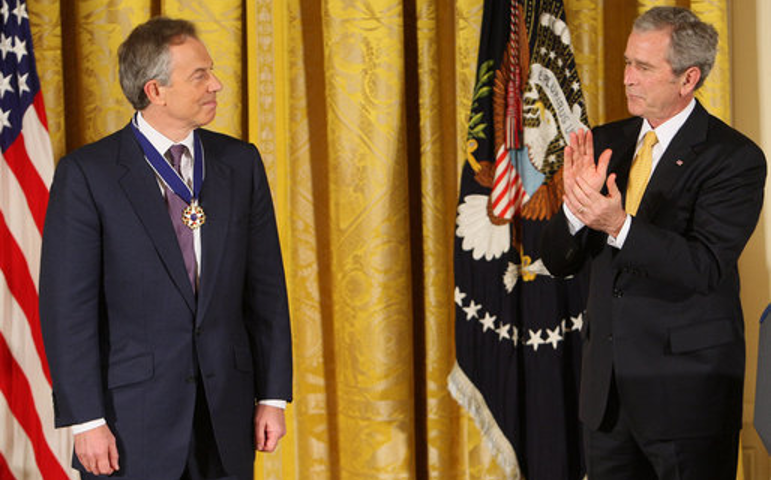
Photo source: The White House – Tony Blair being presented the Presidential Medal of Freedom, 2009, https://georgewbush-whitehouse.archives.gov/news/releases/2009/01/images/20090113-7_p011309cg-0410-515h.html
After the official announcement of the 20-points plan on September 29th, former Prime Minister Tony Blair resurfaced as a potential figure to be involved in Donald Trump’s new “Principles for Peace”, and London’s historic role in shaping Palestine’s fate returned to the global spotlight. For many observers, Blair’s involvement transforms what was presented as a peace plan into a test of political memory. His reappearance in Gaza’s post-war planning revives questions that never fully left: who decides what peace looks like, and on whose terms? A century after Balfour, is the United Kingdom today moving beyond its colonial approach to Palestine, or simply repackaging it in the language of reform and reconstruction?
The return of outside intervention
In 1917, the United Kingdom presented the Balfour Declaration, with the promise of “a national home for the Jewish people” in Palestine, while at the same time avoiding the same recognition of sovereignty for the Palestinians who were already living there. One century later, the United Kingdom once again presents itself as a potential architect of the Palestinians’ future, rebranded in terms of “principles”, “Board of Peace” and “Transitional Authority”.
Tony Blair, one of the most polarising British Prime Ministers after the Cold War, has declared his support for Donald Trump’s proposal for peace, resurfacing as a primary figure in Gaza’s latest planned transition.[1] Considering his Institute’s network in the region, he appears as the right person to lead this initiative, based on technocratic principles, post-war investment strategies and international oversight. Although Tony Blair does not represent the United Kingdom or its position when it comes to international issues, as elaborated and complex as the plan is, one can not help but question, is this a modern spin of a Palestinian mandate?
London recognised the State of Palestine in September 2025, when Prime Minister Keir Starmer framed it as a move to “revive the hope of peace and a two-state solution”, sending an ambassador to the West Bank, but this development does not return sovereignty to Gaza or safeguard Palestinian political agency.[2] Without formally addressing consequences for the occupation, and without shifting the paradigm that a peacebuilding process in Palestine falls almost exclusively under foreign responsibility, the United Kingdom risks repeating mistakes of the past. Starmer’s silence after failing to pressure Israel in July undermines this risk: no full arms embargo, no trade sanctions, trying to balance public sentiment with remaining on Trump’s good side.[3]
Blair’s Economic Peace
The British involvement in Palestine is not only part of the historical context of the current war, and Tony Blair’s role and earlier Middle East mission has acquired rather unfavourable feedback, as he prioritised optics and elite access over institutional reconstruction, in what seems to be a market-first approach to peacebuilding, which fails to produce lasting political stability, as the people that were at the centre of the issue – the Palestinians – have been neglected in this process.[4] Thus, his eight years as Quartet envoy (2007 – 2015) produced superficial outcomes, while Palestinians and some diplomats came to see him as structurally biased toward Israel and entangled in conflict of interest.
Blair is also confronted with his Iraq legacy, especially in terms of trust. His legal basis for invading Iraq has been since found “far from satisfactory”, as it was later proved that Iraq was not in possession of WMDs. He also faced prosecution claims for war-crimes, although it was later blocked.[5] Biographer Francis Beckett argues that the Iraq War was a “major turning point”, highlighting that Blair ventured in the invasion “without any consideration for the future governance of the country”[6], securing only his political path to resignation in 2007. His past challenges any renewed role he seeks in Palestinian affairs.
Blair’s diplomatic and negotiation skills must also be taken into consideration when analysing his potential role. Declassified documents from the Iraq War show that Blair extracted US concessions on the peace process when Washington was doubting London’s support, thus leveraging UK’s interests. Although critics may about his efficiency as a peacemaker because of this[7], it does provide valuable lessons about power and bargaining that have direct effects on current claims that Blair’s involvement can be decisive.
In late September 2025, Blair publicly re-entered the peace arena, when he appreciated President Trump’s Gaza plan as “bold and intelligent”, praising in particular Trump’s willingness to chair a “Board of Peace” that would coordinate Gaza’s post-war recovery.[8] Reports over the summer tied the Tony Blair Institute to discussions with Israeli business figures about the post-war development vision, an image of extravagant real-estate with artificial islands, luxury tourism (the so-called “Trump Riviera”), and an “Elon Musk Smart Manufacturing Zone”. TBI denied authoring the plan but acknowledged that staff took part in calls as it “looked at proposals being made by various parties”[9] – which in all fairness does fall under the purview of the Institute’s role in the region.
More relevant is the timing of the newly announced USA-UK joint peacebuilding venture in Gaza, as it follows both Trump’s UK state visit and investment announcements – $10 billion in economic deals from a three-pillar economic package speculated on 17 September[10], followed by a record UK claim of £150 billion in US commitments announced by September 19[11] – and the UNGA week. The strengthening of economic ties between USA and UK, together with Trump’s relation to Netanyahu and Blair’s regional connections signal a strong alliance against Hamas, and more importantly, a strong alliance for the future of Palestine, which is as uncertain as it ever was. It also reflects a familiar Western approach in which Palestinian sovereignty is deferred until security and stability are first achieved under external guidance.
Hamas has naturally pushed back. Taher Al-Nono, a Hamas official rejected any role for Blair, warning that the group would not accept the imposition of “foreign guardianship over our people”, adding that they are capable of managing their own affairs.[12] Palestinians have also pushed back: Ibrahim Joudeh (39, sheltering in southern Gaza) called the plan “unrealistic,” drafted with conditions the U.S. and Israel “know Hamas will never accept,” meaning “the war and the suffering will continue.” Xavier Abu Eid (former PLO negotiator) warned it “effectively legally separates Gaza from the West Bank.” Mahmoud Habbash (senior adviser to President Abbas) insisted, “We don’t need another representative… The only side that is able to administer Gaza is a Palestinian government and nothing else.” Simon Frankel Pratt (Univ. of Melbourne) said that, to most Palestinians, Blair is seen as a “war criminal” linked to Iraq and would lack legitimacy; Mustafa Barghouti (Palestinian National Initiative) added, “If you mention Tony Blair, the first thing people mention is the Iraq War.”[13]
The US, the UK and Israel seem to treat reconstruction as an investment portfolio, attempting to position themselves as beneficiaries of the peace process, rather than the Palestinians. This approach is the opposite of the UN’s New York Declaration, which sets a 15-month deadline for elections, reunification of Gaza and the West Bank and Palestinian statehood, so it prioritises sovereignty.[14] The proposed Gaza International Transitional Authority (GITA) reverses that logic, demanding order first, sovereignty later. Its instruments, made of external oversight boards and foreign commissions are meant to produce political subordination. By postponing self-rule in the name of stability, it risks creating a model that entrenches dependency instead of ending occupation. While the UN Declaration demands a rapid handover of authority, the GITA model risks delays, promising prosperity while consolidating control.
Britain’s dual policy
While Trump’s policies have been relatively consistent, the UK’s domestic and foreign policy in 2025 pull in opposite directions. On one hand, London escalates criticism of Israel, sanctioning ministers Ben Gvir and Bezalel Smotrich, freezing trade talks, barring Israeli officials from a major London arms fair[15], and prohibiting new Israeli enrolments at the Royal College of Defence Studies starting in 2026.[16] On the other hand, declassified reports show Britain’s long-running military ties with senior Israeli officers, including Herzi Halevi (current IDF Chief of Staff), Aviv Kochavi (former Chief of Staff), and Amir Baram (northern command), all of them figures that oversee operations in Gaza, providing evidence of structural complicity that persists despite periodic official condemnations.[17]
This duality can be observed within humanitarian approaches too. While the UK has decided to fast-track visas for Gaza scholars[18], framing it as cultivating future rebuilders, in a show of compassion and soft power, it does very little to confront the architecture of occupation and humanitarian aid blockade, that remains intact.
The Blair–Trump project sharpens the contradiction. If Britain’s recognition of Palestine is a principled fresh start, why is one of Britain’s most famous statesmen tied to a plan that would formalise external control over Gaza’s political future?
Empty recognition of Palestine
The recent wave of recognition of the Palestinian state has brought forward different perspectives about the meaning, depth and impact of such decisions. Some of them are more pragmatic, some more anchored in legal technicalities. Together, these perspectives illustrate the limits of recent recognition efforts and the obstacles to create a genuine two-state framework.
The first, from Chatham house, is rather blunt. Recognition has not moved Israel’s government, Netanyahu reiterated that a two-state solution will not happen, and previous British measures have not provided enough leverage. With Washington’s protection intact and the UK representing a small part of Israel’s trade and arms imports, London’s influence is limited. Stronger tools remain politically costly, especially under a Trump White House[19]
The second perspective presents recognition more as a PR strategy, especially under public pressure, as it touches upon third states’ legal obligations, in this case Israel’s actions against Palestine. However, conditions attached by recognising states (e.g. demilitarisation or the exclusion of certain parties from governance) conflict with the principles of non-intervention and sovereign equality. Recognition should mark the start of real compliance with international law in all sectors: trade, defence, diplomacy, etc. It should not be seen just as a symbolic substitute for it.[20]
A century of promises, the same pattern
A century after the Balfour Declaration, Trump’s plan starring Blair brings forth a strikingly similar political architecture, where real sovereignty is withheld from the Palestinian people. The United States supplies political power, the United Kingdom brings institutional credibility, and Israel maintains coercive control, at least for the foreseeable future.
For Prime Minister Starmer, recognising Palestine was framed as a moral and diplomatic advance, but the effects are minimal. By avoiding confrontation with Netanyahu’s Israel and quietly accepting Blair’s reappearance in the peace framework, London highlights the double-edged sword of symbolic diplomacy. It offers gestures that proclaim change, while preserving the structures of power that prevent it. Without enforcement, accountability and genuine self-determination of Palestine, the pattern will persist.
[1] Tony Blair, „Statement by Tony Blair in Response to President Trump’s Announcement,” 29 sept. 2025. https://institute.global/insights/news/statement-by-tony-blair-in-response-to-president-trumps-announcement
[2] Christopher Phillips, “UK recognition of Palestine: Will it make any difference?” Chatham House, 23 Sept 2025. https://www.chathamhouse.org/2025/09/uk-recognition-palestine-will-it-make-any-difference
[3] Ibid.
[4] Maria Rovisco et al., “Tony Blair as Middle East Envoy: Celebrity politics, legitimacy and colonial logics,” Global Discourse (2018). https://www.tandfonline.com/doi/full/10.1080/19436149.2018.1516336
[5] Yasmeen Serhan, “Tony Blair’s Gaza Peace Plan Reopens Old Wounds” Time, 30 Sept 2025. https://time.com/7321848/tony-blair-gaza-peace-plan-trump-israel-hamas-iraq-history/
[6]Alasdair Soussi, “Who is the real Tony Blair?”, Al Jazeera, 29 Nov 2016 https://www.aljazeera.com/features/2016/11/29/who-is-the-real-tony-blair
[7] Marina E. Henke, “Tony Blair’s gamble: The Middle East Peace Process and British participation in the Iraq 2003 campaign,” The British Journal of Politics and International Relations (2018). https://doi.org/10.1177/1369148118784708
[8] Blair statement (ref. 1)
[9] Tony Blair’s thinktank worked with a project developing a postwar Gaza plan,” The Guardian, 7 July 2025. https://www.theguardian.com/politics/2025/jul/07/tony-blair-thinktank-worked-with-project-developing-trump-riviera-gaza-plan
[10] “Trump begins second state visit to UK…”, China Daily, 17 Sept 2025 (state-visit agenda; £/$ deals; three-pillar framework; Google UK investment; protests). https://www.chinadaily.com.cn/a/202509/17/WS68ca0f43a3108622abca12c0.html
[11] Jonathan Powell, “UK secures record US investment,” China Daily Global, 19 Sept 2025 (UK claims £150bn package; jobs; Blackstone/Palantir/Prologis). https://global.chinadaily.com.cn/a/202509/19/WS68ccac8aa3108622abca1a11.html
[12] Nidal al-Mughrabi, “Tony Blair’s return to Middle East diplomacy reopens old wounds, new doubts,” Reuters, 30 Sept 2025. https://www.reuters.com/world/middle-east/tony-blairs-return-middle-east-diplomacy-reopens-old-wounds-new-doubts-2025-09-30/
[13] “Tony Blair’s Gaza Peace Plan Reopens Old Wounds,” (ref. 5)
[14] Britain Palestine Project, “Trump Plan vs. New York Declaration” (timeline and sequencing). https://britainpalestineproject.org/trumpplan/
[15] “Israel fumes as UK bars its officials from London arms fair, won’t set up pavilion,” Times of Israel, 19 Sept 2025 https://www.timesofisrael.com/israel-fumes-as-uk-bars-its-officials-from-london-arms-fair-wont-set-up-pavilion/
[16] “UK bans Israelis from enrolling in prestigious defense academy from next year,” Times of Israel, 20 Sept 2025 https://www.timesofisrael.com/uk-bans-israelis-from-enrolling-in-prestigious-defense-academy-from-next-year/
[17] Mark Curtis, “Britain trained Israeli soldiers fighting in Gaza,” Declassified UK, 16 Sept 2025. https://www.declassifieduk.org/britain-trained-israeli-soldiers-fighting-in-gaza/
[18] UK Government, “Scholarships for students from Gaza,” policy page (Sept 2025). https://www.gov.uk/government/publications/support-for-students-travelling-to-the-uk-from-gaza/scholarships-for-students-from-gaza
[19] “UK recognition of Palestine: Will it make any difference?” (ref. 2)
[20] Mohammad Fadel, “Too Little, Too Late? On the Meaning and Consequences of the Recognition of the State of Palestine,” Opinio Juris, 24 Sept 2025. https://opiniojuris.org/2025/09/24/too-little-too-late-on-the-meaning-and-consequences-of-the-recognition-of-the-state-of-palestine/

Mrs. Larisa-Nicoleta Pătrașcu
Mrs. Larisa-Nicoleta Pătrașcu is a Junior Researcher at the Middle East Political and Economic Institute (MEPEI). Her research and professional interests centre on peacebuilding, diplomacy and conflict resolution, international cooperation, and MENA geopolitics.