
The 80th session of the United Nations General Assembly:The High-level Meeting to Launch the Global Dialogue on AI Governance
October 8, 2025
The Price of Peace: From Balfour to Blair, is the Mandate Returning in Gaza?
October 10, 2025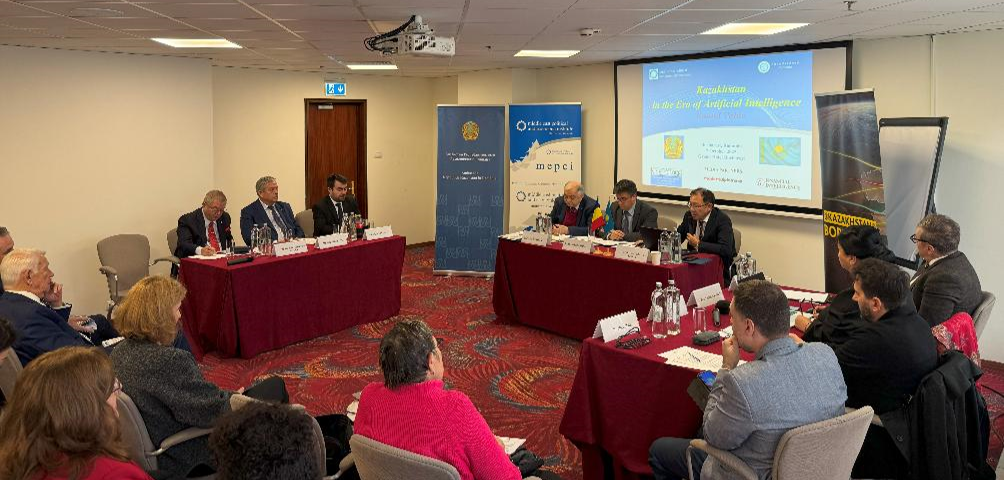
On October 7, 2025, the Middle East Political and Economic Institute (MEPEI) and EuroDefense Romania, in partnership with the Embassy of the Republic of Kazakhstan to Romania, hosted a high-level Round Table titled “Kazakhstan in the Era of Artificial Intelligence” at the Grand Hotel Bucharest. The event gathered diplomats, academics, policymakers, and experts to discuss the main takeaways from President Kassym-Jomart Tokayev’s 2025 State of the Nation Address and his speech at the 80th UN General Assembly, both centered on digital transformation, artificial intelligence (AI), and institutional modernization.
This event is a part of our series of common activities and projects, and it is supported by our media partners: Nine O’Clock, Financial Intelligence, and Modern Diplomacy.
The round table was moderated by Flavius Caba-Maria, President of MEPEI. In the opening session, His Excellency Ali Yerlik, Ambassador of Kazakhstan to Romania, presented his country’s ambitious vision to become a fully digital nation within the next three years. He emphasized the creation of the Ministry of Artificial Intelligence and Digital Development and the introduction of a Unified Digital Code to regulate AI, Big Data, and platform economies. The Ambassador highlighted that 92% of Kazakhstan’s public services are now digitalized, placing the country among the top ten globally in e-government services. He also pointed to Astana Hub, which hosts over 1,300 tech startups, and to major partnerships like the $4.2 billion agreement with Wabtec and the China–Europe transport corridor, as evidence of Kazakhstan’s rising global connectivity.
He further noted that Kazakhstan’s reforms—political, economic, and digital—are part of a broader strategy for sustainable growth and international engagement. Referring to President Tokayev’s UN speech, Ambassador Yerlik reiterated key messages on UN reform, the need for global trust, and collective action on environmental challenges, including water scarcity, melting glaciers, and the Aral Sea crisis.
Romanian experts followed with insights on how Romania and Kazakhstan can deepen their cooperation in AI governance, cybersecurity, and sustainable development.
- Prof. Liviu Mureșan (President, EuroDefense Romania) emphasized Kazakhstan’s transformation into a regional connectivity hub and discussed opportunities for bilateral projects in AI and economic reform.
- Dr. Alexandru Georgescu (Strategic Researcher at ICI-Bucharest and Secretary-General at EuroDefense Romania) outlined joint research and exchange programs with Kazakh institutions, highlighting both nations’ challenges in retaining tech talent.
- Iuliu Stocklosa (President, Chamber of Commerce and Industry of Bucharest) underscored Kazakhstan’s digital ambition and Romania’s complementary AI strategy (2024–2027), stressing collaboration between Romanian and Kazakh companies in innovation and digital services.
- Mihail George Guranda (Senior Expert in Legal and Regulatory Affairs, Strategic Policy Advisor, former Superior Manager of Regulatory Division DNSC) focused on the legal and ethical challenges of AI regulation, advocating for a coordinated institutional framework.
- Ambassador Emil Rapcea (Career Diplomat, Former Ambassador of Romania to Kazakhstan), recalling his diplomatic experience, praised Kazakhstan’s balanced diplomacy and its reform agenda as a model for international cooperation.
- Prof. Octavian-Dragomir Jora (Professor, Bucharest University of Economic Studies/ASE)) reflected on Romania–Kazakhstan relations as a bridge between Europe and Asia, suggesting Kazakhstan’s model could inspire Romania’s own modernization path.
- Dr. Mihai Sebe (Head of Unit, European Affairs Department, European Institute of Romania, and Lecturer, University of Bucharest) underscored the Trans-Caspian Corridor as a vital Europe–Central Asia bridge, where Romania’s Black Sea gateway role and Kazakhstan’s digital leadership jointly advance a sustainable, digitally integrated Eurasian connectivity model.
- Ecaterina Mațoi (Program Director, MEPEI, and President, Strategic Dialogue for Global Affairs Initiative/SDGAi) presented “Kazakhstan: Digitalization and Strategic Autonomy,” detailing initiatives such as Digital Tenge, Alatau Smart City, and the pioneering AI-powered board member SKAI at Samruk-Kazyna, which symbolize the country’s integration of AI into governance and economy.
The roundtable concluded with a Q&A session, during which participants discussed the Trans-Caspian Corridor’s strategic role in connecting Central Asia to Europe, the modernization of Rompetrol, and the development of the Kazakhstan–Romania Investment Fund. The recent visit of a Port of Constanța delegation to Kazakhstan, which resulted in the signing of a cooperation memorandum, was also praised as a key step in expanding logistical and trade links.
Overall, the event illustrated Kazakhstan’s emergence as a regional leader in AI and digital governance, while underlining Romania’s growing interest in deepening partnerships in innovation, infrastructure, and economic modernization. The roundtable reinforced the shared vision of both countries to build a sustainable, connected, and technologically advanced Eurasian future through dialogue, trust, and strategic collaboration.
Flavius CABA-MARIA
Flavius CABA-MARIA is the President, Middle East Political and economic Institute.