Termination of new START and nuclear order
February 11, 2026
Defending sovereignty: U.S. Pressure, Iranian Influence, and the Stance Against Foreign Intervention
February 20, 2026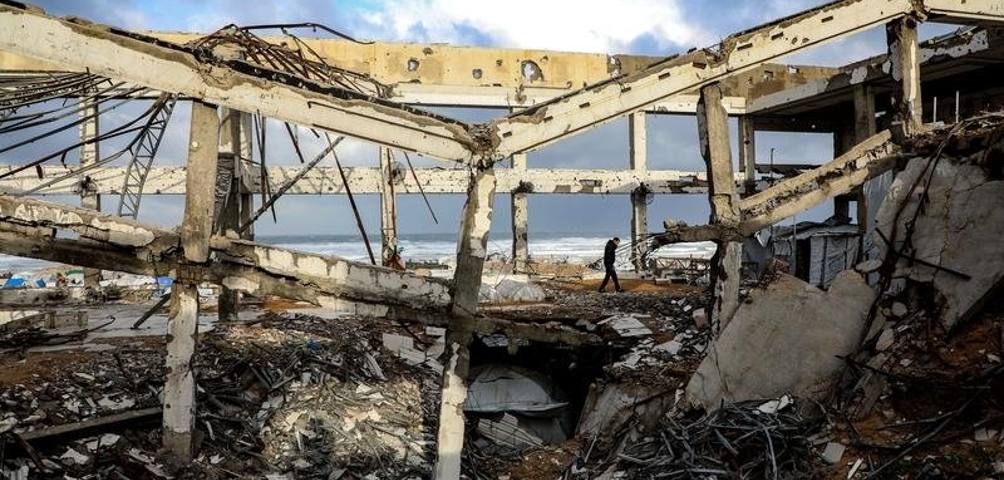
Source of the photo: https://www.dailysabah.com/world/mid-east/gaza-board-of-peace-plan-draws-rare-israel-us-disagreement
In a bid to regain influence following a perceived American retreat from the Middle East, President Trump proposed a 20-point Gaza strategy. Despite the truce and the launch of “Board of Peace” as an audacious gambit to replace the multilateral system, Palestinian casualties continued. Therefore, the vision of transforming Gaza into a so-called “Riviera” by addressing Israel’s security, boosting the economy, and solving the Palestinian issue seems more like a fiasco than a diplomatic solution, which could damage Washington’s credibility and strengthen its opponents.
Ostensibly created to oversee reconstruction, the board’s own 11-page charter does not mention Gaza. A real estate development prospectus cannot replace Palestine’s humanitarian and political crisis. Hence, the “Board of Peace” is nothing more than a Potemkin village of diplomacy, with a grand name, a signed charter, a list of member countries, and high-profile announcements that create the impression of progress and action where none exists.
In the fragmented, multipolar arena of the new Middle East, states are exploring non-Western alliances and greater independence, yet the inescapable logic of American hard security prevents it from losing grip so easily. What the US is losing by enforcing compliance, however, is legitimate authority, the quality of its allegiance, and long-term influence, as the region with many alternatives now demands influence that is earned, not commanded.
Sending initial invitations to debtors, admirers, and autocrats reflects a mindset focused solely on the enforced plan’s legitimacy, investment appeal, and capital mobilization, rather than genuinely resolving Palestine’s crisis. Conversely, Washington’s Western allies recoiled at this proposition for viewing it as an “America First” vehicle and a rival to the United Nations system.
The world saw Trump threatening allies over unilateral whims, like arresting Venezuelan President Maduro, interests in Greenland’s annexation, and imposing 200% tariffs on French wine. To avoid facing this diplomatic mutiny, some regional actors felt compelled to join the peace initiative despite opposing Palestinian displacement. However, their membership does not guarantee a better future for Gaza. It is, rather, an act of pragmatic hedging for their own potential benefit.
Pakistan approved the US plan only on the condition that it aligns with the UN’s stance on a Palestinian state; similarly, Egypt’s participation has not prevented it from pursuing its, Arab League’s endorsed, $53 billion Gaza reconstruction plan. The persistence of Egypt’s alternative itself indicates that Arab participants are preparing for the failure of the American initiative.
A truly effective humanitarian body would have looked radically different. It would have been structured with strong dispute-resolution mechanisms and penalties for breaches, and without a clause granting Israel veto power over its own withdrawal, which is tied to the impossible condition of a full “demilitarization” of Hamas. With these flaws, it can never be a successful grand bargain; rather, it is a fiasco that has achieved neither an end to the war nor a demonstration of American diplomatic strength.
Phase One failed to prevent hundreds of Palestinian casualties, and aid deliveries fell drastically short of the promised levels, making this mirage ceasefire hardly celebrated. Moreover, the “Phase Two” announcement is built on a “Phase One” that was never fully implemented. Its launch centers on a dysfunctional board, where an International Stabilization Force (ISF) remains a ghost. No country has committed troops to the politically sensitive mission of forcibly disarming Hamas for an untrustworthy Israel. It is a suicide task that would entangle any peacekeeping force into an occupying army. How can this be counted as a peace process advancing?
Therefore, the “Board of Peace” is clearly an unworkable machinery of peace, also because it is not a forum of equals. With Trump as its permanent chairman and a $1 billion, pay-to-play fee for a permanent seat, it corrupts the very principle of multilateralism. It ensures the board answers not to international law but to the wealthiest patrons and the chairman’s whims to decide the fate of excluded stakeholder (the Palestinians).
The US dominates the executive board with figures like Jared Kushner and the deeply controversial Tony Blair above a token Palestinian technocratic committee. The plan overall ensures implementation remains at Israel’s discretion but maintains deafening silence on Gaza’s core political issues and treats Palestinian rights as commodities, a contradiction that loudly signals imminent failure.
While it is true that the suffering in Gaza is a monstrous testament to the valid critique of the UN’s bureaucracy and its paralysis, the answer to a dysfunctional system is reform, not replacement with a personalist autocracy. Trump’s recent actions have ingrained his administration as a source of instability rather than a guarantor of order, and the enforced board’s fiasco serves as a definitive case study of why it is fading. Ultimately, America may still be the indispensable ally in the Middle East, but its continued enforcement today will only spark resentment that will explode tomorrow.
Disclaimer. The views and opinions expressed in this analysis are those of the author and do not necessarily reflect the official policy or position of MEPEI. Any content provided by our author is of her opinion and is not intended to malign any religion, ethnic group, club, organization, company, individual, or anyone or anything.

Rabbab A. Khan
Rabbab A. Khan is a Lecturer and Researcher in International Relations, focusing on political sociology and the foreign policy analysis of Saudi Arabia through the prism of US-China great-power competition. The author can be reached at rabab7j@gmail.com