
Saudi Arabia’s Nuclear Ambitions and Washington’s Strategic Dilemma: Redefining Non-Proliferation Rules in a Changing Middle East
July 24, 2026
Syria and China: Seven Decades of Political Accumulation and the Transformation of Geography into a Strategic Opportunity
August 5, 2026Guterres in Damascus: Restoring the Role of the United Nations and Syria’s Future in the Emerging Regional Order
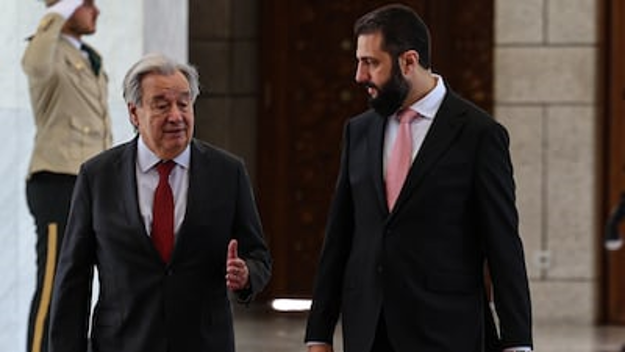
Source of photo: https://www.thenationalnews.com/
The visit of United Nations Secretary-General António Guterres to Damascus was far more than a routine diplomatic engagement. It came at a highly sensitive regional and international juncture, at a time when Syria is attempting to redefine its position within the evolving international order. After more than fourteen years of war that transformed the country into one of the world’s most complex conflict zones, Damascus now faces a new phase defined by the transition from managing conflict to attempting to build peace.
The significance of the visit lies in the fact that the UN Secretary-General does not represent a single state or a political alliance; rather, he represents an international organization established in 1945 with the primary mission of maintaining international peace and security. His presence in Damascus therefore carries a message that extends beyond the Syrian question itself: the stability of Syria has become directly connected to the stability of the wider Middle East and the broader international system. Moreover, the Syrian war was never merely an internal conflict. It evolved into a major arena of great-power competition in the twenty-first century, where the interests of Russia, the United States, Türkiye, Iran, Israel, and several Arab states converged on Syrian territory. Syria consequently became one of the most significant testing grounds for fundamental concepts in international relations, including national sovereignty, external intervention, and the balance of power.
For this reason, Guterres’ visit should not be assessed only through the lens of official meetings and diplomatic statements. Its deeper significance lies in the political message it conveys: the United Nations, which initially entered Syria through the humanitarian assistance framework, is now seeking to re-engage through the pathway of political settlement, at a time when regional and international actors are searching for a new approach toward Damascus.
- The Timing of the Visit: Damascus at the Center of Regional Reconfiguration
Guterres’ visit to Damascus cannot be understood separately from the broader transformations reshaping the Middle East. The region is entering a period of extensive reordering after years of open conflicts, as international priorities are shifting away from merely managing crises toward reshaping political, security, and economic balances. Also, the visit comes at a moment when several regional and international actors are reconsidering their relationship with Syria, following years of experience that demonstrated that isolating Damascus did not resolve the crisis. Instead, it contributed to a prolonged vacuum that was gradually filled by competing regional and global powers.
Russia views Syria as a vital component of its strategic presence in the Eastern Mediterranean. The United States approaches the Syrian file primarily through the perspectives of counterterrorism and limiting the expansion of rival actors. Türkiye links Syria directly to its national security concerns and southern borders, while Iran considers Syria a central element in its regional influence network.
Against this backdrop, the UN Secretary-General’s visit is not simply a return to an old crisis file. It represents an attempt to place the United Nations at the center of discussions about Syria’s future in the post-war era.
- Syria: A Founding Member of the United Nations Transformed into an International Crisis
The relationship between Syria and the United Nations carries a unique historical significance. Syria is not a marginal actor in the history of the international organization; it was among its founding members. Damascus participated in the San Francisco Conference in 1945 and became one of the signatories of the UN Charter, joining the organization at its creation. During the first decades of its membership, Syria actively used UN platforms to advance its foreign policy priorities, particularly regarding the Palestinian issue and the Arab-Israeli conflict. The United Nations General Assembly became one of the central arenas of Syrian diplomacy.
However, after 2011, Syria’s position within the UN system changed dramatically. It moved from being a member state participating in international debates to becoming a permanent item on the agenda of the Security Council. Syria became one of the clearest examples of the crisis of the international system itself, as the Council failed repeatedly to achieve consensus due to deep divisions among major powers. Russia and China used their veto power on several occasions to block resolutions they considered aimed at weakening the Syrian state or opening the door to foreign intervention. Meanwhile, the United States and European countries called for a political transition and broad domestic reforms.
Thus, Syria became an arena of confrontation between two competing visions of international relations:
- A sovereignty-centered approach, emphasizing the primacy of the state and the principle of non-interference.
- A transformation-oriented approach, linking long-term stability to internal political change and international pressure.
- UN Resolutions: Between International Legitimacy and the Limits of Implementation
Since the outbreak of the Syrian crisis, the United Nations Security Council has adopted a series of resolutions aimed at creating a political and humanitarian framework for managing the conflict. One of the earliest attempts was Security Council Resolution 2042 of 2012, which sought to establish an international monitoring mechanism and support efforts toward a political settlement. It was followed by Resolution 2118 in 2013, adopted after the controversy surrounding Syria’s chemical weapons program, which led to the internationally supervised process of dismantling Syria’s declared chemical arsenal.
Meanwhile, Resolution 2139 of 2014 focused primarily on the humanitarian dimension of the crisis, calling for improved access to civilians in need and emphasizing the protection of humanitarian principles. This was followed by Resolution 2165, which authorized the delivery of humanitarian assistance across borders due to the difficulties of reaching several areas inside Syria.
However, the most politically significant international document remains Security Council Resolution 2254, adopted in 2015, which became the main international reference point for a political settlement in Syria. The resolution called for a Syrian-led political process, constitutional reform, and elections under United Nations supervision. It represented an attempt to transform the Syrian conflict from a military confrontation into a structured political transition.
Yet the Syrian crisis revealed a deeper challenge within the international system: the widening gap between international legitimacy and the ability to translate legal frameworks into political realities. UN resolutions possess legal and moral significance, but their implementation depends largely on consensus among major powers. Without such consensus, even the most important international decisions remain vulnerable to geopolitical rivalries.
This represents one of the greatest paradoxes of the Syrian conflict. The Security Council succeeded in defining the outlines of a political solution, but it lacked the necessary mechanisms to impose or enforce that solution. Consequently, Resolution 2254 became a reference point publicly accepted by most international actors, while remaining practically constrained by changing regional and global power dynamics.
The Syrian case therefore reflects a broader transformation in the international system itself. The United Nations is no longer the sole institution capable of managing international crises; instead, it operates within a competitive environment where major powers pursue strategic interests and influence.
- UNIFIL and UNDOF: Syria Within the United Nations’ Regional Security Architecture
The relationship between Syria and the United Nations cannot be fully understood without examining the role of international peacekeeping forces in the Middle East.
The United Nations Interim Force in Lebanon (UNIFIL), established in 1978 following Israel’s invasion of Lebanon, represents one of the most important UN peacekeeping missions in the region. Its role was significantly expanded after the 2006 Lebanon War through Security Council Resolution 1701, which strengthened its responsibility in monitoring the Lebanese-Israeli border and preventing local tensions from escalating into a wider regional conflict. The mission illustrates one of the central functions of UN peacekeeping: not necessarily resolving political disputes, but creating mechanisms that prevent fragile situations from turning into major wars.
Another key component of the UN’s regional security presence is the United Nations Disengagement Observer Force (UNDOF), established in 1974 following the October War to monitor the ceasefire agreement between Syria and Israel in the Golan Heights. UNDOF remains strategically significant because the Golan Heights is not merely a geographic territory; it represents one of the most sensitive security and political issues in the Middle East.
The United Nations considers the Golan Heights Syrian territory occupied by Israel since 1967, while Israel formally annexed the area in 1981 — a decision that has not received broad international recognition. Nonetheless, the continued presence of UNDOF demonstrates that any future Syrian-Israeli security arrangement would likely require an international mechanism capable of monitoring agreements, reducing tensions, and preventing renewed escalation.
- The Reconstruction Equation: Why Politics Comes Before Economics
Guterres’ visit takes place at a time when Syria faces one of the most severe economic and humanitarian challenges in its modern history.
The war has caused extensive destruction to infrastructure and forced millions of Syrians to leave their homes, both internally and abroad. More than 13 million Syrians have been displaced, either as internally displaced persons or refugees outside the country, making Syria one of the largest displacement crises in the world over the past decade.
However, reconstruction is not simply an economic process; it is fundamentally a political project. International companies, development institutions, and financial organizations are unlikely to participate in large-scale reconstruction without political stability, legal guarantees, and a secure investment environment. This is why reconstruction itself has become part of the political struggle over Syria’s future. Some countries view reconstruction as a tool to promote stability and prevent further collapse. Others fear that large-scale reconstruction without a comprehensive political settlement could contribute to consolidating existing realities before addressing the deeper causes of the conflict.
For the United Nations, therefore, its role extends beyond humanitarian assistance. The organization seeks to provide a political framework capable of facilitating economic recovery, attracting investment, and rebuilding state institutions. The central question is not only how to rebuild Syrian cities, but how to rebuild the foundations of governance, legitimacy, and social trust.
- The Next Battle: Rebuilding the Syrian State
The next Syrian challenge will not be limited to rebuilding physical infrastructure. The more difficult task will be rebuilding state institutions and restoring trust between society and the state. International experiences demonstrate that countries emerging from prolonged conflicts do not recover through financial resources alone. Sustainable recovery requires a new political framework capable of addressing the underlying causes of conflict and preventing the return of instability.
For this reason, Syria’s reconstruction process will depend on three fundamental conditions:
- First: The establishment of a stable security environment capable of preventing the resurgence of armed groups and ensuring long-term stability.
- Second: The achievement of a political consensus that creates confidence among domestic and international investors and encourages economic recovery.
- Third: The development of effective state institutions capable of managing resources, delivering public services, and restoring citizens’ confidence in governance.
Therefore, Syria’s next battle will be political as much as it will be economic. The experience of post-conflict societies around the world shows that rebuilding roads, hospitals, and infrastructure is only one dimension of recovery. The deeper challenge is rebuilding the institutional foundations of the state and creating a political environment in which peace can become sustainable.
In this context, the United Nations views stability not merely as the absence of armed conflict, but as the existence of functioning institutions, political inclusion, and conditions that prevent the repetition of violence.
- Does Guterres’ Visit Signal Syria’s Return to the International Community?
Despite the strong symbolic importance of the visit, Guterres’ presence in Damascus does not mean that all disputes surrounding Syria have been resolved. Several complex issues remain unresolved, including Western sanctions, foreign military deployments, the future of the political process, and Syria’s relationship with regional and international powers.
However, the visit does indicate an important shift in international perceptions of Syria. For many years, Syria was viewed primarily as a conflict zone, a humanitarian emergency, and a battlefield for competing geopolitical interests. Today, it is increasingly being discussed as a state whose institutions and international position require reconstruction and reintegration.
The United Nations recognizes that continued instability in Syria could generate consequences extending far beyond its borders, including the resurgence of extremist organizations, continued migration pressures, and increased regional tensions. From this perspective, engagement with Syria is not only about the future of the Syrian state; it is also about preventing broader instability in an already fragile Middle Eastern environment.
Nevertheless, the process of reintegration into the international system will depend on the ability of Syrian and international actors to address unresolved political, security, and humanitarian challenges. The key question is no longer only whether Syria can return to the international community, but under what conditions and through what political framework this return can take place.
- Syria and the Future of the Middle East Regional Order
Syria cannot be viewed simply as an internal crisis approaching its conclusion. It remains one of the most important geopolitical crossroads in the Middle East. Its geographical position has made it a strategic link between the Mediterranean Sea, the Gulf region, Türkiye, and Iraq. This location places Syria at the center of broader security questions involving energy routes, trade corridors, regional connectivity, and military competition.
Throughout modern history, Syria’s strategic importance has extended beyond its borders. Developments inside the country have repeatedly influenced regional balances and international calculations. For this reason, Syria’s future will be directly connected to the emerging regional order in the Middle East. A stable Syria could open the door to a new phase of economic cooperation, reconstruction initiatives, regional integration, and greater diplomatic stability.
By contrast, continued fragmentation and geopolitical competition could reproduce patterns of instability and prevent Syria from fully restoring its sovereignty and institutional capacity.
The Syrian question therefore represents a broader test for the Middle East: whether the region can move from a cycle of conflict and rivalry toward a new model based on cooperation, economic interdependence, and managed competition.
- Can the United Nations Build Peace in Syria?
The visit of United Nations Secretary-General António Guterres to Damascus represents both a symbolic and political moment. It confirms that Syria continues to occupy a central position in the calculations of the international system and that any attempt to reshape the Middle East cannot ignore the Syrian state and its strategic importance.
However, the real challenge does not lie merely in the return of international officials to Damascus. The greater challenge is whether the international community can transform this diplomatic engagement into a sustainable political and economic process capable of producing long-term stability. Historically, the United Nations has often been more successful in managing conflicts than in completely resolving them. Syria therefore represents another major test of the organization’s ability to move beyond the traditional logic of conflict containment toward the more ambitious objective of peacebuilding.
The Syrian experience reflects the broader dilemma facing international organizations in the twenty-first century: how to preserve the principles of sovereignty and international law while responding effectively to internal conflicts that generate regional and global consequences.
The United Nations can provide mediation, humanitarian assistance, and international legitimacy, but it cannot alone impose peace. Sustainable peace requires political will among Syrian actors as well as agreement among regional and international powers whose interests have shaped the conflict. Therefore, the future role of the United Nations in Syria will depend on its ability to act not merely as a humanitarian institution, but as a platform capable of facilitating dialogue, supporting institutional rebuilding, and creating conditions for a durable political settlement.
Disclaimer. The views and opinions expressed in this analysis are those of the author and do not necessarily reflect the official policy or position of MEPEI. Any content provided by our author is of her opinion and is not intended to malign any religion, ethnic group, club, organization, company, individual, or anyone or anything.
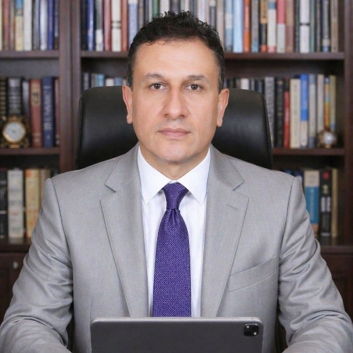
Prof. Shaher Al Shaher
Dr. Shaher Al Shaher is an Associate Professor at the School of International Studies, Sun Yat-Sen University, China. Shaher@mail.sysu.edu.cn