A Review of the Possibility of a Saudi Arabia – United States Nuclear Cooperation Deal, from Civilian Energy Cooperation to a Nuclearized Competition
July 22, 2026
Guterres in Damascus: Restoring the Role of the United Nations and Syria’s Future in the Emerging Regional Order
July 27, 2026Saudi Arabia’s Nuclear Ambitions and Washington’s Strategic Dilemma: Redefining Non-Proliferation Rules in a Changing Middle East
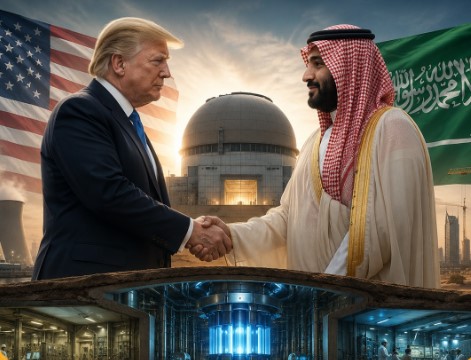
For decades, preventing the proliferation of nuclear weapons has been one of the central pillars of U.S. foreign policy since the end of World War II. Washington has led international efforts aimed at limiting the emergence of new nuclear powers and has strongly supported arms control agreements and non-proliferation frameworks, based on the belief that expanding the nuclear club increases the likelihood of crises, military confrontations, and instability within the international system.
However, international politics is not shaped by principles alone. Calculations of power, strategic interests, and deterrence dynamics also drive it. This reality lies at the heart of the ongoing debate over U.S. nuclear cooperation with Saudi Arabia, whether in the context of developing an advanced civilian nuclear program or potentially acquiring strategic capabilities that could provide Riyadh with additional options in an increasingly uncertain regional environment.
It is essential, however, to distinguish between three fundamentally different levels of nuclear development: the possession of a civilian nuclear energy program for electricity generation, the acquisition of the nuclear fuel cycle—including uranium enrichment capabilities—and the actual possession of nuclear weapons.
The United States has not officially endorsed Saudi Arabia’s acquisition of nuclear weapons. Nevertheless, Washington has become increasingly open to discussing expanded civilian nuclear cooperation with Riyadh amid profound geopolitical transformations in the Middle East and the wider international system.
This emerging position reflects a highly complex American attempt to reconcile two competing objectives: “preserving the global nuclear non-proliferation regime on one hand, while preventing regional strategic imbalances on the other”. In this context, the Trump administration has shown greater willingness to move forward with a nuclear cooperation agreement with Saudi Arabia, viewing such a deal as part of a broader strategic partnership between Washington and Riyadh. The agreement reflects a shift in U.S. calculations, where maintaining American influence in the Gulf and preventing rival powers from filling the strategic vacuum have become increasingly important considerations alongside traditional non-proliferation concerns.
Between Confronting Iran, Containing China, and Preserving Alliances: The Strategic Calculations Behind Washington’s Opening Toward Riyadh
Understanding the evolution of the American position requires examining a complex set of interconnected factors, beginning with Iran’s nuclear ambitions, extending to U.S.-China strategic competition, and ultimately reaching the future of American alliances in the Middle East.
- Confronting Iran and Preventing a Strategic Imbalance in the Gulf
Iran represents the most immediate factor shaping Washington’s calculations regarding Saudi Arabia’s nuclear ambitions.
For years, the United States and its regional partners have viewed Iran’s nuclear program as one of the most significant security challenges in the Middle East. Although Tehran maintains that its nuclear activities are exclusively peaceful, the significant expansion of its nuclear capabilities—particularly in uranium enrichment—has generated regional and international concerns over the possibility that these capabilities could eventually provide Iran with a military nuclear option.
In this context, Washington recognizes that any major transformation in Iran’s nuclear posture would directly affect the security calculations of Gulf states, particularly Saudi Arabia.
As a major regional power, Saudi Arabia is unlikely to accept a strategic environment in which its principal regional rival possesses a potential nuclear advantage or a credible nuclear deterrent capability. Consequently, some American strategic circles argue that strengthening civilian nuclear cooperation with Riyadh could serve as a mechanism for maintaining regional balance and preventing the emergence of a strategic gap between Saudi Arabia and Iran.
From this perspective, the Saudi nuclear issue is not merely about energy production; it is deeply connected to broader questions of regional security, deterrence, and power equilibrium.
This approach is based on a central assumption: attempting to completely restrict allies from developing advanced capabilities may not necessarily prevent their security ambitions. Instead, it could encourage them to seek alternative partners or pursue more independent strategic options outside American influence.
- Preventing Saudi Arabia’s Shift Toward the Chinese and Russian Spheres of Influence
The second major factor shaping Washington’s approach is linked to the broader strategic competition between the United States and China.
Although the security relationship between Washington and Riyadh remains significant, Saudi-American relations have undergone noticeable changes in recent years. Saudi Arabia has increasingly pursued a policy of diversifying its international partnerships, strengthening ties not only with the United States but also with China, Russia, and the BRICS countries.
China has emerged as a leading economic partner for Saudi Arabia in several critical areas, including energy, trade, investment, infrastructure, and advanced technologies. Beijing has also played an important diplomatic role in facilitating the restoration of Saudi-Iranian relations, a development that demonstrated China’s growing political influence in a region traditionally dominated by Washington.
This transformation has generated concerns in Washington, which increasingly views China as its primary strategic competitor in the global system.
Therefore, American nuclear cooperation with Saudi Arabia is not merely about constructing nuclear reactors or transferring civilian technology. It is also connected to a broader geopolitical objective: preserving American influence in one of the world’s most strategically significant regions.
The United States does not want its role in Saudi Arabia to be limited to conventional arms sales. Instead, Washington seeks to remain the primary partner in emerging strategic sectors, including:
* Nuclear energy and advanced technologies;
* Cybersecurity cooperation;
* Defense industries;
* Artificial intelligence;
* Scientific and technological innovation.
From this perspective, nuclear cooperation becomes a strategic instrument designed to reinforce the long-term relationship between Washington and Riyadh while limiting the expansion of Chinese and Russian influence in the Middle East.
In other words, the nuclear issue is becoming part of a wider contest over technological leadership and geopolitical alignment in a region where great-power competition is increasingly visible.
- Redefining the Saudi-American Alliance
Since the historic meeting between U.S. President Franklin D. Roosevelt and King Abdulaziz Al Saud in 1945, the Saudi-American relationship has represented one of the central pillars of the Middle Eastern regional order.
Historically, this relationship was built upon three fundamental foundations:
- Gulf security;
- Energy cooperation;
- Political and strategic coordination.
However, the international environment has changed dramatically.
The United States is no longer as dependent on Middle Eastern oil supplies as it was in previous decades, while Saudi Arabia itself is pursuing an ambitious economic transformation based on diversification, investment, technological development, and industrial modernization through its Vision 2030 strategy.
As a result, both Washington and Riyadh are searching for a new framework for their partnership—one that moves beyond the traditional formula of “oil for security.”
Nuclear cooperation represents an important element of this transformation because it symbolizes a more advanced partnership based on technology, scientific knowledge, and innovation rather than merely traditional energy resources.
For Washington, maintaining a strong relationship with Saudi Arabia requires offering new areas of cooperation, particularly as global powers compete more intensely for influence in the Middle East.
A partnership built around nuclear energy, artificial intelligence, advanced manufacturing, and technological innovation could become a new foundation for strategic cooperation in the twenty-first century.
- The Nuclear Issue as Part of a Broader Regional Arrangement
The debate over Saudi nuclear cooperation is also connected to wider political transformations in the Middle East, particularly the evolving relationship between Saudi Arabia and Israel.
Within some American strategic perspectives, nuclear cooperation could become part of a broader regional package involving:
* Security guarantees from the United States to Saudi Arabia;
* Enhanced defense cooperation;
* New regional security arrangements;
* The possibility of Saudi-Israeli normalization.
However, this pathway remains highly complex because the nuclear issue represents one of the most sensitive strategic questions in the Middle East.
Israel’s possession of an undeclared nuclear arsenal has long shaped regional security calculations. Consequently, any discussion about nuclear capabilities in the Middle East inevitably raises questions regarding the consistency and credibility of the global non-proliferation regime.
While the United States has historically demanded strict nuclear restrictions from many countries, Israel has often been treated as a special case due to its strategic partnership with Washington and its unique security circumstances.
This perceived double standard increases the sensitivity surrounding any potential Saudi nuclear program.
From Riyadh’s perspective, any regional nuclear framework cannot ignore existing strategic realities. Saudi officials have repeatedly argued that their nuclear ambitions are aimed at peaceful purposes, but they also emphasize the importance of sovereign rights and equal treatment within the international system.
Therefore, the challenge for Washington is not only technical but also political: how to maintain the credibility of the non-proliferation regime while addressing the strategic concerns of its regional partners.
- The Real Dispute: Uranium Enrichment and the Nuclear Fuel Cycle
The fundamental disagreement between Washington and Riyadh is not centered on the construction of nuclear reactors for energy production. The real issue is far more sensitive: **control over the nuclear fuel cycle, particularly uranium enrichment capabilities.**
Saudi Arabia argues that its objective is to develop a peaceful civilian nuclear program based on several strategic priorities:
* Diversifying energy sources;
* Reducing dependence on hydrocarbons;
* Developing scientific and industrial capabilities;
* Building an advanced technological foundation.
However, the United States remains concerned that possessing uranium enrichment capabilities could provide a country with the knowledge, infrastructure, and technical expertise required to potentially produce weapons-grade material in the future.
Therefore, the core of the negotiations is not about Saudi Arabia’s right to use nuclear energy. Rather, it concerns the limits of that capability and the safeguards required to prevent any possible military deviation.
From the Saudi perspective, possessing a complete nuclear fuel cycle represents an expression of technological sovereignty and the right to develop an integrated nuclear sector.
From the American perspective, however, enrichment capabilities create strategic risks that extend beyond Saudi Arabia itself and could affect the broader regional security balance.
The disagreement reflects a classic tension within the international non-proliferation system: the difference between the legal right to peaceful nuclear technology and the strategic concerns created by dual-use nuclear capabilities.
- Why Is Washington Accepting the Risk Despite Non-Proliferation Concerns?
The United States faces a difficult strategic dilemma. On one side, Washington has spent decades promoting nuclear non-proliferation and preventing the emergence of new nuclear-capable states. On the other side, geopolitical realities in the Middle East are pushing the United States to reconsider how it manages nuclear risks among its partners and allies.
The first option available to Washington is to completely reject expanded nuclear cooperation with Saudi Arabia. However, such a policy could produce unintended consequences by encouraging Riyadh to seek alternative partnerships with China or Russia—two powers that may be willing to offer nuclear cooperation with fewer political conditions and restrictions than those traditionally imposed by the United States.
The second option is to engage with Saudi Arabia within an American-led framework based on strict safeguards, international monitoring, and transparency mechanisms. This approach would allow Washington to maintain strategic influence while reducing the risks associated with nuclear development outside the Western security framework.
For some American policymakers, the second option represents the more realistic path. Their argument is based on a strategic principle: “managing risks is often more effective than attempting to eliminate them entirely.
This logic reflects the influence of political realism in international relations. Realist thinkers, including scholars such as John Mearsheimer, argue that major powers frequently prioritize national interests, balance-of-power considerations, and strategic competition when confronting shifts in the international environment.
From this perspective, Washington faces a practical choice: either manage a potential Saudi nuclear capability within an American-controlled framework or risk seeing Riyadh move toward alternative strategic partners that operate outside the Western-led order.
The dilemma illustrates a broader transformation in American foreign policy. The United States, which historically positioned itself as the primary guardian of the global non-proliferation regime, now faces circumstances in which maintaining influence may require a more flexible interpretation of traditional policies.
The question is no longer simply whether nuclear technology should spread, but rather “under whose influence and under what conditions such technological development takes place.”
Conclusion: Saudi Nuclear Ambitions and the Future of the International Order
The debate surrounding Saudi-American nuclear cooperation reveals a deeper transformation in the nature of the international system.
The global nuclear non-proliferation regime, established during the Cold War, is increasingly facing pressure from renewed great-power competition, shifting regional balances, and the emergence of a more fragmented international order.
Washington understands that preventing nuclear proliferation remains a vital global interest. However, it must also confront a complex Middle Eastern reality:
* Iran continues to expand its nuclear capabilities and technological expertise;
* Israel maintains an undeclared nuclear arsenal;
* Regional powers are closely monitoring changes in the strategic environment;
* China and Russia are expanding their diplomatic and economic influence across the region.
Within this increasingly complex landscape, the United States is attempting to balance two competing approaches.
The first approach is based on strict adherence to non-proliferation principles and preventing any expansion of nuclear capabilities in the Middle East. However, this strategy carries the risk of pushing strategic partners toward alternative suppliers and reducing American influence.
The second approach involves supporting civilian nuclear development under strict American supervision and international safeguards, with the objective of maintaining strategic influence while limiting potential risks.
Therefore, Washington’s evolving position toward Saudi Arabia should not be interpreted as an acceptance of nuclear weapons proliferation. Rather, it represents an attempt to manage a new strategic reality in a region undergoing profound geopolitical transformation.
The central question is no longer only: “Does Saudi Arabia seek nuclear capabilities?”
The more important question has become:
“Can the United States successfully balance its commitment to nuclear non-proliferation with the necessity of preserving its strategic influence in the Middle East?”
The answer to this question will determine not only the future direction of Saudi Arabia’s nuclear program, but also the credibility and resilience of the global non-proliferation regime itself in an era defined by renewed great-power rivalry and a transition toward a more multipolar world order.
Disclaimer. The views and opinions expressed in this analysis are those of the author and do not necessarily reflect the official policy or position of MEPEI. Any content provided by our author is of her opinion and is not intended to malign any religion, ethnic group, club, organization, company, individual, or anyone or anything.