
Mecca Meets Tehran: Regional Realignments Between Deterrence and Diplomacy
October 30, 2026
From Shenzhen to the World: A New Test of the International Balance of Power
November 2, 2026The Israeli Election and the Regional Order: How Middle Eastern Leaderships Are Reading the Result
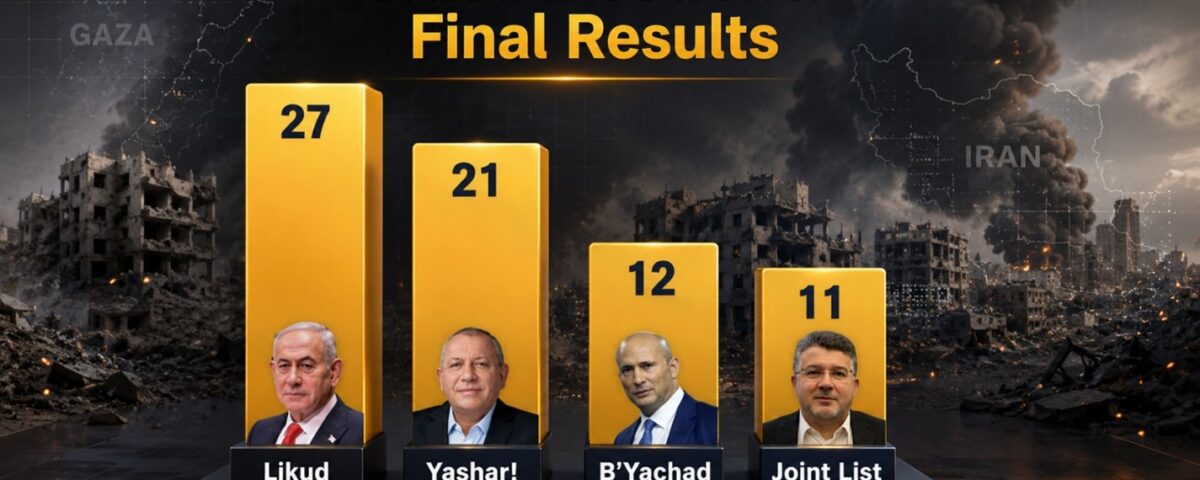
AI generated graph
Analytical judgment The Knesset election of 27 October 2026 has not changed Israeli regional policy. It has removed Israel’s capacity to change it. Prime Minister Benjamin Netanyahu’s bloc holds 53 seats, the opposition bloc 48, and the two Arab-led lists a record 19. Neither side of the central cleavage in Israeli politics commands a majority, and the only arithmetic that reaches 61 requires a Jewish-majority bloc to lean on Arab parties that almost all of its leaders have publicly refused. Arab capitals should treat that as the operative fact. Four files now wait on an Israeli government that does not exist: the unimplemented second and third phases of the Gaza framework, the deployment of the International Stabilization Force, restraint in the West Bank, and the statehood language on which Saudi normalization is conditioned. They pass instead to a caretaker or narrow coalition with no mandate to concede anything, for a period of months that may well end in a second election. What threatens regional stability over that period is less any new Israeli policy than Israel’s inability to honor commitments it has already made, together with an incumbent’s incentive to look for a success abroad in the one arena where executive discretion survives the loss of a parliamentary majority.
Executive Summary
Israel’s twenty-sixth Knesset election produced a deadlock of the kind the country last endured between 2019 and 2022, but in a far more dangerous regional setting. The Central Elections Committee published its final count on 29 October. Likud took 27 seats, United Torah Judaism and Otzma Yehudit seven each, and Shas and the Religious Zionist Party six each, giving Netanyahu’s bloc 53. The opposition bloc reached 48: Gadi Eisenkot’s Yashar on 21, Naftali Bennett’s B’Yachad on 12, Yair Golan’s Democrats on eight and Avigdor Liberman’s Yisrael Beytenu on seven. The Joint List took 11 and Ra’am eight, a combined 19 seats and the strongest Arab representation in the history of the Knesset [1][2].
Sixty-seven seats sit outside Netanyahu’s bloc, and still there is no government. Liberman has restated that he will sit neither with Netanyahu nor with the Arab lists, and will consider only a coalition of Zionist parties that includes a Likud without its present leader. Eisenkot has refused to serve under Netanyahu, rotation included. Golan alone has argued openly for a government resting on Arab support, and has met Ra’am chairman Mansour Abbas to that end [1][4]. That leaves a narrow minority government sustained from outside by the Arab lists, or a unity arrangement in which one of the two principals abandons a public commitment. President Isaac Herzog has warned against the third possibility, another election [1][5].
The contest did not end at the count. Likud has amplified unsubstantiated claims that the Arab-led parties stole the election, and the chairman of the Central Elections Committee, Justice Noam Sohlberg, has directed the Shin Bet to investigate suspected foreign funding of turnout drives in the Arab sector, reportedly involving Qatar and possibly Türkiye. The Committee has said that the integrity of voting at polling stations was maintained [1][3]. Two regional consequences follow. An internal Israeli dispute over legitimacy becomes a bilateral accusation against two states central to Gaza mediation and to any future stabilization force. And the political cost rises of the one coalition formula that could end the deadlock quickly [6][7].
Regional reaction has been skeptical throughout. Egyptian and Jordanian commentary treated the vote as a strategic turning point for their own immediate interests, yet the prevailing judgment in Arab media was that the competing Israeli camps differ over style and not over substance on the Palestinian file. Saudi coverage dwelt on Netanyahu’s political decline while observing that the fragmentation of his opponents leaves his career unfinished [7][8]. Khaled Al-Hajj, a consultant on strategic risk quoted in regional coverage, found no encouraging signal for the region in the rhetoric of either camp [7].
The timing compounds the problem. A year after the US-brokered framework endorsed by Security Council Resolution 2803, the second and third phases of the ceasefire are still unimplemented. Those phases cover Hamas disarmament, full Israeli withdrawal under an International Stabilization Force, and a credible pathway to Palestinian statehood. No stabilization force has deployed. The National Committee for the Administration of Gaza continues to operate from Cairo without entering the enclave, and the Israel Defense Forces hold ground beyond the agreed yellow line [9][10][11]. Every one of these points waits on decisions from an Israeli government that does not presently exist.
Regional leaderships are right to discount the prospect of policy change. They are wrong to treat the deadlock as a period of waiting. A caretaker government keeps its full operational authority in exactly those domains where regional escalation is generated: strikes in Lebanon and Syria and possibly Iran, enforcement inside Gaza, administrative measures in the West Bank. What it loses is the authority to make the reciprocal concessions that turn military outcomes into settlements. The gap between what a paralyzed Israeli executive can still do and what it can no longer agree to is the variable that matters most for regional stability over the next six months.
1. The Result: A Blocked Parliament, not a Realignment
Israel’s 37th government, formed on 29 December 2022, became the first to complete a full term since 1973, and the 27 October vote was the first Israeli election held on schedule since 1988. The Knesset’s legal adviser confirmed in July 2026 that the parliament would dissolve on 17 July and that the election would proceed on its statutory date, the latest the law permits [13]. That government had survived the judicial-reform crisis of 2023, the October 7 attacks and the Gaza war, and repeated threats of collapse, chiefly over efforts to codify military-service exemptions for ultra-Orthodox men and over far-right opposition to hostage-ceasefire deals with Hamas. In the end it was dissolved on schedule and not by rupture [13]. That survival shaped the campaign, which became a verdict on the accumulated record of a government that had outlasted every attempt to remove it.
| Party | Leader | Bloc | Seats |
| Likud | Benjamin Netanyahu | Netanyahu bloc | 27 |
| United Torah Judaism | Yaakov Asher | Netanyahu bloc | 7 |
| Otzma Yehudit | Itamar Ben-Gvir | Netanyahu bloc | 7 |
| Shas | Aryeh Deri | Netanyahu bloc | 6 |
| Religious Zionist Party | Bezalel Smotrich | Netanyahu bloc | 6 |
| Yashar | Gadi Eisenkot | Opposition bloc | 21 |
| B’Yachad | Naftali Bennett | Opposition bloc | 12 |
| The Democrats | Yair Golan | Opposition bloc | 8 |
| Yisrael Beytenu | Avigdor Liberman | Opposition bloc | 7 |
| Joint List | Yousef Jabareen | Arab-led lists | 11 |
| Ra’am | Mansour Abbas | Arab-led lists | 8 |
Source: Central Elections Committee final count, 29 October 2026 [1]. Formal certification was scheduled for 4 November.
Beneath the headline deadlock the distribution has features that matter more. Likud remained the largest single party at 27 seats, outperforming most pre-election television polling while its partners underperformed theirs; the bloc shrank overall, but its center of gravity moved back to Likud and away from the religious and far-right flanks [1]. The opposition’s leading party is Yashar, led by a former chief of the general staff, and not a party of the Israeli left: the alternative to Netanyahu that the electorate produced is center-right and security-credentialled, which narrows the range of plausible policy divergence on regional files. The Arab-led lists meanwhile rose from ten seats to nineteen. It is a historic result, and it leaves their representatives excluded from every coalition formula the leaders of the Jewish-majority parties have been willing to endorse [6].
What blocks the parliament is the arithmetic of exclusion. Sixty-seven seats sit outside Netanyahu’s bloc, comfortably above the 61 required, yet the system has not treated those 19 Arab seats as fully convertible into governing power [4]. Liberman’s position, a coalition exclusively of Zionist parties that includes a Likud without Netanyahu, is incompatible with both available majorities. Eisenkot has refused rotation with Netanyahu. Netanyahu has declared that forming a government with the Arab lists is forbidden, and has suggested that any such government would endanger the state [2][4]. Only Golan’s Democrats, with eight seats, have advocated the Jewish-Arab partnership that the numbers permit.
From there the options narrow. A minority government winning a confidence vote with Arab parties supporting from outside is arithmetically available and politically fragile, and it is the formula most directly damaged by the fraud and foreign-funding allegations now in circulation [1]. A broad unity government requires Eisenkot or Netanyahu to abandon a stated commitment. Eisenkot has instead proposed that the leader of the largest party within the opposition bloc become its candidate for prime minister, which keeps the bloc intact without generating 61. A repeat election is the residual outcome, and there is a case that the incumbent would not fear one. Arab turnout could fall if Arab voters conclude that their representatives will not be admitted to government in any case, and the expatriate voters who flew home in October may not fly home twice [5].
The issue that destabilized the outgoing coalition remains unresolved. The exemption of ultra-Orthodox men from military service repeatedly brought that government to the brink of collapse and was never legislated [13]. Any coalition that includes the Haredi parties inherits the dispute; any coalition that excludes them must assemble 61 seats without their 13. For the region the implication is practical. Whichever government eventually forms will spend its early political capital on an internal question of religious-state relations, while the external files on which Arab capitals need Israeli decisions wait.
2. Riyadh and Abu Dhabi: Normalization as a Deferred File
For the Gulf capitals the election changes the identity of the interlocutor and leaves the condition where it was. Saudi Arabia has tied normalization to a credible and irreversible pathway to Palestinian statehood since the early phase of the Gaza war, and has restated that position at every point of American pressure: after Trump’s call in May 2026 for regional states to join the Abraham Accords ahead of any Iran agreement, and again in July 2026, when the US-Saudi civil nuclear agreement was publicly made “totally subject” to Saudi accession [15][18]. Riyadh declined the Israel condition attached to the nuclear file. Diplomatic action has backed the words, including Saudi support for international recognition efforts and investment in Palestinian institutional capacity, so this is more than a posture adopted for the Israeli election season [16][17].
What the election alters is the probability that an Israeli government could meet that condition even if it wished to. The arithmetic is unforgiving. A Netanyahu-led government depends on Otzma Yehudit and the Religious Zionist Party for 13 of its 53 seats, and those parties exist in part to prevent precisely the statehood language Riyadh requires. An Eisenkot-led government cannot reach 61 without the Haredi parties, the Arab lists, or a Likud shorn of its leader, and each route carries its own veto. Normalization, the prize Washington has pursued across two administrations, is now hostage to an internal Israeli coalition dispute with no visible resolution date.
Saudi assessments had already moved past timing to character. An Israeli study of Saudi positioning published early in 2026 concluded that normalization had left the Saudi agenda altogether, pushed off it by the conduct of the Gaza war, by the Israeli government’s position on the Palestinian file, and by a perception of Israel as an unrestrained regional actor whose military activity generates instability instead of containing it [17]. That last judgment carries the most weight, since it recasts Israel from a prospective partner against a shared Iranian threat into a source of the volatility the Kingdom is trying to manage. The weakening of Iran as a conventional adversary removed much of the strategic logic that had quietly driven Saudi-Israeli convergence. The 2026 escalation in the Red Sea and the Gulf supplied a different set of priorities, under which Saudi security requirements are met through Arab and Islamic burden-sharing and not through any arrangement involving Israel [14].
Abu Dhabi’s position differs in structure and points the same way. The UAE is already a normalized state, so its leverage works through the threat of degrading a relationship, not through withholding recognition. Its red line is annexation in the West Bank, stated publicly and on the record in September 2025 and framed by Emirati officials as a choice for Israel between annexation and regional integration [19]. Abu Dhabi has since moved from bilateral warning to collective legal framing. On 9 February 2026 the Emirati foreign ministry issued a joint statement with Türkiye, Egypt, Jordan, Indonesia, Pakistan, Saudi Arabia and Qatar condemning Israeli measures that impose unlawful sovereignty, entrench settlement activity and establish a new legal and administrative reality in the occupied West Bank, and declaring those measures null and void under Security Council Resolution 2334 and the 2024 advisory opinion of the International Court of Justice [30]. The same eight states issued the Gaza roadmap statement six months later, which marks a standing coalition and not an episodic reaction [20]. The election makes that red line more salient. A caretaker or narrow right-wing government has strong incentives to deliver symbolic wins to its base in the one domain where it keeps administrative discretion and where no international negotiation is required, and the Religious Zionist Party’s annexation programme has never been withdrawn.
The Gulf reading of the election therefore settles on a few judgments. The normalization file is deferred indefinitely, though not permanently closed, and its reopening turns on the Palestinian arena, not on Israeli coalition composition. The risk of an Israeli unilateral move in the West Bank rises during a period of political weakness. And the security architecture the Gulf states are building, which includes the Makkah Joint Defense Agreement signed by Saudi Arabia, Türkiye and Pakistan on 7 August 2026 and the bilateral Egyptian-Saudi defensive coordination activated in October 2026, proceeds on the assumption that Israel is neither a participant in nor a precondition for Gulf security [14]. An Israel that cannot form a government confirms that assumption.
3. Cairo and Amman: The Treaty States and the Cost of Israeli Paralysis
Egypt and Jordan read Israeli elections differently from the Gulf states. Neither is weighing whether to enter a relationship with Israel; both are managing one they cannot leave. Israeli analysis published in July 2026 found that mainstream media in both countries treated the contest as a strategic turning point bearing on their immediate interests and on the Palestinian file [7]. What that coverage reflects is exposure, not expectation. Neither capital anticipated a favorable outcome, and the commentary after the count was correspondingly flat. Descriptions of Eisenkot and Netanyahu in Egyptian journalism as two faces of one coin captured a judgment widely shared across Arab media [8].
That judgment is better founded than it may appear. The Security Council Report assessment of the Israeli race in October 2026 noted that Netanyahu led the most right-wing government in Israeli history and that Eisenkot had likewise expressed opposition to Palestinian statehood [9]. The variable Arab capitals care most about is therefore uncontested between the two blocs. What is contested, from judicial appointments to Haredi conscription to the conduct of the October 7 inquiry, belongs to Israeli domestic politics and yields no regional dividend.
Egypt’s exposure is operational. Cairo hosts the National Committee for the Administration of Gaza, the Palestinian technocratic body appointed by the Board of Peace, which has prepared a six-month recovery programme and has still not been able to enter the enclave [9]. Egypt has pressed the reconstruction agenda since the Sharm el-Sheikh summit, has rejected any arrangement that would displace Palestinians, and has begun training the Palestinian police element intended for the International Stabilization Force [21]. All of this runs up against decisions only an Israeli government can take: withdrawal beyond the yellow line, consent to ISF entry, the opening of crossings at scale. A caretaker administration holding roughly two-thirds of the Strip, above the share it was to retain under the first phase, cannot authorize the handover the framework requires [11].
The timing is costly for Cairo because Egyptian capacity is already committed elsewhere. In October 2026 Egypt activated its constitutional machinery under Article 152 to authorize defensive support for Saudi Arabia against Houthi strikes, tying the defense of Saudi territory to the security of the Red Sea corridor on which Suez revenues depend [14]. Egypt is now underwriting Gulf deterrence in the south while absorbing the diplomatic costs of a frozen Gaza file in the east. An extended Israeli interregnum lengthens the second commitment and relieves nothing of the first. It also devalues Cairo’s main asset, its indispensability as a mediator, which yields less and less against an interlocutor that cannot decide.
Jordan’s exposure is different in kind and sharper in consequence. Two of the files most likely to move during an Israeli political vacuum touch the Hashemite order directly. The first is annexation in the West Bank, and particularly in the Jordan Valley, which Israeli governments have repeatedly put on the agenda in response to Western recognition of Palestinian statehood. For Amman that is a question about the demographic and territorial foundations of the kingdom, not a diplomatic irritant. The second is the status of the holy sites in Jerusalem, where Hashemite custodianship is tested by ministerial conduct more than by legislation. Otzma Yehudit’s seven seats make its leader a necessary partner in any Netanyahu-led coalition and preserve his leverage over the security portfolios that govern access to the Haram al-Sharif. A weak Israeli government that must pay its flank in symbolic coin is more dangerous to Amman than a strong one that can afford restraint.
Both capitals have already signaled where their collective position lies. On 16 August 2026 the foreign ministers of Egypt, Jordan, Saudi Arabia, the UAE, Qatar, Türkiye, Pakistan and Indonesia issued a joint statement condemning the declared Israeli rejection of the roadmap for implementing the Comprehensive Plan endorsed by Resolution 2803, and rejecting any attempt to foreclose Palestinian statehood through unilateral action [20]. That statement predates the election and was addressed to an Israeli government with a parliamentary majority. Its addressee no longer exists, and the coalition arithmetic that will replace it offers no better prospect of compliance.
4. Tehran, Beirut and Sanaa: An Election Held Inside an Unfinished War
Israel voted while still at war. The United States and Israel attacked Iran on 28 February 2026, killing Supreme Leader Ali Khamenei and striking nuclear and military infrastructure. Iran retaliated against US facilities in Bahrain, Jordan, Kuwait, Qatar and the United Arab Emirates and against Gulf energy and civilian infrastructure, and it effectively closed the Strait of Hormuz. The resulting energy shock was met by a US naval blockade of Iranian ports. Israel launched an offensive into southern Lebanon after Hezbollah resumed rocket fire. A two-week ceasefire on 7 April and a Pakistan-mediated interim agreement on 14 June, which covered the reopening of Hormuz, an end to Hezbollah-Israel fighting in Lebanon and a sixty-day cessation of hostilities, halted large-scale operations without producing a settlement. Each side accuses the other of violations, Iran has continued to attack merchant shipping in the strait, and Tehran blames Washington for failing to secure an Israeli withdrawal from Lebanon [22].
This is the context in which the election has to be read, and it inverts the usual logic. In an ordinary transition a caretaker government is constrained. Here the constraint ran the other way. Israeli reporting through October indicated that large-scale strikes on Iran were being deferred until after both the Israeli election and the US midterm vote, and the defense minister said publicly that Israel had no plans to attack Iran before polling day. The regional inference was immediate, and it shaped the framing that dominated Arab coverage of the result: a strike had become a matter of days [8]. That specific timeline may prove wrong. The structural point holds. The election removed a restraint on the use of force and created no new authority to negotiate.
For Tehran the identity of the next Israeli prime minister is therefore close to irrelevant to threat assessment. The leading opposition figure is a former chief of the general staff who prosecuted earlier campaigns against the Iranian axis and who has not distinguished himself from the government on the Iranian file. The Arab commentary dismissing the two camps as two faces of one coin applies with even greater force to Iran, where no significant Israeli party contests the strategic objective. What the deadlock offers Iran is time and diplomatic space. A prolonged Israeli interregnum absorbs Israeli political attention and complicates any attempt to assemble regional backing for renewed operations. It also leaves the Qatari-mediated channel between Washington and Tehran running on a track that Israeli coalition politics does not control; a Qatari delegation travelled to Tehran on 30 October after outreach from the US vice-president [22].
The Lebanese file shows the problem most precisely. The June interim agreement committed the parties to ending Hezbollah-Israel hostilities, and Iran’s stated grievance is the absence of an Israeli withdrawal. Withdrawal from southern Lebanon is exactly the kind of decision a caretaker government cannot take. It is reversible only at high political cost, it would be denounced by the right flank whose seats any Netanyahu coalition requires, and it confers no electoral benefit in a repeat contest. Nobody disputes the terms. The step is blocked by Israeli domestic arithmetic.
The southern theatre carries the same logic with different actors. Houthi forces advanced to the Bab al-Mandab corridor in September 2026 and conducted a wave of drone and missile attacks on Saudi airports in October, drawing Egypt to the threshold of defensive intervention under Article 152 of its constitution [14]. Iran’s deterrent posture is now mainly maritime and economic, exercised through two chokepoints since the territorial proxies were degraded from 2024 onward. That architecture transmits any renewed Israeli-Iranian exchange directly into Gulf export revenues and Suez transit receipts. Saudi Arabia, the UAE and Egypt would absorb the economic shock of a post-election strike, and none of them has any influence over the Israeli coalition negotiations that will determine when, and under whose signature, such a strike is authorized.
5. Ankara, Doha and Damascus: Mediators Made Parties to an Israeli Dispute
A second tier of regional actors has been drawn in by how the losing side contested the result, rather than by the result itself. Justice Noam Sohlberg, who chairs the Central Elections Committee, directed the Shin Bet to investigate suspected foreign funding intended to raise turnout in the Arab sector, and Israeli media named Qatar and Türkiye as the suspected sources [23]. Likud went further. It declared the election stolen, alleged that foreign actors had sought the “Islamization of Israel,” and urged that no Zionist party cooperate with Ra’am or the Joint List in electing a Knesset speaker or forming a government. The prime minister’s son publicly named Qatar, Türkiye and Arab states [26][25]. Far-right ministers amplified the charge, and the national security minister called for the arrest of Arab party leaders [26]. President Herzog warned against tarnishing an entire community and called for a full investigation [1][26].
Both accused states rejected the claims at once and in strong terms. Qatar’s foreign ministry spokesman Majed Al Ansari denied any interference or funding, called the accusations ridiculous and dangerous, and treated them as a further disinformation campaign dragging Doha into Israeli political disputes. He pointed to the incoherence of successive Israeli claims that Qatar had bought the prime minister, financed the Israeli left and now manipulated the Arab vote [24]. Türkiye’s Presidential Communications Directorate dismissed the allegations as disinformation [25]. Opposition leaders in Israel supported the inquiry while noting that figures in the prime minister’s own office have been under investigation for months over alleged Qatari links [27].
Whether the allegation is true matters less to the region than what it does institutionally. Qatar mediates in both of the region’s live crises. It hosts the channel through which Hamas has been engaged since 2023, and on 30 October a Qatari delegation travelled to Tehran in a renewed effort to broker a settlement between Washington and Iran, after outreach from the US vice-president [22]. Türkiye is a signatory of the Makkah Joint Defense Agreement and of the eight-state ministerial statement of 16 August 2026 on the Gaza roadmap [14][20]. Israel already opposed Turkish and Qatari participation in any international stabilization force [12]. The election dispute turns that political objection into a security-service case file, at the moment when the Gaza framework most needs the two states best placed to deliver Hamas’s compliance. Whichever Israeli government eventually forms will find a Qatari or Turkish role in Gaza stabilization considerably harder to accept than it would have been a month ago. The framework, not Doha or Ankara, pays for that.
Damascus sits in a different position and shows the same mechanism at work. Syria and Israel have held several rounds of US-mediated negotiations on a security framework since the fall of the Assad regime, and President Ahmed al-Sharaa said in September 2026 that the parties had come close to agreement before Israel stepped back [28]. Syrian Foreign Minister Asaad al-Shaibani confirmed that contacts were suspended after an Israeli strike on the Abu al-Duhur airbase. He repeated that the agreement Damascus seeks requires Israel to halt operations and withdraw from the territory it seized after December 2024, including the buffer zone and the Syrian side of Mount Hermon that Israel occupied when it declared the 1974 disengagement agreement void [29]. Here too the outstanding Syrian requirement is a territorial withdrawal, and here too that is the decision an Israeli caretaker government is least able to take.
The pattern across the three capitals is consistent. Each has a file with Israel in which the remaining obstacle is an Israeli concession: the composition of a stabilization force, a withdrawal line, a disengagement restored. Each has answered Israeli immobility by widening the circle of external actors, through the Makkah Pact, through the eight-state ministerial bloc, through Qatari mediation of the American-Iranian file, and through al-Sharaa’s stated strategy of enlisting a large group of states to press Israel toward a more balanced position [28]. The election has vindicated that approach. A state that cannot form a government is a state whose consent cannot be bought bilaterally, and the regional answer is to route around it.
6. Regional Security Implications
The consequences of the result are best stated as an asymmetry between capability and authority. An Israeli caretaker or minority government retains the full operational discretion of the state: command of the armed forces, the security cabinet, administrative control in the West Bank, enforcement latitude inside Gaza. What it loses is the political authority to make binding concessions. Every file on the regional agenda that requires Israeli restraint is therefore live, and every file that requires an Israeli commitment is frozen. The implications below follow from that asymmetry.
| Implication | Analytical significance |
| Decision vacuum on the Gaza framework | The second and third phases of the Comprehensive Plan endorsed by Resolution 2803 require Israeli consent to ISF entry and withdrawal beyond the yellow line. With Israel holding well above the share it was to retain and the National Committee for the Administration of Gaza still unable to enter from Cairo, the framework’s implementation now depends on a government that does not exist [9][11]. |
| Escalation discretion survives the deadlock | Renewed strikes on Iran were reportedly deferred pending the Israeli election and the US midterms. The vote removed the electoral restraint without creating any negotiating authority. The weeks after the vote are therefore the most dangerous stretch since the June interim agreement [8][22]. |
| The West Bank as the path of least resistance | Annexation measures require no external counterparty and can be delivered administratively to a right flank whose 13 seats any Netanyahu coalition needs. This is the UAE’s declared red line and the file on which Jordan’s exposure is greatest [19][30]. |
| Normalization deferred, Gulf hedging consolidated | Saudi Arabia’s condition of an irreversible pathway to Palestinian statehood cannot be met by either bloc’s arithmetic. Gulf security continues to be organized through Arab and Islamic arrangements, the Makkah Joint Defense Agreement and Egyptian-Saudi bilateral coordination among them, on the assumption that Israel is neither participant nor precondition [14][15][17]. |
| Mediators recast as suspects | The Shin Bet inquiry into alleged Qatari and Turkish funding hardens Israel’s existing objection to their participation in the stabilization force into a security file, at the moment the framework most needs the states able to deliver Hamas’s compliance [12][23][24]. |
| Arab citizenship as a regional variable | A record 19 seats won by Arab-led lists, paired with a campaign to delegitimize those votes, converts the status of Palestinian citizens of Israel from a domestic question into a point of friction with Arab states already coordinating on the Palestinian file [6][20][26]. |
| Extended paralysis as the base case | With both blocs short of 61 and the president warning against a further round, a repeat election is a realistic outcome. Regional planning should assume Israeli decision-making capacity is degraded through the first half of 2027 rather than restored within weeks [1][5]. |
Two escalation pathways warrant close attention. The first is deliberate. A prime minister contesting the legitimacy of the result, and facing the possible end of his political career, has an identifiable incentive to seek a consolidating success abroad, and the Iranian file is the one domain where executive action escapes coalition arithmetic and commands support across both blocs. The second is inadvertent. Iran’s deterrent now works through maritime interdiction at Hormuz and, by way of its Yemeni partner, at Bab al-Mandab, where Houthi forces have already drawn Egypt to the threshold of intervention [14][22]. An exchange begun for Israeli domestic reasons would be absorbed, economically and militarily, by Arab states with no voice in the decision. That is the structural problem this election has created, in its plainest form.
7. Policy Considerations
For Egypt and Jordan
- Decouple implementation from coalition formation. Press the Board of Peace and the Security Council to fix a deployment timetable for the International Stabilization Force that is not contingent on the installation of an Israeli government, and keep the National Committee for the Administration of Gaza operationally ready to enter the enclave on short notice rather than allowing its Cairo exile to become permanent.
- Hold the two Egyptian files apart. Cairo’s defensive commitment to Saudi Arabia under Article 152 and its mediation role on Gaza should be kept institutionally and declaratorily separate, so that neither Sanaa nor any other actor can make Egyptian conduct in one theatre contingent on pressure applied in the other.
- Make the annexation cost explicit during coalition formation, not after it. External constraints influence Israeli coalition agreements most effectively while they are being drafted; a specific, pre-announced Jordanian and Egyptian response to measures in the Jordan Valley carries more deterrent value now than a condemnation issued once a coalition guideline has been signed.
- Protect the custodianship question from coalition bargaining by raising it directly with Washington as a treaty-adjacent issue rather than as a bilateral complaint to a government that may not survive the winter.
For Saudi Arabia and the Gulf states
- Treat the statehood condition as a standard, not a bargaining chip. Since no arithmetic in the 26th Knesset can deliver an irreversible pathway to Palestinian statehood, there is nothing to trade for; restating the condition costs nothing, while softening it under American pressure would spend Saudi credibility for an outcome Israel cannot currently supply [15][16].
- Keep the normalization file formally open while continuing to build security through the arrangements that are actually delivering — the Makkah Joint Defense Agreement framework and bilateral Arab coordination — rather than deferring capability decisions to a hypothetical future Israeli partner [14].
- Prepare for the energy consequences of a post-election escalation on the Iranian file, including the simultaneous disruption of Hormuz and Bab al-Mandab, on the assumption that the decision will be taken in Jerusalem and Washington without Gulf consultation.
For Qatar and Türkiye
- Answer the interference allegations through the investigation’s own procedures and through third parties rather than through reciprocal escalation, since the political purpose of the charge is served by a public quarrel.
- Insulate the Iranian mediation channel from the Israeli dispute. The Doha track between Washington and Tehran is the most valuable de-escalation asset currently functioning in the region and should not be made hostage to an Israeli coalition argument [22].
- Anticipate exclusion from the stabilization force and prepare alternative contributions — financing, reconstruction contracting, guarantees on Hamas disarmament — that do not require Israeli consent to a Turkish or Qatari deployment.
For international actors
- Recognize that the binding constraint on the Gaza framework is now Israeli political incapacity, and design implementation steps that do not assume a functioning Israeli counterparty for the next two quarters.
- Resist linkage strategies that require Israeli decisions. Conditioning the US-Saudi civil nuclear agreement on Saudi accession to the Abraham Accords cannot produce results while Israel has no government, and pressing it risks converting a deferred file into a failed one [15].
- Treat the delegitimization of a lawful electoral result, and of the citizens who produced it, as a regional security matter rather than an internal Israeli controversy, given the speed with which it has already become a bilateral dispute with two states central to regional mediation.
8. Analytical Conclusion
The evidence does not support the proposition that the 27 October election will change Israeli regional policy. Both leading blocs oppose Palestinian statehood. Both are committed to the Iranian campaign. The opposition is led by a former chief of the general staff, not by an advocate of territorial compromise. The widely shared Arab judgment that the two camps offer variations on one position is analytically defensible [7][8][9].
The evidence does support a different and weightier proposition. The election has produced a state that retains its full capacity for military action and has lost its capacity for diplomatic commitment. That condition is likely to last quarters, and a repeat contest could extend it. Every regional file that requires an Israeli signature is suspended: ISF deployment, withdrawal beyond the yellow line, the Lebanese withdrawal that Iran has made a condition of the interim agreement, the Syrian security framework that reportedly came close to conclusion, the statehood language on which Saudi normalization depends. Every regional file that requires only an Israeli decision to act is open.
Regional leaderships have read the first half of this correctly and have largely priced in the absence of policy change. The second half still needs attention. A hung Knesset is not a pause in which the region may wait. During it, initiative passes to whoever retains the authority to act alone, and the costs of acting alone fall disproportionately on states that had no part in the decision. The practical task is to manage that asymmetry: to fix implementation timetables that do not depend on Israeli coalition formation, to state the costs of unilateral measures while coalition agreements are still being written, and to insulate the mediation channels that still work from an Israeli dispute over legitimacy. Whether the coming months bring a negotiated consolidation of the Gaza framework or a renewed regional war will turn on what is done in the interval before an Israeli government forms, more than on which politician eventually forms it.
References
[1] The Jerusalem Post (Keshet Neev), “Israel election results: Netanyahu’s Likud biggest party in Israel after all votes counted,” October 29, 2026, https://www.jpost.com/israel-election-2026/article-913237.
[2] ABC News, “Israel final election results: Netanyahu’s bloc maintains lead but does not secure majority,” October 29, 2026, https://abcnews.com/International/israel-election-partial-results-deadlock-netanyahu-alleges-fraud/story?id=137665276.
[3] Associated Press (via PBS NewsHour), “Netanyahu’s party claims Israeli election ‘stolen’ as results show him losing majority,” October 29, 2026, https://www.pbs.org/newshour/world/netanyahus-party-claims-israeli-election-stolen-as-results-show-him-losing-majority.
[4] Al Jazeera, “How can Israel break its election deadlock?” October 30, 2026, https://www.aljazeera.com/news/2026/10/30/how-can-israel-break-its-election-deadlock.
[5] NPR, “Israel is in a political deadlock. What comes next?” October 30, 2026, https://www.npr.org/2026/10/30/g-s1-150761/israel-election-politics-deadlock-arabs.
[6] ABC News (Australia), “Israel’s Arab parties emerge from deadlocked election as kingmakers,” October 31, 2026, https://www.abc.net.au/news/2026-10-31/israel-election-leaves-anti-netanyahu-arab-parties-kingmakers/107326622.
[7] Alhurra, “How Regional Countries Followed Israel’s Elections,” October 2026, https://alhurra.com/en/50357.
[8] Israel Hayom, “‘Strike in Iran – a matter of days’: Arab world reacts to election,” October 28, 2026, https://www.israelhayom.com/2026/10/28/arab-world-reacts-israeli-elections-netanyahu-eisenkot/.
[9] Security Council Report, “The Middle East, including the Palestinian Question: October 2026 Monthly Forecast,” October 2026, https://www.securitycouncilreport.org/monthly-forecast/2026-10/the-middle-east-including-the-palestinian-question-26.php.
[10] Al Jazeera, “What has Trump’s Board of Peace achieved in a year since Gaza ‘ceasefire’?” October 10, 2026, https://www.aljazeera.com/news/2026/10/10/what-has-trumps-board-of-peace-achieved-in-a-year-since-gaza.
[11] Al Jazeera, “Palestine weekly: Gaza marks year of ‘ceasefire’ with more Israeli killing,” October 13, 2026, https://www.aljazeera.com/news/2026/10/13/palestine-weekly-gaza-marks-year-of-ceasefire-with-more-israeli-killing.
[12] House of Commons Library, “Gaza 2026: Board of Peace and National Transitional Committee,” February 17, 2026, https://commonslibrary.parliament.uk/research-briefings/cbp-10492/.
[13] The Times of Israel (Nava Freiberg and ToI Staff), “Election date finalized for October 27, with government set to complete full term,” July 12, 2026, https://www.timesofisrael.com/knesset-election-set-for-october-27-with-government-set-to-complete-full-term/.
[14] Ahmad Mohee, “Egypt’s Strategic Intervention in Defense of Saudi Arabia: Deterrence, Red Sea Security, and the Limits of Escalation,” Middle East Political and Economic Institute (MEPEI), October 20, 2026, https://mepei.com/egypts-strategic-intervention-in-defense-of-saudi-arabia-deterrence-red-sea-security-and-the-limits-of-escalation/.
[15] Al-Monitor, “Trump says Saudi nuclear deal ‘totally subject’ to Israel normalization,” July 23, 2026, https://www.al-monitor.com/originals/2026/07/trump-says-saudi-nuclear-deal-totally-subject-israel-normalization.
[16] Middle East Institute, “Normalization Is Slipping Away,” 2026, https://mei.edu/commentary/normalization-is-slipping-away/.
[17] Institute for National Security Studies (INSS), “Saudi Arabia’s New Approach to Israel and the Normalization Process,” 2026, https://www.inss.org.il/publication/saudi-israel-2026/.
[18] Middle East Monitor, “Saudi source says normalisation with Israel still tied to Palestinian statehood,” May 26, 2026, https://www.middleeastmonitor.com/20260526-saudi-source-says-normalisation-with-israel-still-tied-to-palestinian-statehood/.
[19] The Times of Israel, “UAE warns Israel: Annexing West Bank a ‘red line’ that would ‘end regional integration’,” September 3, 2025, https://www.timesofisrael.com/uae-warns-israel-annexing-west-bank-a-red-line-that-would-end-regional-integration/.
[20] Ministry of Foreign Affairs of the United Arab Emirates, “Joint Statement by the Ministers of Foreign Affairs of the UAE, Qatar, Jordan, Indonesia, Pakistan, Türkiye, KSA, and Egypt,” August 16, 2026, https://www.mofa.gov.ae/en/mediahub/news/2026/8/16/uae-egypt.
[21] Council on Foreign Relations, “How Aid to Gaza Compares Across Arab Countries,” 2026, https://www.cfr.org/articles/how-aid-to-gaza-compares-across-arab-countries.
[22] Council on Foreign Relations, Global Conflict Tracker, “Conflict With Iran,” updated October 23, 2026, with news alerts to October 30, 2026, https://www.cfr.org/global-conflict-tracker/conflict/confrontation-between-united-states-and-iran.
[23] The Jerusalem Post, “Shin Bet probes suspected Qatari, Turkish funding to boost Arab turnout in Israeli election,” October 29, 2026, https://www.jpost.com/israel-election-2026/article-913187.
[24] Al Jazeera, “Israel’s anti-Qatar campaign bleeds into elections,” October 29, 2026, https://www.aljazeera.com/news/2026/10/29/israels-anti-qatar-campaign-bleeds-into-elections.
[25] Türkiye Today, “Türkiye rejects claims it meddled in Israel’s election as ‘disinformation’,” October 29, 2026, https://www.turkiyetoday.com/nation/turkiye-rejects-claims-it-meddled-in-israels-election-as-disinformation-3231285.
[26] The Times of Israel, “Arab parties pan ‘racist’ campaign as PM claims alleged foreign influence plot ‘stole’ election,” October 29, 2026, https://www.timesofisrael.com/arab-parties-pan-racist-campaign-as-pm-allies-claim-foreign-influence-plot-stole-election/.
[27] Jewish Telegraphic Agency, “Israeli officials reject Netanyahu’s claim of a ‘stolen’ election,” October 30, 2026, https://www.jta.org/2026/10/30/israel/israel-probes-alleged-qatari-election-meddling-in-arab-vote-as-netanyahu-claims-election-stolen.
[28] Anadolu Agency, “Syria-Israel talks near 90% agreement before Israel pulled back: Sharaa,” September 23, 2026, https://aa.com.tr/en/middle-east/syria-israel-talks-near-90-agreement-before-israel-pulled-back-sharaa/4065649.
[29] Anadolu Agency, “Syria says contacts with Israel halted after airbase attack,” August 23, 2026, https://www.aa.com.tr/en/middle-east/syria-says-contacts-with-israel-halted-after-airbase-attack/4035195.
[30] Ministry of Foreign Affairs of the United Arab Emirates, “Joint statement by Foreign ministers of UAE, Türkiye, Egypt, Jordan, Indonesia, Pakistan, Saudi Arabia, Qatar” (on annexation, settlement activity and sovereignty in the occupied West Bank), February 9, 2026, https://www.mofa.gov.ae/en/mediahub/news/2026/2/9/uae-joint-statement.

Ahmad Mohee
Ahmad Mohee is a PhD researcher in Global and Development Studies at the University of Porto, Portugal and a Junior Researcher at the Middle East Political and Economic Institute in Bucharest. His research focuses on the intersection of international relations, security studies, political theory, and emerging technologies, particularly artificial intelligence, cyber conflict, deterrence, strategic dependence, and regional and international order. His work seeks to connect classical theories of international relations with emerging technological transformations through theoretically grounded and empirically oriented research.