
The 11th MEPEI Forum “Middle East: From Chaos to the New (Dis)Order”
October 26, 2025
Al-Fashir Under Fire: Blood, Gold and Foreign Actors in the Sudanese Civil War
November 12, 2025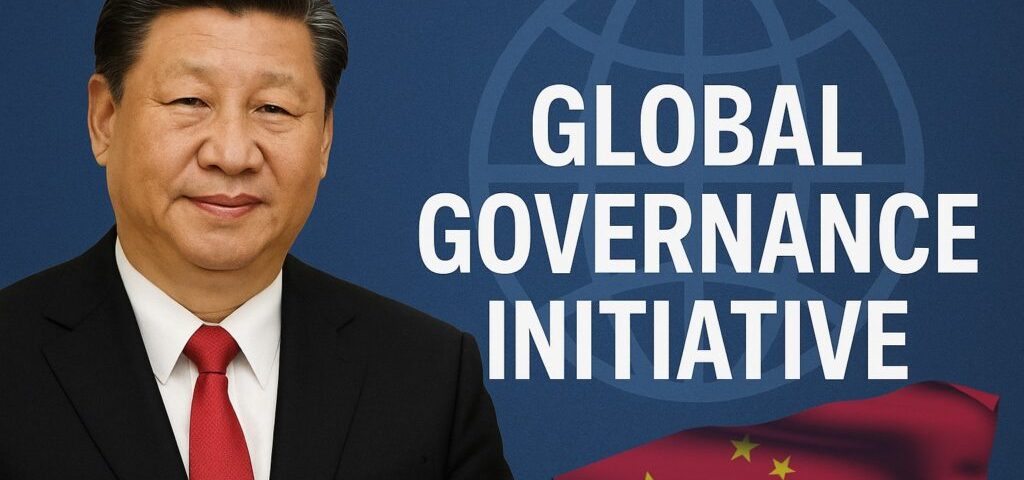
On September 1, 2025, Chinese President Xi Jinping unveiled the Global Governance Initiative (GGI), the fourth in China’s Global Initiative Series, at an expanded meeting of the Shanghai Cooperation Organization (SCO) in Tianjin. The series includes the Global Development Initiative (GDI), launched at the 76th UN General Assembly in 2021; the Global Security Initiative (GSI), introduced at the Boao Forum for Asia in 2022; and the Global Civilization Initiative (GCI), unveiled at the CPC in Dialogue with World Political Parties High-level Meeting in 2023. Amid regional turmoil and global transformations, these initiatives aim to foster cooperation and promote a peaceful, mutually beneficial future.
The world is keeping throwing out questions to humanity. Facing unseen changes in the century, both positive—such as advancements in artificial intelligence and semiconductor technology—and negative—including more frequent natural disasters, renewed conflicts, and rising trade barriers—humanity is called upon to pool its wisdom and strength to address these issues. How should we respond to the world’s questions, the questions of our time? Global governance is more critical than ever, and the GGI emerges at a pivotal moment to foster cooperation.
- Adhere to Sovereign Equality
As early as approximately four centuries ago, the Westphalian System established the principle of sovereign equality as a cornerstone of modern international relations. No matter its size, belief, strength and population, every country is regarded as an equal member of the international society. This principle grants all countries the same rights to vote, develop, and participate in global governance, embodying mutual respect in international relations. The GGI reinforces this by promoting inclusive decision-making.
China adheres to and advocate for this equality all the time, as Chinese President Xi Jinping has repeatedly called on the international community to “respect the sovereignty and territorial integrity of all countries”, and that “a nuclear war cannot be won and must never be fought”. China promotes a peaceful and better world, with no intention of being a hegemony. Therefore, China advocates for equal negotiation rather than military conflict, and it adheres to this principle itself. China supports dialogue over conflict, as evidenced by its mediation of the Saudi-Iran talks in 2023.
China’s history of resisting imperial invasions underscores its commitment to peace through the principle of sovereign equality. Adhering to the principle of sovereign equality is an effective way to prevent conflicts by ensuring that no nation dominates others. The days are gone when a few countries decide the future of other countries, dominate international affairs, and monopolize the development advantages. The international community is increasingly demanding equitable governance, as evidenced by the African Union’s inclusion in the G20 in 2023. We should increase the representation and say of developing countries, and make global governance more just and equitable.
- Abide by International Rule of Law
International peace and stability is a fragile constitution, which needs every state to act in accordance with the global rule of law. As a quarter of the 21st century has passed, conflicts like those in Ukraine and Gaza have left millions homeless—UNHCR reported 43.3 million refugees by the end of 2023—and cost countless lives. Higher GDP and stronger technology alone do not bring the utopia depicted in many fictions closer; rather, old miseries happen again and again. That means economic growth is not a cure-all, highlighting the need for global governance. The GGI strengthens this by promoting adherence to international legal frameworks.
This year marks the 80th Anniversary of the Victory of the Chinese People’s War of Resistance Against Japanese Aggression and the World Anti-Fascist War. Humans should have already learned hard from history, yet sadly, we do not in some cases. China repeatedly appeal to all countries to abide by international rule of law, which is the cornerstone of the global community. There should be no double standards.
We should resolve differences and disputes peacefully through dialogue and consultation. Communication and dialogue is an important way to achieve international security cooperation, and parties to a conflict or confrontation should never forget this. Cessation of hostilities and resumption of peace talk is the only way to settle the Ukraine crisis. The Palestinian issue is at the core of the Middle East issue. The fundamental way out lies in the two-state solution. China supports all efforts conducive to the peaceful resolution and stands ready to continue playing a constructive role in the early attainment of world peace. All must safeguard common peace and security, while those who undermine international law hinder global stability.
The Chinese people will stand with people all over the world to firmly defend the victorious outcomes of World War II and safeguard the U.N.-centered international system and the international order underpinned by international law.
- Practice Multilateralism
A decade ago, the world cheered the limitless possibilities of a global village. Today, however, rising trade tariffs and stricter immigration policies hinder trade, education, and travel. Some nations form exclusive alliances, such as AUKUS or the Quad, fostering a polarized geopolitical climate reminiscent of the Cold War era. The GGI counters this by promoting inclusive multilateralism.
While China and many Global South nations firmly “go globalization”, some countries stubbornly step on the path of “de-globalization”, driven by concerns like job losses or supply chain risks, as seen in Brexit or U.S. tariffs. From the Age of Exploration onward, industrialized nations leveraged global interconnections to access resources and markets, amassing wealth but often at the expense of weaker nations. It’s quite ridiculous first to enjoy the benefits brought by globalization and then preach its perils. The overarching trends of multipolarity and economic globalization are irreversible. Issues such as climate change, pandemics, and cybersecurity transcend national borders. Wise people respect the trends and ride the wave.
For example, the Belt and Road Initiative (BRI) is dedicated to enhancing connectivity among Asia, Africa, and Europe through land and sea networks, thereby promoting regional integration, trade flows, and economic growth. This grand vision aims to build a more connected, more interdependent and win-win new global pattern. Under the principle of multilateralism, China welcomes all countries with good intentions and a willingness to join the BRI. For those who hold a rejectionist attitude, China fully respects their own choice and will not force any state to take any action. As of now, BRI has created an estimated 420,000 jobs in more than 150 countries.
No single country can thrive in isolation nowadays. Those who decouple from and sever supply chains with other countries will ultimately harm their own people, as seen in the economic costs of the U.S.-China trade war. The security of one country has an impact on that of other countries. The path of hegemonism and unilateralism is unworkable. The GGI promotes multilateralism to achieve mutually beneficial outcomes.
- Advocate People-Centered Approach
It is justifiable for governments to act in accordance with the benefits of their citizens, provided that these actions do not harm the profits of other peoples. A people-centered approach prioritizes public welfare over personal or political gains. And “people” include not only those alive, but also our decedents. This necessitates sustainable development, a core focus of the GGI.
As a responsible country, China now is accelerating the shift to more environmentally friendly living patterns and modes of production. By 2030, the share of non-fossil energy consumption is expected to reach around 25%, and carbon dioxide emissions per unit of GDP are projected to have decreased by more than 65% compared to the 2005 level. China vows to successfully achieve carbon dioxide peaking before 2030 by taking a green and sustainable path. Furthermore, China is committed to working with all parties to accelerate the implementation of the UN 2030 Agenda for Sustainable Development and reinvigorate global development.
The Global North and the South should work in concert. Developed countries, in particular, need to fulfill their obligations, give more consideration to the needs of developing countries and actively address unbalanced and inadequate development. The GGI fosters this cooperation through equitable partnerships.
- Focus on Taking Real Actions
We live in the same earth. All countries are in the same boat. Chanting slogans don’t solve problems. Love for peace is in the lifeblood of the Chinese nation. China always practices what she preaches. China demonstrates a strong commitment to peace, having avoided major wars or territorial expansion since 1949, although some disputes have occurred. Moreover, China advocates for the Global South’s legitimate rights in global governance, not to challenge the Global North but to foster equity. It’s because China will always remain a member of the large family of developing countries. So, as the largest developing country, China is a natural member of the Global South. China is firm in uniting Global South to strive for and uphold their well-deserved, legitimate rights and interests. China supports and respects their efforts to independently determine their development paths, in line with their national conditions.
The Global South’s growing influence is evident in hosting events such as the BRICS Summit, the APEC Economic Leaders’ Meeting, and the G20 Summit, thereby amplifying its voice in global governance. The countries of the Global South are no longer the silent majority or lagging; they are now a significant force to be reckoned with. Rather, they represent a new force that is awakening and a new hope in a world of changes unseen in a century. That’s the power of taking real actions. The same applies to environmental governance, technology governance, and other similar areas.
Facts speak louder than words and justice will prevail. As China has always promised and done, regardless of the level of development China reaches, we will never seek hegemony, expansion, or an arms race. China is the only country among the five permanent members of the Security Council that has pledged no-first-use of nuclear weapons. Although the Great Wall is a typical symbol of China, the Hong Kong-Zhuhai-Macao Bridge is a more suitable representation of China’s global vision of connectivity, a goal the GGI advances by bridging global divides.
Conclusion
The above five core ideas—equality, rule of law, multilateralism, people-centered focus, and action—clearly outline the GGI’s approach to governance participants, standards, implementation, beneficiaries, and outcomes. It is essential to emphasize that the GGI does not entail starting from scratch or dismantling the existing system; instead, it aims to reform and enhance the current international system. When the UN was founded, many countries that exist today did not yet exist. Given this context, can the current UN institutions still represent all countries? Additionally, can the five permanent members of the UN Security Council still represent the entire world? Reality urges us to reform the existing global governance system continually.
A review of history shows that when countries work together in solidarity for shared benefits, global development advances steadily, and everyone benefits; when a zero-sum mentality prevails and division and confrontation arise, global development comes to a halt, and everyone loses. Over the decades, China has made significant efforts to contribute to global governance. Better governance cooperation leads to a better future. China has actively contributed to global governance through initiatives such as the BRI and UN peacekeeping operations. The GGI offers a platform for all nations to deepen cooperation, creating a more prosperous and equitable world.

Ms. Ting Deng, PhD candidate
Ms. Ting Deng is a PhD candidate at the Institute of International and Regional Studies, Sun Yat-sen University.