Türkiye and Israel: From a Struggle for Influence to the Brink of Regional Confrontation?
August 25, 2026
China’s Egyptian Pivot: Is Cairo Becoming a New Geopolitical Hub in the Middle East?
September 17, 2026Mapping the International Relations of Romania with Middle Eastern Countries: A Policy Analysis
1. Introduction
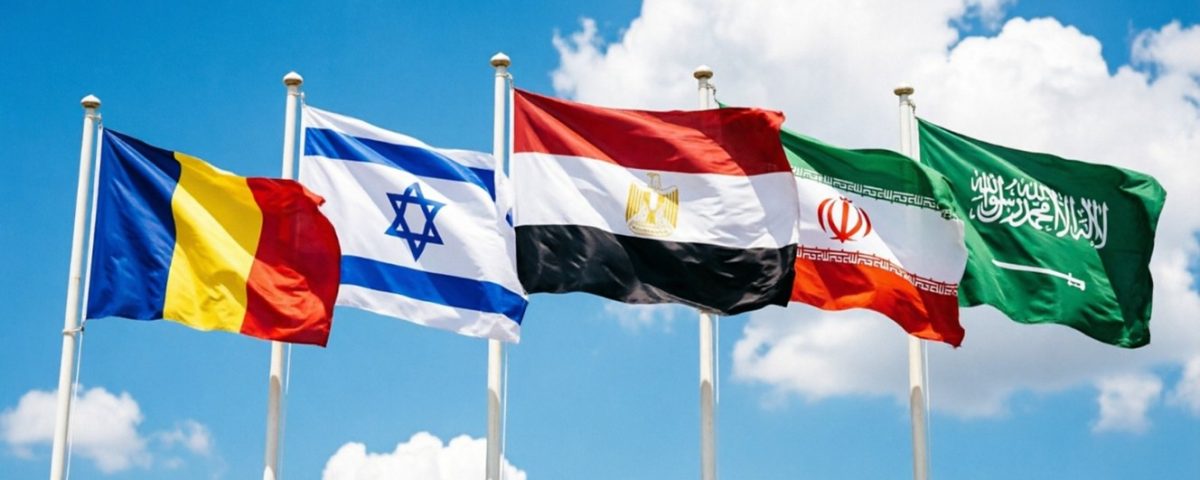
Romania is not often placed at the centre of European policy toward the Middle East, but its position on the eastern edge of the European Union and NATO gives it a distinct role. Bucharest approaches the region through several overlapping lenses. It is an alliance member committed to Euro Atlantic security, an EU member bound by common positions, a Black Sea state affected by maritime and energy disruptions, and a middle-sized economy seeking markets, investment, and energy diversification. Its relationships with Israel, the Gulf states, Iran, Egypt, and the Levant are therefore uneven. They are shaped less by a single grand strategy than by institutional habits, security constraints, and sectoral interests [7, 19].
This analysis maps those relationships across the full Middle Eastern spectrum. It argues that Romania’s regional policy is stable but underused. Bucharest has credibility with Israel, workable ties with Gulf partners, constrained engagement with Iran, and practical but thin relationships across Egypt and the Levant. The policy challenge is not to choose between these files. It is to connect them through a coherent framework that links diplomacy, energy, defense, and trade.
2. The Cold War Inheritance
Romania’s present Middle Eastern posture cannot be separated from the communist period. Under Nicolae Ceaușescu, Bucharest pursued a foreign policy that sought room for maneuver inside the Soviet bloc without openly breaking with Moscow. This produced two habits that still matter. The first was diplomatic independence within limits. Romania kept diplomatic relations with Israel after the 1967 war, while most Soviet aligned states did not. The second was transactional engagement with Arab governments, including commercial, technical, and sometimes security related exchanges [1, 2].
These choices gave Romania a reputation as an interlocutor that could speak across regional divides. They also created ambiguities. Post communist governments inherited diplomatic channels, but they also inherited suspicions about Romania’s past arms exports and political alignments. The task after 1989 was to convert Cold War access into democratic credibility. That meant anchoring Middle Eastern policy in NATO and EU frameworks while preserving the older Romanian instinct for cross regional dialogue [1, 2, 7].
3. Israel: Romania’s Deepest Middle Eastern Partnership
Romania’s relationship with Israel is the most developed part of its Middle Eastern portfolio. It is supported by historical memory, security cooperation, and political affinity. Romania’s reckoning with its role in the Holocaust, especially during the Antonescu regime, has become a central part of its diplomatic language toward Israel. Scholarship and official reports on the destruction of Jews and Roma in Romania have helped Bucharest build a more credible post-communist memory politics [3].
Security cooperation has expanded since Romania joined NATO. The two states share concerns about terrorism, cyber threats, and regional instability. Romanian defense planners view Israeli technology and operational experience as useful complements to NATO standards. The relationship is not without friction, but it remains institutionally dense and politically resilient [7, 19].
The most sensitive recent test came in 2018, when Prime Minister Viorica Dăncilă suggested that Romania would move its embassy in Israel from Tel Aviv to Jerusalem. President Klaus Iohannis pushed back, and the embassy did not move. The episode exposed a split between domestic political signaling and Romania’s constitutional and European constraints [4, 5]. The EU Council conclusions at the time reaffirmed the bloc’s position that Jerusalem’s status should be resolved through negotiations and that EU missions should remain in Tel Aviv [6]. Romania’s eventual restraint demonstrated that its pro-Israeli orientation is strong, but it is still bounded by EU coordination and presidential authority.
Romania’s Israel policy is likely to remain close, but Bucharest needs to avoid appearing one dimensional. It can support Israel’s security and integration into European research and innovation networks while continuing to back EU language on humanitarian law, settlements, and a two-state solution. Without that balance, Romania risks losing credibility with Arab partners and within the EU’s own foreign policy machinery [6, 7].
4. The Gulf: Commercial Ambition without Strategic Depth
Romania’s relations with the Gulf states are less developed than its ties with Israel, but they have grown in importance as Bucharest seeks investment, energy partnerships, and export markets. The United Arab Emirates, Saudi Arabia, and Qatar are the main interlocutors. Kuwait, Bahrain, and Oman remain peripheral, though not irrelevant, in diplomatic terms [7].
The Gulf file is primarily economic. Romania offers agricultural products, information technology services, logistics through the port of Constanța, and opportunities in energy transition projects. Gulf sovereign funds and companies look for stable returns, infrastructure access, and food security. Romania’s challenge is that it often approaches Gulf capitals with broad diplomatic goodwill but without a fully packaged investment strategy. Memoranda are signed, but implementation can be slow. The result is a relationship that feels friendly without yet being structurally deep [7, 8].
Security also matters, though indirectly. Gulf states are interested in maritime stability, energy infrastructure protection, and the broader balance of power in the eastern Mediterranean and Black Sea regions. Romania does not project influence into the Gulf, but its NATO role gives it relevance. The Vilnius Summit Communiqué reinforced NATO’s attention to resilience, critical infrastructure, and southern flank security, all of which intersect with Gulf interests [8]. Romania can position itself as a reliable partner for training, logistics, and Black Sea related security discussions, but it should not overstate its independent strategic weight.
The most realistic Romanian approach to the Gulf is sectoral. Bucharest should prioritize a small number of deliverables: agricultural exports, port logistics, renewable energy investment, and digital services. It should also professionalize economic diplomacy by placing sector specialists in key Gulf embassies and by coordinating with Romanian exporters, port authorities, and energy firms. Without this, Romania’s Gulf policy will remain pleasant but underperforming [7].
5. Iran: A Policy of Constraint
Romania’s relationship with Iran is the most constrained of its Middle Eastern files. Bucharest does not have a proactive Iran policy. It has a policy of alignment with EU nonproliferation objectives, sanctions regimes, and NATO deterrence. As an EU member, Romania supports the European approach to the nuclear file and the broader effort to prevent Iran from acquiring a nuclear weapon. As a NATO member hosting missile defense infrastructure, it is part of the alliance architecture that Tehran views with suspicion [9, 10, 11].
The JCPOA remains the reference point for European diplomacy, even though the agreement has been weakened by withdrawal, sanctions, and Iranian escalation. Romania supported the original deal through EU channels and has treated IAEA monitoring as essential. Recent IAEA reports on Iran’s enrichment and verification challenges underscore why European governments remain concerned [9, 10].
Romania’s bilateral economic ties with Iran are limited. Sanctions compliance, financial restrictions, and risk aversion have kept trade marginal. The Iranian community in Romania is small, and people to people contacts are modest. Bucharest’s main interest is to avoid escalation that could affect energy markets, maritime security, or alliance cohesion. The Deveselu missile defense facility is part of NATO’s broader architecture, and Romanian officials generally describe it in defensive terms rather than as an instrument aimed at Iran specifically [11].
Romania should keep its Iran policy within the EU and NATO frameworks, but it can still contribute quietly. Bucharest can support humanitarian exemptions, academic exchanges, and technical channels that remain lawful. It should also ensure that sanctions enforcement does not become an afterthought. Iran is not a central Romanian priority, but it is a strategic risk file that requires institutional attention [10, 11].
6. Egypt and the Levant: Practical Ties, Fragmented Strategy
Egypt is one of Romania’s more natural Middle Eastern partners. The relationship is anchored in trade, maritime logistics, and agricultural complementarity. Egypt remains one of the world’s largest wheat importers, and Romanian grain and agricultural exports can fit Egyptian demand [14]. The Suez route also matters to Romanian trade with Asia, which gives Cairo a structural relevance that goes beyond bilateral politics [7].
Romania’s Egypt policy should be commercial and pragmatic. Cairo is an important regional actor, but Bucharest does not need to over invest in high politics. It can focus on food security, port connectivity, energy cooperation, and educational exchanges. Romania should also be careful not to treat Egypt solely as a market. Egypt’s regional mediation role, particularly regarding Gaza and eastern Mediterranean energy, means that political dialogue remains necessary [7, 14].
The Levant is more complicated. Jordan is a stabilizing partner and a useful interlocutor on security, refugees, and regional moderation. Romania’s relations with Jordan are friendly but modest, and they benefit from Jordan’s role as a bridge between Israel, the Gulf, and the broader Arab world [7].
Lebanon matters to Romania for diaspora and stability reasons. Romania has maintained interest in Lebanese sovereignty and has supported international stabilization efforts where capacities allow. UNIFIL remains a reference point for European engagement with Lebanese security, and Romania’s defense institutions have participated in international missions connected to broader eastern Mediterranean stability [15, 16]. Romania should continue people to people links, especially through its community ties, while avoiding overcommitment in a politically fragmented state.
Syria is a risk management file. Romania supported EU restrictive measures against the Assad era government and has been concerned about refugee flows, terrorism, and regional spillover [12, 13]. Bucharest’s interests now center on a credible political transition, safe refugee returns, reconstruction conditioned on governance, and prevention of extremist resurgence. Romania is not a major actor in Syria, but it has a stake in outcomes that affect Türkiye, the eastern Mediterranean, and Europe’s southeastern border [13].
Iraq is less prominent than it was during the coalition years, but it remains relevant for energy and regional balance. Romania’s earlier military contribution gave it a place in post 2003 Iraq, but current engagement is mostly diplomatic and commercial. Romanian firms may find niche opportunities in energy services, agriculture, and reconstruction, but Iraq should be approached with realistic expectations and strong risk assessment [15].
7. Cross Cutting Dynamics
Three dynamics cut across all of Romania’s Middle Eastern relationships.
The first is the EU framework. Romania cannot pursue a fully independent Middle Eastern policy on sanctions, Jerusalem, Syria, or Iran without breaking with Brussels. This limits ambition but also provides cover. Romania can use EU positions to avoid bilateral overexposure while still shaping language from within. The challenge is to move from passive alignment to active influence. Bucharest should prepare technical papers, build coalitions with other member states, and use its Black Sea perspective to inform EU deliberations [6, 9, 12].
The second is energy. Europe’s effort to reduce dependence on Russian fossil fuels has made diversification a strategic priority [17]. Romania’s Black Sea gas projects, especially Neptun Deep, could strengthen its regional energy position over time [18]. This does not make Romania a Gulf style energy power, but it gives Bucharest new leverage in conversations about gas, electricity interconnection, hydrogen, and energy transition. Romania should connect its Middle Eastern diplomacy to its energy strategy, particularly with Egypt, the Gulf, and European partners.
The third is Black Sea security. The war in Ukraine has made the Black Sea a central strategic space. Romania’s ports, air defense, and NATO role now matter more to partners outside the region, including Gulf states and Israel. The Military Balance in Europe has shifted, and Romania’s eastern flank position gives it relevance beyond its size [19]. Bucharest should use this position carefully. It can offer logistics, training, and resilience expertise without pretending to be a major security provider.
8. Policy Recommendations
Romania should adopt a differentiated Middle East strategy rather than a single regional doctrine. The following steps are practical and achievable.
First, preserve the Israel partnership while broadening diplomatic credibility. Romania can remain a strong supporter of Israel’s security and European integration, but it should also sustain EU consensus on humanitarian law and a two-state solution. This will protect Romania from charges of one-sided alignment and improve its standing with Arab partners [6, 7].
Second, build a Gulf economic diplomacy cell. Romania should assign dedicated commercial officers to Abu Dhabi, Riyadh, and Doha. Their mandate should be specific: identify investable projects in agriculture, logistics, renewables, and digital infrastructure. The Foreign Ministry, Economy Ministry, Constanța port authorities, and export promotion agencies should meet quarterly to track implementation [7].
Third, keep Iran policy within EU and NATO boundaries, but maintain lawful humanitarian and academic channels. Romania should not seek a unilateral opening to Tehran, but it can support technical nonproliferation work and sanctions compliant humanitarian trade [9, 10].
Fourth, deepen Egypt relations through food security and maritime logistics. A Romania Egypt working group on grain trade, port cooperation, and energy transition would give the relationship a concrete architecture. This would also connect Romanian Black Sea exports to Egyptian demand [14].
Fifth, treat the Levant as a stabilization priority. Romania should support Jordan’s resilience, maintain people to people links with Lebanon, and back UN and EU efforts that prevent state collapse. In Syria, Bucharest should insist that reconstruction is linked to credible governance, refugee protection, and counterterrorism safeguards [12, 13, 15, 16].
Sixth, use Romania’s Black Sea position as a diplomatic asset. Bucharest can invite Gulf and Israeli partners to participate in resilience, port security, and energy transition forums that connect the Black Sea to the eastern Mediterranean. This would transform Romania from a peripheral Middle East observer into a functional bridge between regions [8, 18, 19].
9. Conclusion
Romania’s Middle Eastern relations are not driven by a single grand ambition. They are a patchwork of historical legacies, alliance commitments, economic needs, and cautious diplomacy. Israel remains Romania’s strongest partner in the region. The Gulf offers economic potential but requires better institutional follow through. Iran is a constrained file defined by EU sanctions and NATO alignment. Egypt and the Levant provide practical opportunities but demand realistic expectations.
The central policy task is coherence. Romania already has access, credibility, and geographic relevance. What it lacks is a disciplined mechanism for converting those assets into sustained influence. If Bucharest aligns its diplomatic, energy, and defense instruments, it can become a more useful European actor in the Middle East without overstating its power.
References
- Deletant D (1995) Ceausescu and the Securitate: Coercion and Dissent in Romania, 1965-1989. M.E. Sharpe, Armonk, NY
- Tismăneanu V (2003) Stalinism for All Seasons: A Political History of Romanian Communism. University of California Press, Berkeley
- International Commission on the Holocaust in Romania (2004) Final Report. International Commission on the Holocaust in Romania, Bucharest
- BBC News (2018) Romania to move Israel embassy to Jerusalem, says PM Viorica Dancila. BBC News. https://www.bbc.com/news/world-europe-43834203. Accessed 19 Aug 2026
- Presidency of Romania (2018) Statement by President Klaus Iohannis regarding the possible relocation of the Romanian Embassy in Israel. Presidency of Romania, Bucharest. https://www.presidency.ro. Accessed 19 Aug 2026
- Council of the European Union (2018) Council conclusions on the Middle East Peace Process, 14 May 2018. Council of the European Union, Brussels
- Romanian Ministry of Foreign Affairs (2025) Bilateral relations and country profiles: Egypt, Iran, Iraq, Israel, Jordan, Lebanon, Qatar, Saudi Arabia, United Arab Emirates. Ministry of Foreign Affairs, Bucharest. https://www.mae.ro. Accessed 19 Aug 2026
- NATO (2023) Vilnius Summit Communiqué. NATO, Brussels
- Council of the European Union (2015) Joint Comprehensive Plan of Action, Vienna, 14 July 2015. Council of the European Union, Brussels
- International Atomic Energy Agency (2023) Verification and monitoring in Iran in light of United Nations Security Council resolution 2231 (2015). IAEA Board of Governors, GOV/2023/26, Vienna
- NATO (2024) Missile defence. NATO. https://www.nato.int/cps/en/natohq/topics_49635.htm. Accessed 19 Aug 2026
- Council of the European Union (2011) Council Decision 2011/273/CFSP of 9 May 2011 concerning restrictive measures against Syria. Official Journal of the European Union L 121:11-14
- UNHCR (2024) Syria Regional Refugee Response: Romania. UNHCR. https://data.unhcr.org/en/situations/syria. Accessed 19 Aug 2026
- USDA Foreign Agricultural Service (2024) Grain: World Markets and Trade. USDA, Washington, DC
- Romanian Ministry of National Defence (2024) International missions and operations. Ministry of National Defence, Bucharest. https://www.mapn.ro. Accessed 19 Aug 2026
- United Nations Peacekeeping (2024) UNIFIL: facts and figures. United Nations. https://peacekeeping.un.org/en/mission/unifil. Accessed 19 Aug 2026
- European Commission (2022) REPowerEU: a plan to rapidly reduce dependence on Russian fossil fuels and fast forward the green transition. European Commission, Brussels
- OMV Petrom (2024) Neptun Deep. OMV Petrom. https://www.omvpetrom.com. Accessed 19 Aug 2026
- International Institute for Strategic Studies (2025) The Military Balance 2025. Routledge, London