
The Unbound Ally: Netanyahu, Washington, and the Lebanon Exception
July 6, 2026
Egypt’s Strategic Posture in a Transforming Middle East – The Octagon and Egypt’s Regional Role
July 10, 2026NATO’s Southern Flank in Transition: The Istanbul Cooperation Initiative and Regional Security in the Middle East
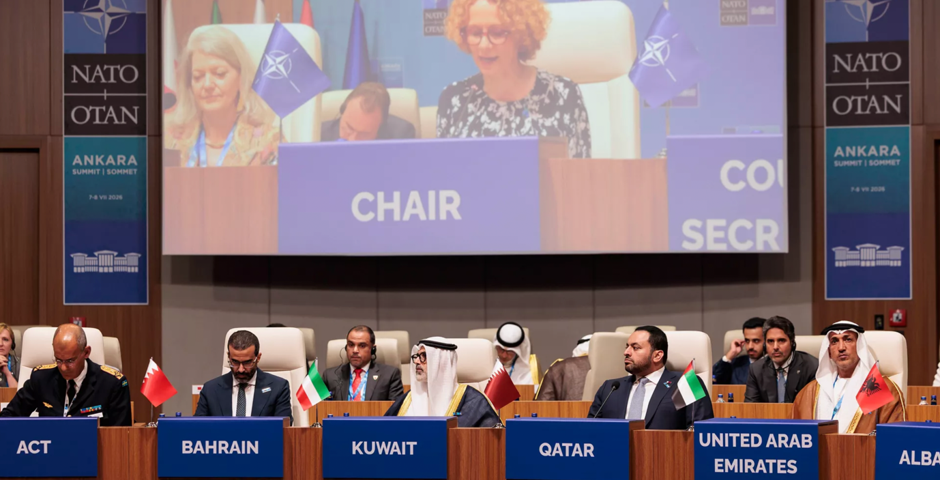
Source of the photo: NATO. https://www.nato.int/en/multimedia/multimedia/photos/2026/07/07/engagement-of-ministers-of-foreign-affairs-with-ici-partners
The 2026 NATO Summit took place on 7-8 July in Ankara, Türkiye. The main priority on the agenda had been reaching the 5% quota for members’ investments in developing Allied defense capabilities, industries and procurement mechanisms.
Türkiye, as a host, had a central role in how the issues were addressed. As a mediator, and a state that connects NATO’s interests in the Black Sea, the Eastern Mediterranean and the Middle East, it is both part of the European security architecture, and an important regional power. It has good relations with Muslim countries in the region, as a result of its balancing role, and it has the second largest military in NATO after the United States.
In this context, one critical moment of this year’s Summit was the Engagement of Ministers of Foreign Affairs with ICI Partners, which took place on 7 July[1], attended by the foreign ministers of Bahrain, Kuwait, Qatar and the UAE.
The Istanbul Cooperation Initiative
But what is the Istanbul Cooperation Initiative, and why is its importance becoming more visible? Established in 2004, at the last NATO Summit hosted by Türkiye, it represents one of the foundations of cooperation between NATO and especially Gulf countries, completing the previously established Mediterranean Dialogue.
One of the most significant breakthroughs in NATO’s engagement with the Gulf since the creation of the ICI was the establishment of the NATO – ICI Regional Centre in Kuwait in 2017, which marked the Alliance’s first long-term presence in the region. The Centre was designed as a platform for improving mutual understanding of security threats and facilitating closer cooperation through training and public diplomacy initiatives. It has since overseen more than 50 capacity-building programmes covering maritime security, cyber defence, chemical, biological, radiological and nuclear response, combating terrorism, as well as crisis management. Saudi and Omani officials have also participated in these activities despite the fact that neither country is formally an ICI member. Their participation in the Centre’s programmes shows the strategic interest of the two states in maintaining forms of engagement with NATO that respond to their own national security interests.
Another breakthrough took place following the 2024 NATO Summit in Washington, with the creation of the position of Special Representative for the Southern Neighbourhood, assumed in July 2024 by Spanish diplomat Javier Colomina. The position is meant to give the Alliance a more visible political presence in the Middle East, encourage dialogue with regional partners and address existing misconceptions through diplomacy.[2]
However, the only point in the Ankara Summit Declaration that addresses the Middle East is the fifth, and it reads like an affirmation of the US position:
“The Alliance continues to respond and adapt to the strategic competition, pervasive instability, hybrid threats and recurrent shocks that define our broader security environment. Allies reiterate that Iran must never have a nuclear weapon and call on Iran to fully respect freedom of navigation in the Strait of Hormuz.”[3]
The impact of the war in Iran on NATO – an ICI perspective
The US-Israel-Iran war has brought into discussion in what way could NATO get involved in regional security, with President Trump repeatedly expressing his disappointment in the lack of Allies’ involvement in securing safe maritime passage or supporting the US military. There are two perspectives on this issue. On the one hand, NATO is a defensive military alliance, while the situation was not defensive but offensive. On the other hand, Mark Rutte stated that some Allies, including Romania and Italy, had contributed to supporting the United States, which generated strong reactions from Iran. Italy was quick to deny that its support went beyond purely logistical assistance, and Romania invoked the strategic partnership it has with the US[4], while declaring it did not take part in the war. This episode itself raises questions about how NATO capabilities can or should be used. From this perspective, and in order to maintain the internal logic of the Alliance, the ICI could have played a more prominent role.
Yet the conflict also highlighted that the real-time operational value of ICI mechanisms is not an instrument yet. Gulf states have faced heavy attacks involving Iranian long-range missiles and drones. Although most were intercepted, they generated new concerns and created risks for Gulf security and for the energy trade. This has pushed regional states to explore further air-defence options and to strengthen their security relations with the United States, NATO members and Türkiye.[5]
Türkiye is using the current moment of US pressure and growing distance within NATO to fill part of that power vacuum, while reassessing the relationship with the United States. Türkiye’s Western security is largely assured, and it has maintained balanced channels of communication with Russia, but the Black Sea remains volatile. At the same time, Türkiye is becoming increasingly active in the Eastern Mediterranean, North Africa and the Horn of Africa, which generates concerns for other regional contenders, such as Israel. The growing competition and rivalry between Israel and Türkiye have been a leitmotif of the NATO Summit, as president Trump declared he is considering removing sanctions on Türkiye if a solution is found for relocating the Russian systems it acquired in 2019, which would allow for Turkish acquisition of F-35 planes, a move that Israel strongly opposes, as it would directly affect its air superiority.[6]
As European states increasingly focus on their own contributions to security, learning to rely less on American support and instead develop their own defense industries, new priorities and interests begin to take shape. Italy provides one example of a NATO member investing in the expansion of relations and cooperation with Gulf partners. While calling for renewed attention to the Alliance’s Southern Flank, Foreign Minister Antonio Tajani confirmed that Italy is promoting more strategic cooperation with Gulf partners in areas ranging from maritime security to critical raw materials and strategic corridors such as IMEC. He also underlined the importance of the NATO – ICI Regional Centre in Kuwait and called for it to be strengthened. At the same time, a NATO liaison office in Amman, Jordan, has recently been opened within the Italian Embassy, further reflecting Italy’s effort to support a broader NATO presence and stronger political engagement in the region.[7]
Just as the 2003 Iraq War generated new security concerns in the Gulf and opened a new phase of cooperation with NATO, the current regional escalation may create another phase of collaboration in line with NATO 3.0 policies.[8]
Challenges of a multipolar NATO and rising regional powers in the Middle East
For a long time, NATO viewed the Middle East primarily through the lens of combating Russian influence. The fall of the Syrian regime has been a major turning point. Before this, NATO supported Türkiye against spillover from the Syrian civil war, even though that same war also saw Alliance members positioned on different sides of the conflict. However, there is now far less Russian influence to combat, while Iranian influence has become more central. Europe, meanwhile, wants to keep its distance from this particular conflict, which it did not start. Although many countries, both NATO and non-NATO remain friendly towards the United States, they have also begun to pursue their own interests more openly and independently.[9]
For example, although the GCC states face common and significant security challenges, they do not share a unified understanding of security, nor are their priorities the same, and they are in turn rivals on other fronts, such as Yemen or Sudan. As a result, they also have different expectations of NATO. Reliance on the US Navy has remained the main pillar of the Gulf’s deterrence strategy, further complicating the question of what role NATO itself should play in the region.[10]
External factors, such as US policy in the region and the radically different views regarding normalization with Israel also weight in on cooperation perspectives between NATO and Gulf countries, specifically ICI countries.
The different interests of NATO members in the region also represent a major challenge. NATO has struggled to gain real traction in the Gulf because of three main limitations:
- the reluctance of major regional actors to participate fully in the Initiative;
- the predominance of bilateral arrangements with individual Gulf states rather than a cohesive bloc-to-bloc approach;
- continuing divisions within the GCC over threat perceptions and security interests.
Conclusions
Further avenues of cooperation between NATO and ICI remain to be explored, and they depend on a variety of factors.
Firstly, the step taken at the 2026 NATO Summit in Ankara where NATO recognized the position on freedom of navigation in the Strait of Hormuz and agreement regarding Iran’s nuclear program is important because it sets clear signals to potential Gulf partners.
Secondly, continuous parallel bilateral or multilateral engagement from NATO members with regional actors further facilitates cooperation, such as Italy’s involvement in regional security architecture directly through NATO mechanisms, Canada’s Prime Minister’s visit to Saudi Arabia following the NATO summit that resulted in the signing of 13 new commercial agreements and memorandums of understanding (MOUs) worth over $1 billion[11], President Macron’s visit in Syria prior to the Summit, or the EU-Gulf Cooperation Council (GCC) High-Level Forum on regional security and cooperation that took place on July 13th on the margins of the Foreign Affairs Council[12].
Thirdly, Türkiye’s role within the Alliance continues to grow, and although its mediator position drew criticism in the Russia-Ukraine conflict because of the refusal to participate in sanctions, it has allowed it to navigate geopolitical tensions while consolidating its influence in areas of interest, especially from a global trade perspective, in the Eastern Mediterranean, Horn of Africa and the Middle East.
Lastly, there are a few situations that will require very careful approaches:
- The Turkish-Israeli diplomatic escalations, which risk bringing the US to face a difficult decision if the conflict becomes military, as it would have to make a choice between a NATO ally and its closest ally.
- The Strait of Hormuz issue regarding transit fees, which has been under a unified international approach of opposition, yet with the last round of attacks, European perspectives have become receptive to accepting voluntary transit fees to Iran and Oman. In this context, the escalation continues, as President Trump publicly stated his intention of imposing a 20% fee, significantly greater than the one Iran was considering.[13]
- The Gaza – West Bank – Lebanon – Syria – Israel conflicts, which remain a source of regional instability. Syria’s participation at the NATO Summit, where it officially achieved the lifting of US sanctions[14], together with speculation of accepting a previously rejected more prominent role in Lebanon[15] interfere with Israel’s security objectives in the region.
NATO’s Southern Flank is going through a reconfiguration period, marked by conflict intensification, divergent interests, and intensifying rivalries. The cohesion of the Alliance will be put to test in navigating conflict hotspots, and overcoming internal fractures. This year’s ICI participation remains a promising development, but it urgently needs to be supported by clear mechanisms and instruments, and expanded to more partners.
[1] https://www.nato.int/en/news-and-events/events/event-programmes/2026/07/nato-summit-2026#tabs-a3a5088932-item-bf045da230-tab
[2] https://gulfif.org/the-istanbul-cooperation-initiative-twenty-years-on-assessing-nato-gcc-cooperation/
[3] https://www.nato.int/en/about-us/official-texts-and-resources/official-texts/2026/07/08/the-ankara-summit-declaration
[4] https://www.digi24.ro/stiri/externe/reactia-furioasa-a-iranulului-dupa-ce-seful-nato-a-spus-ca-italia-si-romania-au-ajutat-sua-sa-atace-iranul-o-marturisire-zdrobitoare-3831573
[5] https://www.newarab.com/news/nato-summit-examines-future-gulf-iran-security-relations?amp
[6] https://edition.cnn.com/2026/07/07/politics/netanyahu-opposes-sale-f35-jets
[7] https://www.esteri.it/en/sala_stampa/archivionotizie/comunicati/2026/07/riunione-dei-ministri-esteri-nato-con-i-paesi-delliniziativa-di-cooperazione-di-istanbul-tajani-strategico-rafforzare-i-rapporti-dellalleanza-con-i-paesi-del-golfo/
[8] https://mobile.aa.com.tr/en/opinion/opinion-can-natos-ankara-summit-reshape-gulf-security/3990938
[9] https://gulfif.org/the-istanbul-cooperation-initiative-twenty-years-on-assessing-nato-gcc-cooperation/
[10] https://mobile.aa.com.tr/en/opinion/opinion-can-natos-ankara-summit-reshape-gulf-security/3990938
[11] https://www.pm.gc.ca/en/news/news-releases/2026/07/09/prime-minister-carney-deepens-partnership-saudi-arabia-across-trade
[12] https://www.consilium.europa.eu/en/meetings/fac/2026/07/13/
[13] https://www.cnbc.com/2026/07/13/trump-iran-hormuz-strait-charge-reimburse.html
[14] https://abcnews.com/Politics/trump-hell-remove-syria-state-sponsor-terrorism-time/story?id=134586488
[15] https://www.arabnews.com/node/2650297/middle-east

Mrs. Larisa-Nicoleta Pătrașcu
Mrs. Larisa-Nicoleta PĂTRAȘCU is a Junior Researcher at the Middle East Political and Economic Institute (MEPEI). Her research and professional interests center on peacebuilding, diplomacy and conflict resolution, international cooperation, and MENA geopolitics.