
Makkah joint defence agreement: Analysis
August 12, 2026
Who Governs Global Football? The Rise of Arab Influence Inside FIFA: The August 2026 FIFA crisis and the rise of institutional influence in global football governance
August 16, 2026Partition by Attrition: The Saudi-Emirati Rivalry in Yemen and the Limits of Gulf Alliance Cohesion
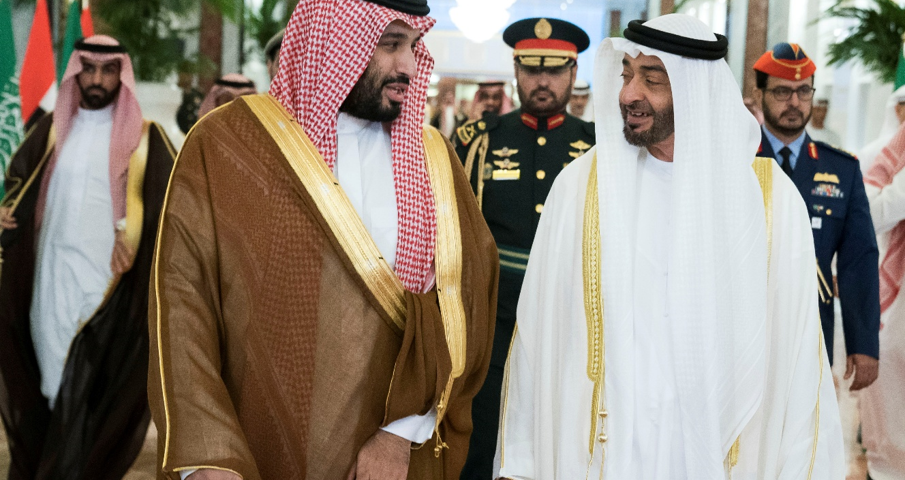
Photo Credit: VIA REUTERS, Creator: WAM
Alliances rarely collapse in a single act of rupture; they erode until one crisis forces years of accumulated divergence into the open. That is the most useful lens for understanding why, in the first week of January 2026, Saudi Arabia found itself bombing the positions of a militia armed and cultivated by its own Gulf Cooperation Council partner, and why, within days, that partner’s proxy had dissolved itself entirely (GIS Reports 2026; Al Jazeera 2026a).
Introduction
For a decade, Saudi Arabia and the United Arab Emirates have been treated, in both policy and scholarly literature, as the twin architects of a “counter-revolutionary axis” that has shaped Middle Eastern order since the Arab Spring, aligned against Iran, against political Islam, and against the Houthi movement that unseated Yemen’s internationally recognized government in 2014-15 (GIS Reports 2026). The events of December 2025 and January 2026 disrupted that assumption in the starkest possible way. The Southern Transitional Council (STC), a secessionist movement built and financed by Abu Dhabi since 2017, launched a rapid offensive that captured most of the former state of South Yemen, including Hadramawt, al-Mahra, and the strategic port of Mukalla (Sana’a Center 2025; CSIS 2026). Riyadh’s response was not diplomatic pressure but airstrikes, first against an alleged Emirati arms shipment at Mukalla on 30 December, then against STC positions across the south, culminating in the recapture of Aden on 7 January and the STC’s formal dissolution two days later (CSIS 2026; Al Jazeera 2026a). This paper treats that sequence not as a Yemen story but as an alliance-theory story: a rare, directly observable case of a shared external threat proving insufficient to hold a patron-patron alignment together once the patrons’ downstream territorial and economic interests diverged past a critical threshold.
From Counter-Revolution to Counter-Purpose
The Saudi-Emirati alignment was never built on identical interests; it was built on overlapping ones. Both states joined the 2015 Saudi-led coalition (Operation Decisive Storm) to reverse the Houthi takeover of Sanaa and to contain what both governments read as Iranian encroachment on the Arabian Peninsula (GIS Reports 2026). But the two capitals pursued that shared objective through structurally different instruments from the outset. Riyadh backed the internationally recognized government and its Islah-aligned factions, prioritizing a reunified Yemeni state under a centralized authority it could manage diplomatically. Abu Dhabi, by contrast, cultivated the STC as an independent power center in the south, a hedge that gave the UAE direct control over Aden, Yemen’s Red Sea and Gulf of Aden coastline, and a client that owed its loyalty to Abu Dhabi rather than to any unified Yemeni chain of command (Stimson Center 2026). The 2019 Riyadh Agreement, which folded STC representatives into the Presidential Leadership Council, papered over this divergence rather than resolving it (House of Commons Library 2026). It gave both patrons a stake in the same formal government while leaving their proxies’ underlying interests, unification versus federation, or federation versus outright secession, unreconciled.
The STC as Symptom, Not Cause
What changed by late 2025 was not the existence of this divergence but its cost of concealment. Two developments sharpened Riyadh’s threat perception of its own ally. First, the UAE’s regional posture had grown more visibly autonomous elsewhere: Abu Dhabi’s continued backing of the Rapid Support Forces in Sudan, and its comparatively muted response to Israel’s recognition of Somaliland, which Riyadh explicitly rejected, read in Saudi strategic circles as evidence of a UAE-centered network extending down the Red Sea and Horn of Africa corridor, with the STC as its Yemeni node (Stimson Center 2026). Second, geography raised the stakes of the STC’s advance beyond symbolism. Hadramawt shares a long land border with Saudi Arabia itself, and al-Mahra features in Riyadh’s long-standing ambition for an oil pipeline to the Arabian Sea that would bypass both the Strait of Hormuz and the Bab al-Mandab chokepoints (Stimson Center 2026). An UAE-aligned, secession-minded authority controlling that corridor was no longer a tolerable hedge; it was a direct constraint on Saudi Arabia’s own strategic depth. The STC’s December offensive did not create this problem. It simply forced Riyadh to price it in.
When the Coalition Fired on Itself
The sequence of events between 30 December 2025 and 9 January 2026 is worth reconstructing in full because its speed is itself analytically significant. STC forces, under the banner of “Operation Promising Future,” seized control of nearly the entire former South Yemen within weeks, including productive oil fields (Sana’a Center 2025). On 30 December, the Royal Saudi Air Force struck the STC-held port of Mukalla, targeting what Riyadh described as a weapons shipment from the UAE, an accusation Abu Dhabi denied (GIS Reports 2026). Saudi-backed government forces then recaptured Seiyun and Mukalla within days, and by 7 January had entered Aden as STC resistance collapsed (Al Jazeera 2026b). Yemen’s president, Rashad al-Alimi, used the moment to formally cancel Yemen’s defense agreement with the UAE, order Emirati personnel out of the country, and declare STC activity an act of rebellion against the state (Middle East Council on Global Affairs 2026). STC leader Aidarus al-Zoubaidi skipped scheduled peace talks in Riyadh and fled to the UAE via Somaliland; he was subsequently removed from the Presidential Leadership Council and charged with treason (Al Jazeera 2026b). Within days, the UAE announced the withdrawal of its remaining forces from Yemen, and the STC announced its own dissolution, a de-escalatory gesture that Abu Dhabi did not treat as a concession so much as a tactical retreat (GIS Reports 2026; House of Commons Library 2026).
Theorizing the Break: Alliance Cohesion Under Partial Threat Convergence
Classical alliance theory offers two complementary tools for reading this case. Walt’s balance-of-threat framework explains why Riyadh and Abu Dhabi aligned in the first place: both perceived the Houthi movement, and by extension Iran, as a threat warranting external balancing. But balance-of-threat theory has always struggled with cases where allies converge on which actor is threatening while diverging on what kind of threat that actor poses, and this case is a clean illustration of that gap. For Saudi Arabia, the Houthi threat has been substantially territorial and kinetic since 2015, involving cross-border missile and drone strikes; Yemeni fragmentation directly imperils Saudi border security and economic corridor plans. For the UAE, the more salient threat has historically been ideological and maritime, political Islam and control of Red Sea shipping lanes, objectives better served by a compliant, semi-autonomous southern client than by a unified Yemeni state Riyadh would ultimately dominate. Snyder’s alliance security dilemma supplies the second half of the explanation: patrons sponsoring proxies are perpetually exposed to entrapment (being dragged into a client’s local war) or abandonment (a partner cutting a client loose to protect the wider relationship). What is unusual about the Yemen case is that Riyadh resolved its own entrapment risk not by abandoning its ally but by attacking its ally’s proxy directly, treating the STC as an instrument of Emirati policy rather than as an autonomous actor, and thereby localizing an inter-patron dispute as an intra-Yemeni military operation. This is a more aggressive resolution of the alliance dilemma than the literature typically models, and it suggests that proxy-mediated alignments are not merely a way of managing risk between patrons. They can become the mechanism through which patrons discipline each other without a formal rupture.
Cairo Enters the Ledger
Reading the Saudi-Emirati rupture as a two-actor story understates its reach, because Egypt moved almost immediately to align itself with Riyadh’s version of events, and did so for reasons that have little to do with loyalty and everything to do with its own exposure. Egypt’s economic security runs directly through the same waters the STC crisis threatened: the Suez Canal remains one of the country’s most reliable sources of foreign currency, and any instability along the Red Sea and Gulf of Aden corridor, whether from Houthi missile fire or from a fragmented Yemeni south, is a direct threat to that revenue stream (Arab Center Washington DC 2026). Cairo also shares Riyadh’s reading of the underlying pattern: that the UAE’s parallel positioning in Sudan, where Abu Dhabi has continued to back the Rapid Support Forces, and its comparative comfort with Israel’s regional posture, add up to a broader Emirati project that unsettles both governments (Arab Center Washington DC 2026).
That alignment produced concrete cooperation rather than rhetorical sympathy. Saudi Foreign Minister Faisal bin Farhan traveled to Cairo on 5 January 2026, in the middle of the Yemen crisis, and the two governments described their positions as “identical” (Arab Center Washington DC 2026). What followed extended well beyond Yemen: Saudi Arabia and Egypt coordinated to restrict Emirati cargo flights suspected of supplying the RSF from using Saudi and Egyptian airspace, and applied joint pressure on Libyan commander Khalifa Haftar to disrupt smuggling routes supporting the same network, including a temporary closure of the Al-Kufra airport (European Council on Foreign Relations 2026). None of this was formalized into a treaty or a new bloc. It did not need to be. It functioned as exactly what alliance theory would predict from a state that shares a rival’s threat perception without sharing its patron relationship: Cairo bandwagoned with Riyadh’s read of the UAE rather than staying neutral between two Gulf patrons on which it depends economically in different ways.
For alliance theorists, Egypt’s entry is the more generalizable half of this case. Riyadh and Abu Dhabi’s rupture is a story about two patrons discovering their proxy-mediated interests had diverged. Cairo’s alignment is a story about a third state reading that divergence correctly and moving to exploit it before the dust settled, treating the Saudi-Emirati split not as a crisis to be managed neutrally but as an opportunity to consolidate its own Red Sea security interests under cover of solidarity with the stronger of the two patrons.
Why This Matters Beyond Yemen
The broader lesson is that “shared threat perception,” the foundational variable in most alliance-cohesion models, is a necessary but insufficient condition once a coalition operates through semi-autonomous proxies with their own territorial and economic stakes, and it says nothing on its own about how third parties will behave once that insufficiency becomes visible. Yemen is not an isolated data point. The same UAE posture visible in its Sudan and Somaliland positioning suggests Abu Dhabi is pursuing an increasingly independent Red Sea-Horn of Africa strategy that treats Gulf partnership as compatible with, rather than subordinate to, its own commercial and maritime ambitions. Riyadh’s willingness to use force against a fellow GCC member’s proxy, rather than confining its response to diplomacy, signals a lowered threshold for coercive signaling within what is nominally an alliance rather than a rivalry. Egypt’s rapid alignment with Riyadh shows that lowered threshold has consequences for how neighboring states calculate their own position, not just for how the two principal rivals treat each other. Analysts describing the current state of affairs as a Saudi-Emirati “cold war” are not overstating the case (GIS Reports 2026); the STC’s dissolution resolved the immediate crisis without resolving the interest divergence that produced it, which means Yemen’s south, and the wider Red Sea corridor Egypt now has an active stake in, remains a latent flashpoint rather than a settled question.
Conclusion
The Yemen episode offers alliance theorists something genuinely rare: a real-time, high-resolution case of an alignment fracturing along the precise fault line the theory predicts, not a breakdown of shared threat perception, but a breakdown of the assumption that shared threat perception implies shared downstream interests. For Gulf-studies specialists, it is evidence that the GCC’s post-2011 cohesion has always been more instrumental than structural, sustained by convergence on a small number of adversaries rather than by any deeper alignment of territorial or economic preference. Egypt’s swift, self-interested alignment with Riyadh adds a second lesson that sits alongside the first: once a patron-patron alliance fractures visibly, neighboring states with their own exposure to the same theater will not wait for the dust to settle before choosing a side, and their choices will be read by both principals as evidence of who is winning the argument. Both literatures have reason to keep watching Yemen and the Red Sea corridor around it, not as a humanitarian crisis in need of resolution, which it certainly remains, but as an unusually clear laboratory for what happens when two patrons discover, in public and under fire, how differently they had always defined the alliance they thought they shared, and for how quickly that discovery reshapes the calculations of everyone else with a stake in the outcome.
References
Al Jazeera. 2026a. “Yemen’s Saudi-Backed Government Retakes Southern Areas from STC: What Next?” January 12. https://www.aljazeera.com/news/2026/1/12/yemens-saudi-backed-government-retakes-southern-areas-from-stc-what-next.
Al Jazeera. 2026b. “Saudi-Led Coalition Says STC’s al-Zubaidi Fled to UAE via Somaliland.” January 8. https://www.aljazeera.com/news/2026/1/8/saudi-led-coalition-says-stcs-al-zubaidi-fled-to-uae-via-somaliland.
Arab Center Washington DC. 2026. “Egypt: Partnering with Saudi Arabia on Security in the Red Sea and Gulf of Aden.” January 27. https://arabcenterdc.org/resource/egypt-partnering-with-saudi-arabia-on-security-in-the-red-sea-and-gulf-of-aden/.
CSIS (Center for Strategic and International Studies). 2026. “Understanding the Saudi Reaction to the Escalation in Yemen.” February 19. https://www.csis.org/analysis/understanding-saudi-reaction-escalation-yemen.
European Council on Foreign Relations. 2026. “Power Struggle: What the Saudi-UAE Rivalry Means for the Red Sea, and Europe.” February 4. https://ecfr.eu/article/power-struggle-what-the-saudi-uae-rivalry-means-for-the-red-sea-and-europe/.
GIS Reports Online. 2026. “The Saudi Arabia-UAE ‘Cold War’ in Yemen.” April 22. https://www.gisreportsonline.com/r/saudi-arabia-uae-yemen/.
House of Commons Library. 2026. “Yemen in 2025/26: Changing Balance of Power in the South.” July 8. https://commonslibrary.parliament.uk/research-briefings/cbp-10427/.
Middle East Council on Global Affairs. 2026. “Momentous Change Sweeps Yemen as STC Overreaches in Hadramawt.” January 14. https://mecouncil.org/blog_posts/momentous-change-sweeps-yemen-as-stc-overreaches-in-hadramawt/.
Sana’a Center for Strategic Studies. 2025. “The STC Moves into Eastern Yemen: Reaction from Sana’a Center Experts.” December 16. https://sanaacenter.org/publications/analysis/25993.
Stimson Center. 2026. “Saudi Arabia Takes Full Control of Yemen’s South.” April 25. https://www.stimson.org/2026/saudi-arabia-takes-full-control-of-yemens-south/.
Disclaimer. The views and opinions expressed in this op-ed are those of the author and do not necessarily reflect the official policy or position of MEPEI. Any content provided by our author is of her opinion and is not intended to malign any religion, ethnic group, club, organization, company, individual, or anyone or anything.

Mr. Ahmad MOHEE
Mr. Ahmad MOHEE is a junior researcher at MEPEI. He holds an MA in Arab Studies (Political Science) from the Institute of Arab Research and Studies at the Arab League in Cairo. His MA thesis, The Impact of the Israeli-Iranian Cyberwar on Arab Regional Security, examined how cyber conflict dynamics reshape deterrence calculations and alliance structures in the Middle East through a Regional Security Complex (RSC) lens. His research focuses on the intersection between technology and classical political theory in conflict studies, with particular emphasis on cyber warfare, deterrence, and defensive strategies, and their impact on regional and international order.